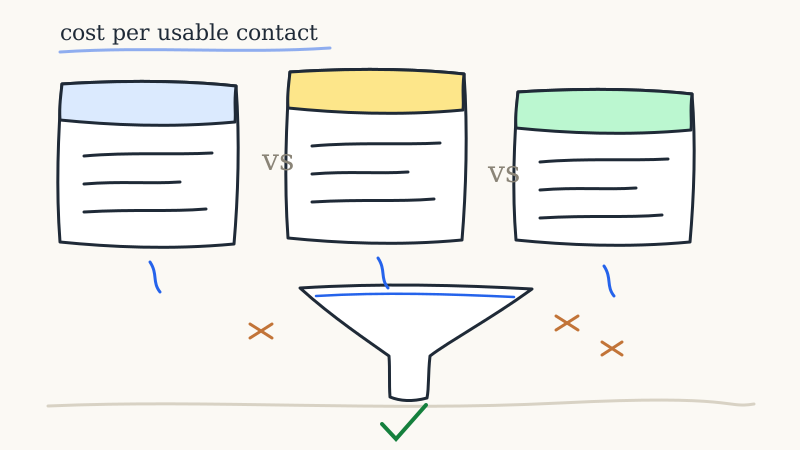
Email verification is sold as a solved problem. Upload a list, get a cleaner list back, bounce rate drops, deliverability saved. The tools compete on price per email and on how many decimal places they put after “99” in their accuracy claim.
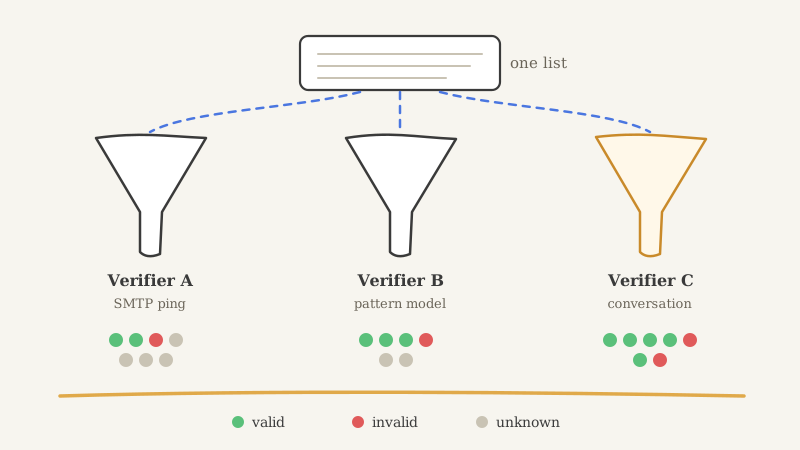
That framing hides the only part of the decision that matters. On a typical B2B list, the verifier is not struggling with the obvious cases. It finds the typos, the role accounts, the dead domains, and the addresses that bounce loudly. Any of the three tools in this comparison will catch those. What separates them is what happens to the slice of your list the server refuses to answer questions about: catch-all domains, greylisted mail servers, and addresses that come back as “unknown.”
That slice is not small. On lists built from B2B data providers it routinely lands somewhere between a fifth and a third of the file, and it is weighted toward exactly the companies you want to reach, because larger organizations are more likely to run catch-all or aggressively defensive mail servers. How your verifier handles that bucket determines your real bounce rate. Everything else is rounding.
So the question is not which tool is most accurate. It is which tool is most honest about what it does not know, and what you are supposed to do with the part of your list it cannot resolve.
The short version
- ZeroBounce is the broadest platform of the three. Verification sits inside a wider suite that includes data append, inbox placement testing, an email finder, and domain monitoring. It applies a probabilistic scoring layer to catch-all addresses rather than leaving them unlabelled, which is useful if you accept that a score is a guess with a number attached.
- NeverBounce is the enterprise-adjacent option, owned by ZoomInfo, built around a real-time API and bulk list cleaning. It is conservative in its labelling: addresses it cannot resolve come back as unknown or accept-all, and it declines to pretend otherwise. That honesty is a feature, but it hands the hard decision back to you.
- MillionVerifier is the price-led option. It does bulk verification cheaply, keeps credits from expiring, and reports catch-all as its own distinct bucket instead of folding it into valid or invalid. For teams who already have a policy for catch-all addresses, that is often all they need from a verifier.
None of the three resolves catch-all addresses to a definitive yes or no, because a standard verification probe cannot. Two of them tell you that clearly. One of them gives you a number that feels like an answer. Understanding why requires a short detour into how verification actually works.
How verification actually works, and where it stops
A verifier runs a cascade of checks that get progressively more expensive and more informative.
Syntax and formatting. Free, instant, catches typos and malformed addresses. Every tool does this identically.
Domain and MX records. Does the domain exist, and does it have mail servers? Dead domains and parked domains get killed here. Again, no meaningful difference between tools.
Known-pattern filtering. Disposable domains, spam traps the vendor has seen before, role accounts like info@ and support@, and addresses on the vendor’s own suppression data. This is where vendor data assets start to matter, because the quality of the list of known-bad addresses depends on how much mail flow the vendor has observed.
SMTP probe. The verifier opens a conversation with the recipient mail server and asks, without delivering anything, whether the mailbox exists. A cooperative server says yes or no. This is the step that produces a real answer.
And then it stops, because a large share of mail servers do not cooperate. A catch-all server accepts every address you ask about, including addresses that do not exist, so a yes is worthless. A defensive server greylists the probe, rate-limits it, or returns a deliberately ambiguous code. Microsoft-hosted tenants in particular have gotten noticeably harder to probe, which is its own deliverability problem for Outlook inboxes.
So the verifier arrives at the same fork regardless of vendor. It has an address on a domain that will not tell it the truth, and it has to put that address in a bucket. The three tools make three different choices, and that choice is the product.
ZeroBounce: a score where there is no answer
ZeroBounce returns catch-all addresses with an AI-derived confidence score rather than leaving them in an undifferentiated unknown pile. The model reasons from pattern evidence: does this address shape match the naming convention observed elsewhere at that domain, does the local part look human-generated or machine-generated, what has the vendor seen from similar addresses historically.
This is genuinely useful. A score of 9 on firstname.lastname@ at a company where every other verified contact follows firstname.lastname@ is a reasonable bet. A score of 2 on a three-letter local part at the same domain is a reasonable pass. Used as a ranking signal, the score lets you send to the top of your catch-all bucket and suppress the bottom, which is strictly better than treating the whole bucket as one undifferentiated risk.
The failure mode is what buyers do with it. A score is not a verification result, and the moment it appears in a column next to valid and invalid, people start treating it as one. Teams set a threshold once, usually too low, and then send to everything above it on the assumption that the tool validated those addresses. It did not. It estimated them. If the estimate is wrong on a few percent of a large send, that is a bounce rate problem that lands on your sending domains, not on ZeroBounce.
The rest of the platform is the real argument for ZeroBounce. Inbox placement testing, blacklist and DMARC monitoring, and data append in the same account means fewer vendors and one bill. If you do not already have authentication configured correctly and are not monitoring domain reputation, the bundled tooling has value independent of the verification engine. If you already run those functions elsewhere, you are paying platform pricing for a verifier.
NeverBounce: conservative labels, decision handed back
NeverBounce’s defining characteristic is restraint. Addresses it cannot resolve are returned as unknown or as accept-all, and it does not convert that uncertainty into a score that implies more knowledge than it has. Its historical positioning has leaned on bounce guarantees and free re-verification, which only makes sense for a vendor confident that its valid bucket is actually valid, and that confidence comes from keeping the ambiguous cases out of it.
The real-time API is the strongest part of the product. Verifying at the point of capture, inside a form submission or a CRM write, prevents bad data from entering your systems in the first place, which is a fundamentally better strategy than cleaning quarterly. Teams that are serious about stopping list decay rather than periodically repairing it tend to end up with a real-time verification call somewhere in their stack, and NeverBounce is a common choice for that slot.
The ZoomInfo ownership cuts both ways. If you are already a ZoomInfo customer, procurement and integration get easier. If you are not, you are buying a point solution from a company whose strategic priority is a much larger data platform, and the roadmap will reflect that.
The limitation is the one NeverBounce is honest about. It will tell you precisely which addresses it could not determine, and then it is your problem. For a team with a documented catch-all policy that is fine. For a team that bought a verifier expecting a clean list, receiving a large unknown bucket with no guidance feels like an unfinished job, and the usual reaction is the worst possible one: send to them anyway and see what happens.
MillionVerifier: cheap, clear, and deliberately narrow
MillionVerifier does one thing. It verifies lists in bulk, at a price point well below the platform vendors, with credits that do not expire and a free daily allowance that makes evaluation trivial. There is no data append, no inbox placement suite, no enrichment ambition.
Its result taxonomy is its best feature. Catch-all is its own bucket, visibly separate from good and bad, labelled plainly rather than folded into either. For an operator this is the most useful presentation of the three, because it matches reality: here are the addresses I confirmed, here are the ones I confirmed are dead, and here is the set nobody can confirm with a probe. No score, no implied permission, just an accurate statement of what is known.
That clarity is also the ceiling. MillionVerifier tells you the shape of your problem and leaves the solving to you. If you have thirty thousand catch-all addresses at your best-fit accounts, you now know exactly how many you have and nothing more about whether any of them are real.
For teams running high volume through a verifier purely as a hygiene step before a separate catch-all process, the economics are hard to argue with. For teams who need the catch-all question actually answered, the price advantage is irrelevant, because the cheapest tool and the most expensive tool both decline to answer it.
What the per-email price hides
All three publish per-email pricing that falls as volume rises, and all three structure it differently enough that spreadsheet comparison is misleading. Credit packs that never expire are worth more than cheaper credits that reset monthly if your sending is seasonal. Subscription pricing is worth more than credits if your volume is steady and you want predictable cost. Bundled tooling changes the comparison entirely if it replaces a vendor you are already paying.
The larger cost is not on the invoice at all. Three numbers determine whether a verifier was worth buying.
What fraction of your list lands in the unresolved bucket. If verification sends a third of your file to catch-all or unknown, the tool has processed your list without reducing your risk on the part of it you care about most.
What your actual bounce rate is after sending to the valid bucket. This is the only real accuracy measurement. Vendor accuracy claims are measured on vendor test data, which is not your data. If a tool’s valid addresses bounce at more than a percent or two, its valid label is not load-bearing.
What you did with the unresolved bucket. If the answer is “sent to it anyway,” your verifier spend bought you nothing, because the bounces that damage your sending reputation came from exactly the addresses verification never cleared. If the answer is “suppressed all of it,” you paid for a verifier and then deleted the part of your market with the largest companies in it.
That third number is where most teams lose, and it is not a problem any of these three tools is built to fix.
The gap all three leave open
A standard verification probe cannot resolve a catch-all address, because the server’s answer carries no information. That is not a vendor deficiency. It is a property of the protocol. Any tool that claims to resolve catch-all addresses with a simple probe is either guessing or wrong.
Resolving them requires a different approach: a slower, more conversational interaction with the receiving mail server that establishes whether a specific mailbox exists, without sending anything to it and without the volume of probes that gets your probing infrastructure blocked. It is harder, it is slower per address, and it is why the catch-all bucket is still a standing problem across the category.
This is the specific job Scrubby does. It is the validator that safely clears catch-all email, and it exists because the rest of the category stops at the fork in the cascade rather than working through it. We cover the mechanics of that handoff in more detail in our guide to verifying catch-all emails before cold outbound.
The practical consequence is that the verifier decision is smaller than it looks. Pick whichever of the three fits your budget and integration pattern, then route the bucket it cannot resolve to something built for that bucket. A cheap bulk verifier plus real catch-all resolution outperforms an expensive platform whose catch-all answer is a confidence score, and it costs less.
A one-afternoon test that beats every vendor accuracy claim
Do not evaluate verifiers on their marketing. Evaluate them on your list, which is the only list whose accuracy affects you.
Pull a sample of three to five thousand addresses from your real target data. Not a clean list, not an old list you already trust. A current list, pulled the way you normally pull one, with whatever mix of data provider sources you actually use. Keep it representative of your ICP, because a sample skewed toward small companies will understate your catch-all rate badly.
Run the identical file through all three. All three offer trial credits or a free allowance large enough for a sample this size. Same file, same day, no deduplication between runs.
Compare bucket distributions first, not verdicts. Line up valid, invalid, and unresolved counts across the three tools. The spread tells you more than any single result. If one tool reports dramatically fewer unresolved addresses than the other two on the same file, it is not seeing more than they are. It is classifying ambiguity as certainty, and you should find out which direction before you trust it.
Measure disagreement on individual addresses. Count the addresses one tool called valid and another called invalid. That disagreement rate is the honest upper bound on how much any of them actually knows about your data. Expect it to be uncomfortably high.
Then send a small, controlled batch and watch what bounces. Take a few hundred addresses that every tool agreed were valid, send to them from a warmed sending identity, and record the bounce rate. Repeat with a few hundred that one tool scored as probably-good catch-all. The difference between those two bounce rates is the entire value of the scoring layer you are being asked to pay for. If it is small, the score is noise. If it is large, the score is real and you have just priced it.
That last step requires sending infrastructure you are willing to risk, which is precisely why most teams skip it and buy on vendor claims instead. If your sending identities are shared with live campaigns, do not run the test on them. Running verification tests against production sending domains is how a procurement exercise turns into a deliverability incident.
Where verification sits in the stack
Verification is a hygiene step, not a strategy. It reduces the bounces you can predict. It does nothing about send volume, warmup state, domain reputation, content, or targeting, and a perfectly verified list sent from a cold domain at the wrong volume will still land in spam. The full picture of inbox placement involves considerably more than list cleanliness.
Which is the real reason this decision tends to get over-weighted. Choosing a verifier is a concrete, comparable, spreadsheet-friendly decision, so teams spend weeks on it while the harder infrastructure questions go unaddressed. The list is clean and the sending domains are two weeks old with no warmup history.
In the programs we run, verification is one stage in a chain we operate end to end rather than a tool a client picks and manages. Inboxy handles the sending domains, mailboxes, and warmup that determine whether clean addresses actually reach an inbox, Scrubby clears the catch-all portion of the list that standard verification leaves open, and Underfive gives the replies a unified inbox for email and LinkedIn wired into the CRM, so a conversation that starts from a verified send does not die in an unmonitored mailbox. The verifier matters, but it matters as one link, and the chain is only as strong as the weakest one. That is the premise behind how we operate outbound as infrastructure rather than as a tool selection problem.
The actual recommendation
If you already own ZoomInfo, or you need real-time verification at the point of data capture, use NeverBounce and build an explicit policy for its unknown bucket before your first send.
If you have no deliverability tooling at all and would otherwise buy inbox placement testing and domain monitoring separately, ZeroBounce earns its price on the bundle. Treat the catch-all score as a ranking signal, never as a verification result, and set your threshold higher than feels necessary.
If you have volume, a tight budget, and a separate process for catch-all addresses, use MillionVerifier. Its honest bucket labelling and non-expiring credits make it the best value in the category for exactly that setup.
And in all three cases, decide what happens to the unresolved bucket before you buy anything, because that decision affects your bounce rate more than the choice of vendor does. The list of addresses nobody could verify is not a rounding error at the bottom of a report. On a B2B list it is often the most valuable segment you have, and the verifier you are evaluating is not going to solve it for you.