Every outbound program eventually stalls on the same question, and it is almost never the copy. It is the data. You can have a tight ICP, a sharp sequence, and a warmed sending infrastructure, and still watch reply rates sit flat because a third of your contacts left the company eight months ago.
So you go shopping. The shortlist is almost always Apollo, ZoomInfo, and Lusha. All three claim hundreds of millions of contacts, all three claim verified emails, and all three publish coverage numbers that are impossible to compare because nobody defines “verified” the same way. Their pricing pages are deliberately vague, and their sales teams will each tell you the other two have stale data.
Here is the honest breakdown: where each one actually wins, where the pricing turns against you, and the test you should run before you commit to an annual contract.
The Short Version
If you want the conclusion before the reasoning:
- Apollo is the best value for small to mid-size teams that want data and a sending tool in one place. Broad coverage, generous credit allowances, weakest on mid-market and enterprise accuracy.
- ZoomInfo has the deepest firmographic and org-chart data, the best direct dials, and the most reliable enterprise coverage. It is also by far the most expensive and the hardest contract to exit.
- Lusha is the precision tool. Smallest database of the three, but high accuracy on the records it does have, and the easiest to use for targeted, low-volume, high-value prospecting.
Now the parts that matter once you are the one running the campaigns.
Apollo: Volume and Bundling
Apollo’s strategic bet is bundling. You get a contact database, a sequencer, a dialer, and basic enrichment in one subscription. For a team that would otherwise buy data from one vendor and sending from another, that consolidation is genuinely valuable and often halves the stack cost.
What it does well:
- Coverage breadth at startup and SMB. If your ICP is companies under roughly 500 employees, especially tech companies, Apollo’s coverage is competitive with anything on the market.
- Credit economics. Export and enrichment credits are far more generous per dollar than the alternatives, which matters if your motion depends on volume rather than surgical targeting.
- Usable filters out of the box. Technographic filters, job-change signals, and intent topics are included at tiers most teams can afford.
- Fast self-serve onboarding. You can be building lists the same day without a procurement cycle.
Where it bites:
- Accuracy degrades at the top of the market. Enterprise org charts and senior titles at large companies are noticeably weaker. If you sell to VPs at 5,000-person companies, you will feel it.
- Phone data is thin. Mobile and direct dial coverage lags well behind ZoomInfo, and a meaningful share of the numbers are company switchboards.
- Email verification is optimistic. Apollo’s “verified” tier is better than its unverified tier, but it still passes through catch-all domains and role accounts that will quietly hurt your sender reputation. Running your list through an independent verification pass is not optional here. We wrote about how to verify catch-all emails before cold outbound because this is the single most common reason a technically correct campaign lands in spam.
- Shared data pool effects. Because so many teams prospect from the same Apollo filters, your “perfect ICP list” is frequently the same list your three closest competitors pulled last week.
ZoomInfo: Depth, Org Charts, and Direct Dials
ZoomInfo is the incumbent, and it earns that position in specific places. Its advantage is not raw contact count. It is the structure around each contact: reporting lines, department sizing, revenue data, location hierarchies for multi-entity companies, and genuinely good direct dial phone numbers.
What it does well:
- Direct dials and mobile numbers. If calling is a real channel for you, this is the main reason to pay the premium. Connect rates on ZoomInfo mobile data are materially better than the alternatives.
- Org-chart and hierarchy data. For multithreading into a buying committee, knowing who reports to whom is the difference between a coordinated play and a scattershot one. If that is your motion, our guide to multithreading outbound deals across the full buying committee pairs directly with this kind of data.
- Enterprise and non-tech coverage. Manufacturing, healthcare, financial services, logistics: verticals where Apollo thins out, ZoomInfo generally holds.
- Intent and scoops. Research-backed account signals that are more substantive than keyword-based intent feeds.
Where it bites:
- Price, and the shape of the price. Annual contracts, seat-based pricing, credit caps that reset annually rather than monthly, and overage charges that surprise people in month nine.
- Contract friction. Auto-renewal clauses and multi-year terms are standard. Read them carefully, and read them before you are three weeks from renewal. The same discipline applies to any outbound vendor, which is why we published a checklist on auditing your outbound tech stack before renewing annual contracts.
- You are paying for data you will not use. Most teams buy ZoomInfo for one capability (usually phones or enterprise coverage) and fund an entire platform to get it.
- Decay is still decay. Deeper data is not fresher data by default. Senior titles at fast-moving companies go stale on the same clock everywhere.
Lusha: Accuracy on a Narrower Set
Lusha is the smallest database of the three and makes no serious claim otherwise. Its pitch is precision: when Lusha returns a contact, the odds that the email and the title are currently correct are high. It started as a browser extension for enriching individual LinkedIn profiles, and that heritage still shapes it.
What it does well:
- Per-record accuracy. On the records it holds, particularly European contacts, hit rates are strong and the false-positive rate is low.
- Workflow simplicity. The extension-first model fits reps who build lists by researching accounts rather than by running bulk filters.
- GDPR posture. More conservative handling and clearer consent documentation than the alternatives, which matters if you are selling into the EU and your legal team has opinions. Worth reading alongside our breakdown of cold email compliance under CAN-SPAM, GDPR, and CASL.
- Transparent, lower entry pricing. Easier to start small without a procurement conversation.
Where it bites:
- Coverage gaps at scale. Building a 20,000-contact list from Lusha alone means accepting large holes in your addressable market.
- Weak account-level search. It is a contact enrichment tool more than a list-building engine. If you want “every RevOps leader at a Series B SaaS company in North America,” this is the wrong instrument.
- Credit model punishes volume. The per-credit economics stop making sense well before the volume most outbound programs need.
Head to Head on the Things That Actually Decide It
| Dimension | Apollo | ZoomInfo | Lusha |
|---|---|---|---|
| Best for | SMB and tech ICPs, volume motions | Enterprise, non-tech verticals, calling | Targeted, low-volume, EU-heavy |
| Database size | Very large | Very large | Moderate |
| Email accuracy | Mixed, verify independently | Good | High on covered records |
| Direct dials | Weak | Strongest | Moderate |
| Org charts | Basic | Strongest | Minimal |
| Firmographic depth | Moderate | Strongest | Light |
| Pricing model | Credit-based, self-serve friendly | Annual, seat plus credits | Credit-based, low entry |
| Contract friction | Low | High | Low |
| Bundled sending | Yes | Partial | No |
The Pricing Trap Nobody Flags in the Demo
All three price on some version of credits, and credits are where budgets break. Three specific things to pin down in writing before you sign:
- Do credits roll over, and on what cycle? Annual credit pools that reset without rollover mean you either front-load usage or burn money. Monthly pools with no rollover are worse.
- What consumes a credit? Revealing an email, revealing a phone, exporting a record, and re-enriching a record you already own may each cost separately. Ask for the full consumption table, not the headline number.
- What is the overage rate, and is it capped? Uncapped overage on a successful quarter is how a 20,000 dollar contract becomes a 48,000 dollar one.
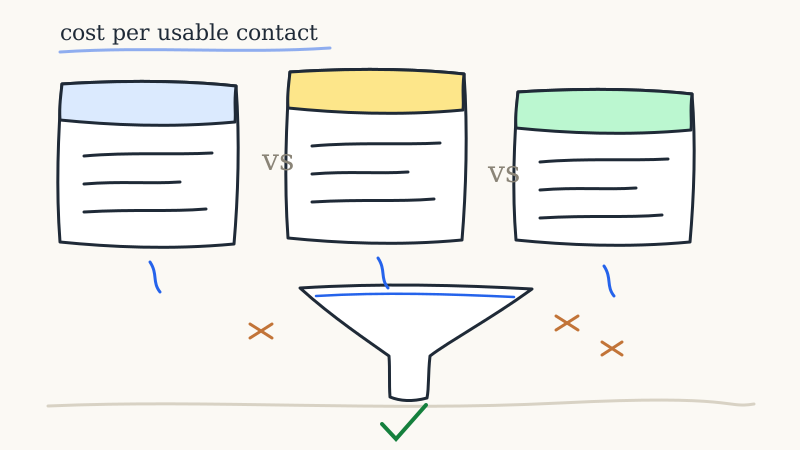
Then run the real math: cost per usable contact, not cost per record. If a provider gives you 10,000 records at 30 percent decay and a competitor gives you 6,000 at 8 percent, the cheaper list is the more expensive one. That calculation feeds straight into your outbound cost per meeting benchmark, which is the only number that should ultimately govern the decision.
How to Test Any Provider in Under a Week
Do not take the coverage claim. Run this before committing to anything longer than a month:
- Build a 200-contact gold set. Pull a sample that matches your actual ICP, not a broad filter. Same titles, same company sizes, same geographies you will really target.
- Request the same sample from each vendor during the trial. Identical filters across all three. Vendors will offer to build the list for you, which defeats the purpose. Build it yourself.
- Verify independently. Run every list through a third-party verification pass to measure real deliverable rates rather than the vendor’s self-reported “verified” label.
- Spot-check 30 records manually. Open LinkedIn and confirm the person still holds the title at the company. This is tedious and it is the single most informative hour you will spend.
- Measure phone validity separately. Dial 25 numbers. Count how many reach the named human versus a switchboard or a dead line.
- Score cost per verified, currently-employed contact. Compare that number across the three. It will rarely match the ranking the pricing pages imply.
Keep the gold set. Re-run it at renewal. Providers improve and regress, and the vendor you chose eighteen months ago is not necessarily the right one now. Our checklist for vetting a B2B lead data provider covers the longer-form version of this evaluation.
The Answer Most Teams Land On
In practice, mature outbound programs do not pick one. They layer. A broad primary source for coverage, a precision source for high-value accounts, and an independent verification step before anything enters a sending tool. That is the shape of a data enrichment waterfall, and it is genuinely the correct architecture once your volume justifies it.
Which surfaces the uncomfortable thing all three share: none of them run your outbound. A contact database is an input. It does not warm your domains, rotate your inboxes, write the sequence, handle the replies, or get a meeting onto a calendar. Teams routinely spend 30,000 dollars a year on data and then underinvest in every layer that turns data into pipeline, which is the most common version of a stalled outbound program we see.
That is the gap Vendisys is built to close. We are outsourced GTM infrastructure rather than software or an agency: we operate the outbound stack end to end on your behalf. Email campaigns run through EMY at 98 percent deliverability, LinkedIn outreach runs through LIA at over 1,000 inMails a month, and GetKali runs calendar invite campaigns that book demos directly. The data question still matters, but it stops being the bottleneck when someone is accountable for the whole system rather than one input to it.
If you are weighing a data contract against the cost of staffing the function, our comparison of GTM infrastructure versus hiring BDRs frames the same budget decision from the other direction.
The Bottom Line
Pick Apollo if you are an SMB or tech-focused team that wants coverage and sending in one subscription, and budget for independent email verification on top. Pick ZoomInfo if you sell into enterprise or non-tech verticals, or if calling is a primary channel, and negotiate the credit and renewal terms hard. Pick Lusha if your motion is precision over volume, especially in Europe.
Then test all three against your own gold set, because the only coverage number that matters is coverage of your ICP, and no vendor publishes that one.