Every outbound team eventually hits the same wall. The SDRs are booking meetings, the dashboard looks healthy, and then the AEs start pushing back: “half of these are not real opportunities.” The instinct is to add a qualification framework. The debate that follows is almost always the same one: MEDDIC or BANT?
Both are good frameworks. Neither is a silver bullet, and picking the wrong one for your stage and motion quietly costs you either pipeline volume or deal quality. This is a practical breakdown of what each framework actually measures, where each one fails, and how to decide which belongs in your outbound process.
What BANT actually checks
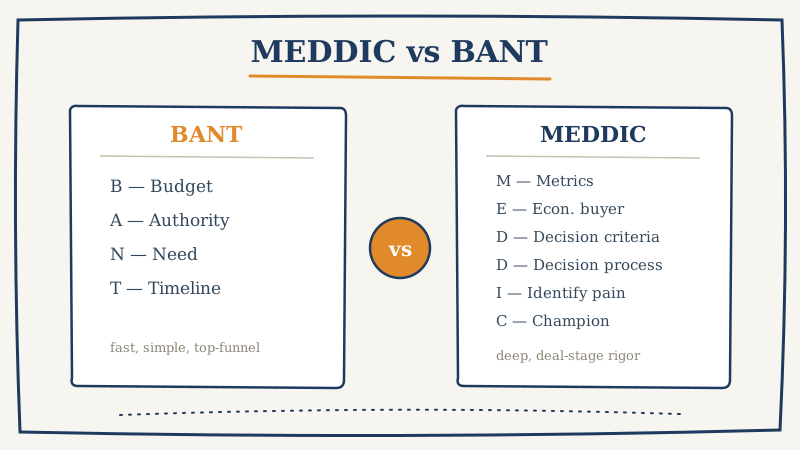
BANT is the older, simpler of the two. It comes from IBM and it asks four questions:
- Budget. Can this prospect fund a solution?
- Authority. Are we talking to someone who can say yes, or influence the person who can?
- Need. Is there a real problem our product solves?
- Timeline. When do they intend to act?
The appeal is speed. An SDR can run a BANT check inside a single discovery call, or even infer most of it from a well-researched account before the call happens. It maps cleanly to a checklist, it is easy to train, and it gives sales leaders a simple yes or no on whether a meeting should advance.
The weakness is that BANT is a snapshot of readiness, not a map of the deal. It tells you whether a buyer looks fundable and interested today. It tells you almost nothing about how the buying decision will actually get made, who else has to sign off, or what criteria the prospect will use to compare you against alternatives. In a modern B2B purchase with five to ten stakeholders, “we talked to someone with authority” is not the same as “we understand the decision process.”
BANT also over-indexes on budget. Early-stage buyers frequently do not have a line-item budget for a category they have never bought before. Disqualify them on budget and you throw away accounts that would have created budget once they saw the metric you could move.
What MEDDIC actually checks
MEDDIC was built for complex, high-value enterprise sales, and it goes deeper on purpose:
- Metrics. What quantifiable outcome does the buyer care about?
- Economic buyer. Who controls the money, specifically?
- Decision criteria. What standards will they use to choose a vendor?
- Decision process. What are the actual steps, approvals, and timeline to a signature?
- Identify pain. What is the compelling business problem driving action?
- Champion. Who inside the account is selling on your behalf when you are not in the room?
MEDDIC does not ask “is there budget.” It asks who owns the budget and what metric will make them release it. It does not ask “is there authority.” It maps the full decision process and identifies the internal champion who will navigate it for you. That rigor is why MEDDIC-run teams tend to forecast more accurately and slip fewer deals late in the quarter.
The cost of that depth is time. You cannot fully qualify a MEDDIC opportunity in a single cold-sourced first meeting. Metrics, decision process, and champion identification are things you uncover across two or three conversations. Ask an SDR to complete MEDDIC before booking and they will book almost nothing, because most of those fields are genuinely unknowable at first contact.
The mismatch that breaks outbound teams
Here is where teams go wrong. They read that MEDDIC is the “more serious” framework and mandate it at the top of the funnel. SDRs are told a meeting only counts if it is MEDDIC-qualified. Predictably, booked-meeting volume collapses, because a first touch from a cold sequence cannot surface a decision process or an economic buyer yet.
The opposite failure is running pure BANT all the way through the deal. The SDR books on BANT, the AE inherits a “qualified” lead, and three calls later discovers there are four other stakeholders and a procurement gate nobody mapped. The meeting looked qualified because it passed a top-funnel checklist that was never designed to describe a complex deal.
The frameworks are not competitors. They operate at different stages of the funnel. BANT is a top-of-funnel filter. MEDDIC is a deal-stage operating system. The teams that get this right use a light qualification bar to book meetings and a heavier one to advance opportunities. Getting your outbound engine to that level of consistency is exactly the kind of process design that Vendisys builds into an outsourced GTM motion, so the meetings that reach your AEs are ones they can actually work.
How to blend them in an outbound motion
The practical answer for most outbound teams is not “pick one.” It is a staged model where the framework gets heavier as the deal gets more real.
Stage 1, before the meeting is booked (SDR owns this): Run a stripped-down BANT, weighted toward Need and Authority, not Budget. The SDR’s job is to confirm the account fits ICP, the contact is a decision maker or credible champion, and a specific pain has been named by the prospect rather than assumed. Skip a hard budget gate here. If you disqualify on budget at first touch, you will kill early-stage accounts that convert well.
Stage 2, the discovery call (SDR to AE handoff): This is where you start layering MEDDIC. The AE’s first real conversation should surface Metrics (what number does the buyer want to move) and Identify pain in depth. The SDR passes over what they learned so the AE does not restart discovery from zero. A tight handoff here is the difference between a meeting that advances and one that quietly no-shows.
Stage 3, opportunity to close (AE owns this): Complete MEDDIC. Confirm the economic buyer by name, document the decision criteria and process, and formally identify the champion. An opportunity should not move to a late forecast stage until these fields are filled in with real answers, not guesses.
Mapping it visually:
| Funnel stage | Owner | Framework | Bar to pass |
|---|---|---|---|
| Pre-meeting | SDR | Light BANT (Need + Authority) | ICP fit, named pain, right persona |
| Discovery | SDR to AE | MEDDIC starts (Metrics, Pain) | Quantified problem confirmed |
| Opportunity | AE | Full MEDDIC | Economic buyer, process, champion |
This staging keeps SDR volume high, because the top-funnel bar is realistic, while protecting AE time, because nothing advances without the deeper rigor.
Make it operational, not aspirational
A framework only works if it is written down and enforced in the workflow, not just described in a kickoff deck. Three things make the difference.
First, write explicit field definitions. “Authority” and “economic buyer” mean different things, and if two reps interpret them differently your data is noise. Put the definitions in the CRM next to the fields.
Second, build the checks into your pipeline stages so an opportunity physically cannot advance without the required fields populated. If your CRM lets a deal reach “commit” with no documented decision process, reps will skip it under quota pressure every time.
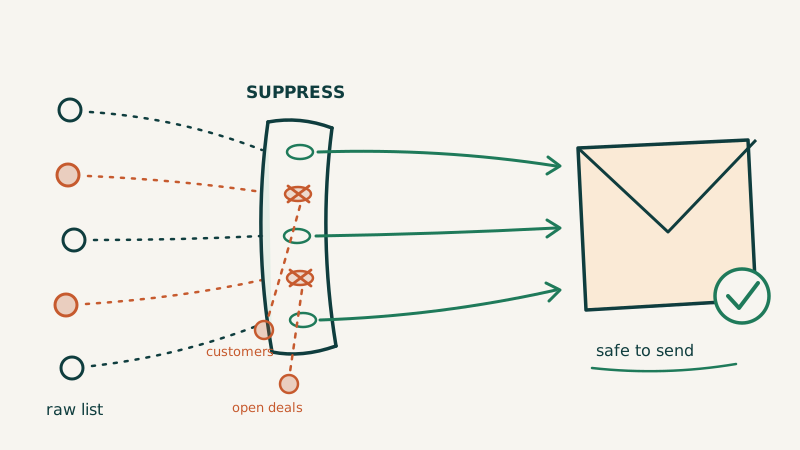
Third, protect data quality upstream. None of this matters if the contact records feeding your outbound are wrong. A perfectly qualified meeting booked against a stale or invalid email is still a wasted slot. Validating your list with a tool like Scrubby before a sequence goes out keeps your reps qualifying real humans instead of bounced addresses, and it keeps your deliverability high enough that the meetings get booked at all.
The booking step matters too. When an SDR does qualify a real opportunity, the meeting has to actually land on the calendar and hold. Reducing friction between “yes” and “confirmed slot” with a booking workflow like Kali cuts the drop-off between a qualified conversation and a meeting the AE can run.
So which one should you use?
If you sell a transactional product with short cycles and one or two stakeholders, BANT alone is probably enough, and MEDDIC will feel like overkill that slows your reps down. If you sell complex, high-value deals into large buying committees, you need MEDDIC to close consistently, but you should still gate the top of your funnel with a light BANT so your SDRs can move.
For most B2B outbound teams sitting between those extremes, the winning answer is both, staged by funnel position. Use a lightweight BANT to decide what gets booked, and MEDDIC to decide what advances. Qualify light at the top, qualify deep at the bottom, and make sure the definitions and CRM enforce the line so the framework survives contact with a quota.
Get that layering right and the argument between your SDRs and your AEs about “what counts as qualified” mostly disappears, because both teams are finally measuring the same deal with the right tool at the right time.