Every AI SDR demo looks the same. A clean dashboard, a sequence that writes itself, a calendar filling with meetings while a voiceover explains that you will never have to hire a rep again. It is a good show. It is also the least reliable predictor of whether the tool will work in your business.
The category has exploded. Products like vsdr.ai, getaia.io, getchampions.io, and triguna.ai all promise some version of an autonomous rep that researches, writes, sends, and books. Some are genuinely useful. Some are a thin wrapper on a language model pointed at a list you already could have emailed yourself. The difference is not visible in a demo, because a demo runs on the vendor’s cherry-picked account and the vendor’s warmed-up infrastructure, not on your data hitting your prospects’ inboxes.
This is the framework we use to separate the two. It scores an AI SDR platform on the layers that actually determine outcomes, in the order those layers matter.
Start with the outcome, not the feature list
Before you look at a single product, write down the number you are buying. Not “more pipeline.” A specific figure: qualified meetings per month, at a cost per meeting you can defend, in a segment you can name.
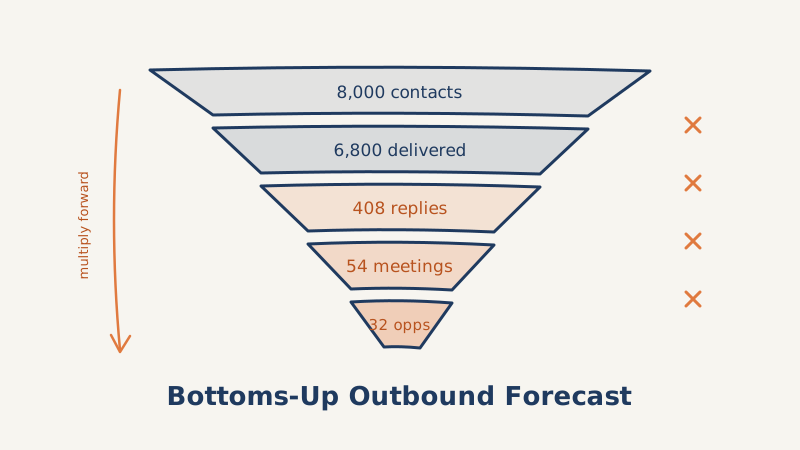
That number reframes the entire evaluation. An AI SDR that sends 10,000 emails a month is not impressive if 200 of them land in the primary inbox and three turn into meetings. A tool that sends 1,500 highly targeted, well-authenticated emails and books eight qualified meetings is the better buy, even though the dashboard looks quieter.
Hold every feature up against the outcome. If a capability does not plausibly move qualified meetings or lower cost per meeting, it is a demo prop, not a reason to sign.
Layer 1: Data and targeting
An AI SDR is a distribution engine. Point a distribution engine at a bad list and you distribute a bad message to the wrong people faster than any human could. This is the layer most buyers skip and most regret.
Ask hard questions about where the contact data comes from and how fresh it is. B2B data decays fast: people change jobs, companies get acquired, roles get renamed. A platform that enriches once and never revalidates is quietly degrading every day you use it. Ask whether the tool verifies deliverability before it sends, or whether it fires into unverified addresses and lets bounces pile up. Bounces are not a minor annoyance. A high bounce rate tanks your sending reputation, and a wrecked reputation means even your good emails stop landing.
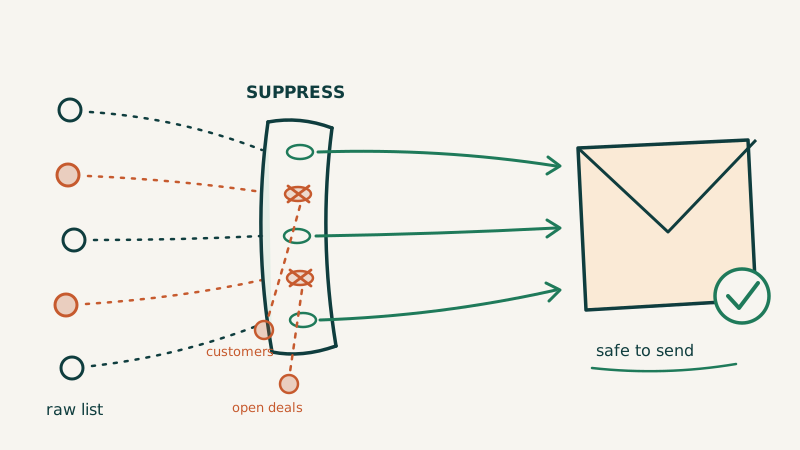
This is where an independent verification step earns its keep. Running your list through a dedicated validator like Scrubby before the AI SDR sends catches the catch-all traps, the role accounts, and the dead addresses that no built-in enrichment reliably screens out. If the platform cannot integrate a real verification gate, treat that as a serious gap, not a rounding error.
Then look at targeting logic. Can the tool build a segment around genuine buying signals, or does it just spray your total addressable market? Signal-based targeting (funding rounds, hiring patterns, technology changes, competitor movement) is the difference between timely outreach and interruption. Monitoring competitor and market signals with a tool like CAM can feed that timing layer, so the AI SDR reaches an account when something has actually changed rather than at random.
Layer 2: Deliverability and infrastructure
You can write the best email in the world and it does not matter if it never reaches the inbox. Deliverability is a technical discipline, and most AI SDR platforms treat it as an afterthought.
Interrogate the sending infrastructure directly:
- Domains and inboxes. Does the platform provision separate sending domains and inboxes, or does it send from your primary domain? Sending cold volume from your primary domain is how companies torch the deliverability of their real business email.
- Authentication. SPF, DKIM, and DMARC are non-negotiable. Google, Yahoo, and Microsoft now gate bulk senders on authentication and low complaint rates. A platform that cannot show you clean authentication is a platform that will get you filtered.
- Warmup. New domains need a ramp. Ask how the tool warms domains and whether it respects sending limits, or whether it lets you blast volume on day one and burn the domain in a week.
- Reputation monitoring. Does the platform watch domain reputation and blacklist status, and does it pull back automatically when reputation drops? Or do you find out you have been flagged when your reply rate quietly hits zero?
If a vendor cannot answer these questions crisply, they are selling you a message generator and calling it a sending engine. The gap between those two is where deals go to die.
Layer 3: Message quality that survives contact
Now we get to the part the demos love: the AI writing the email. This matters, but less than the vendors imply, and in a different way than they claim.
The failure mode is not that AI writes bad grammar. It is that AI writes generic, obviously templated copy that a buyer has now seen a hundred times. When every AI SDR in the market uses similar models and similar prompts, the average output converges, and the average output is easy to spot and easy to ignore.
Evaluate message quality on three axes:
- Relevance. Does the copy reference something specific and true about the account, or does it stuff in a company name and call it personalization? Real relevance comes from real research, which loops back to your data layer.
- Restraint. Good outbound is short, specific, and makes one clear ask. Watch out for tools that pad emails with adjectives and value-prop word salad.
- Voice control. Can you enforce your own voice, banned phrases, and guardrails, or are you stuck with the model’s defaults? You will be represented by this copy. You need editorial control over it.
Ask to see raw output on your own ICP during the trial, not the vendor’s polished sample. Send test emails to your own seed inboxes and read them as a buyer would. If you would delete it, so will your prospect.
Layer 4: The human loop
The phrase “autonomous AI SDR” is doing a lot of work in most pitches. In practice, the platforms that produce results still have a human somewhere: configuring the ICP, approving copy, reading replies, and adjusting when the numbers move. The question is not whether there is a human loop. It is whether the loop is yours to run and whether you have the time and skill to run it.
This is the honest fork in the decision. If you have an operator who will own the tool, an AI SDR platform can be a genuine force multiplier. If you are buying it to avoid having anyone own outbound at all, you are buying disappointment with a monthly invoice. In that case, a managed service that runs the entire motion for you, the model behind Vendisys, is a better fit than a self-serve platform, because the human loop is included rather than assumed. Products in the same ecosystem, from getaia.io on the agent side to underfive.ai on the presence side, only pay off when someone owns the strategy they execute.
Be brutally honest about which situation you are in before you sign anything.
Layer 5: Measurement and the exit test
Finally, look at what the platform lets you measure and how easily you could leave.
On measurement, the only vanity-proof metrics are downstream: qualified meetings, meeting-to-opportunity rate, and cost per meeting. Any dashboard can show opens and clicks. Insist on reporting that ties activity to booked, qualified meetings, and make sure that data is exportable into your own CRM so you own the record.
On the exit test, ask what happens when you cancel. Do you keep your domains, your sequences, your reply history, and your data? Or does the platform own the infrastructure and take it with them? A vendor confident in retention will happily let you own your assets. A vendor that locks you in is telling you something about how they expect to keep you.
A simple scorecard
Run every AI SDR platform you are considering through the same five questions, weighted in this order:
- Data and targeting: Is the list fresh, verified, and built on real signals?
- Deliverability: Is the sending infrastructure separate, authenticated, warmed, and monitored?
- Message quality: Does the copy survive contact with a real buyer on your ICP?
- Human loop: Do you have an owner for the tool, or do you need the loop included?
- Measurement and exit: Can you prove ROI in qualified meetings and walk away with your assets?
Score each platform one to five on every line. The winner is rarely the one with the flashiest demo. It is the one that holds up on the boring layers underneath, because those layers are what actually put a qualified meeting on your calendar.
The demo sells the destination. This framework checks the engine. Buy the engine.