Every early-stage founder eventually hits the same wall. The product works, a few customers love it, and now you need more of them faster than word of mouth will deliver. You cannot afford a sales team yet, and even if you could, you do not have the repeatable motion to hand a rep. So the job falls to you.
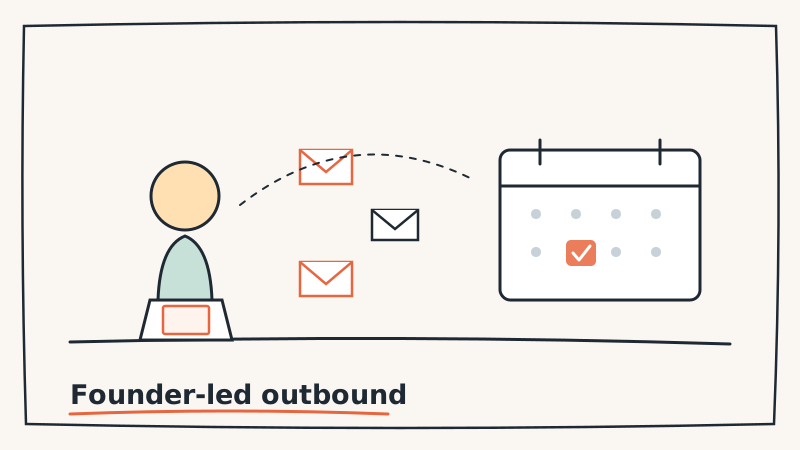
That is not a failure state. Founder-led outbound is one of the highest-leverage things you can do in the first year, and not because you are cheaper than a rep. You are better positioned than any rep will ever be. You know the problem cold, you can change the product in response to what you hear, and a prospect who gets an email from the founder pays attention in a way they never do for a random SDR. The trick is running the motion with enough discipline that it produces meetings instead of eating your week.
This is the playbook for doing exactly that: what to send, how to protect your sending reputation, how to measure whether it is working, and how to recognize the moment to hand it off.
Why the founder should run outbound first
There is a strong temptation to skip this step. Hiring a sales development rep feels like progress, and running cold email yourself feels like a distraction from building. Resist it. The reason has nothing to do with saving money.
When you do outbound yourself, every reply is market research. You learn which pain points land and which fall flat, which industries lean in and which never respond, what objection comes up on the third call every single time. That knowledge is the raw material for a repeatable sales process. A rep you hire before you have it will spend six months rediscovering what you could have learned in six weeks, and they will do it on your payroll while missing quota.
The founder-led phase is where you turn “we think people want this” into a documented motion: a target profile, a message that converts, a sequence that books meetings, and a set of objections you have real answers for. Only once that exists can anyone else run it. Handing outbound to a hire before that point is not delegation. It is outsourcing your own learning to someone with less context than you.
Step 1: Build a small, sharp list before you write a word
The single biggest mistake in early founder outbound is starting with the email. The email barely matters if the list is wrong. A brilliant message to a poorly chosen prospect gets ignored. A blunt, honest message to exactly the right person books a meeting.
Start narrow on purpose. Do not build a list of 5,000 companies that vaguely fit. Build a list of 100 that fit precisely. Write down the specific attributes of your best current customers or the customers you most want: company size, industry, the exact role of the person who feels the pain, and any trigger that suggests now is the right time. A founder who can only name “B2B companies” as a target has not done the work yet. A founder who can say “seed to Series A vertical SaaS companies, 20 to 60 people, where the head of sales just joined in the last quarter” has a list worth building.
That precision does two things. It makes your message writeable, because you know exactly who is reading it and what they care about. And it keeps volume low enough that you can genuinely personalize, which is the whole advantage of being the founder in the first place.
Before you send anything to that list, verify the email addresses. Nothing kills a young sending domain faster than a wave of bounces, and early-stage contact data is full of dead addresses and catch-all traps that will not tell you they failed until it is too late. Run the list through a validator like Scrubby first so you are only sending to real, deliverable inboxes. Twenty verified prospects beat a hundred unverified ones, both for your reply rate and for the health of your domain.
Step 2: Protect the domain you actually depend on
Here is a mistake that follows founders around for years: sending cold email from the primary company domain. You send a few hundred cold emails from [email protected], complaints and bounces accumulate, and suddenly your invoices, your customer support replies, and your investor updates start landing in spam. The domain that runs your business is now damaged, and repairing sender reputation is slow and painful.
Do it the right way from the start. Buy a separate but similar sending domain (for example, a “.co” or a “get-” variant of your main domain), point it at your real site, and send cold outreach from there. Set up SPF, DKIM, and DMARC authentication on that domain before you send a single email. Google, Yahoo, and Microsoft now actively gate bulk senders on proper authentication and low complaint rates, and skipping it is the fastest way to get filtered.
New domains also need to warm up. Do not go from zero to two hundred emails a day. Start with a handful of sends, ramp gradually over a few weeks, and keep daily volume modest even at steady state. Founder-led outbound does not need huge volume to work, which is convenient, because huge volume is exactly what burns young domains. If any of this feels like more infrastructure than you want to own, that is a legitimate signal, and we will come back to it.
Step 3: Write like a founder, not like a template
Now the message. The good news is that founder-led outbound has a structural advantage no automated tool can copy: you are the founder, and you can prove it in two sentences. Use that.
The email that works from a founder is short, specific, and human. It names a real problem the recipient has, connects it to something specific about their company or situation, and makes one small, low-friction ask. It does not open with three sentences about your company. It does not list features. It reads like a person who understands their world reached out because they might genuinely be able to help.
A workable structure:
- A first line that proves you did your homework. Reference something true and specific about them, their company, or their market. Not “I saw you are the VP of Sales.” Something that could only apply to them.
- One sentence on the problem, in their language. State the pain you solve the way they would describe it, not the way your pitch deck describes it.
- One sentence on why you, briefly. “I’m the founder of X, we help companies like yours do Y.” That is it. Founder credibility does the heavy lifting.
- A soft, single ask. “Worth a quick 15 minutes?” converts better than a hard demo push at this stage. You are opening a conversation, not closing a deal in one email.
Avoid the tells of generic outbound: walls of text, adjective-stuffed value propositions, and the obvious mail-merge feel. If you would delete it, so will they. Read every email out loud before it goes. When you make it easy to say yes, put a real scheduling link in the follow-up so an interested prospect can book without a back-and-forth. A tool like Kali turns a warm reply into a confirmed meeting on your calendar instead of a thread that slowly goes cold while you trade availability.
Step 4: Sequence and follow up, because the first email rarely lands
Most founders send one email, get no reply, and conclude outbound does not work. The reply usually lives in the follow-ups. A prospect who ignored your first email is not saying no. They are busy, and your one email did not rise above the noise on the day it arrived.
Build a short sequence of three to five touches over two to three weeks. Vary the angle each time rather than repeating “just following up.” One touch can lead with a different pain point, another can share a relevant result or proof point, another can be a genuinely short breakup message that often pulls a reply precisely because it removes the pressure. Space them out enough to be polite and persistent, not annoying.
Multi-channel helps here too. If your prospects live on LinkedIn, a thoughtful connection or comment alongside the email sequence compounds the effect. The goal is to become familiar without becoming a nuisance, so that when the timing is finally right, you are the name they already recognize.
Timing is worth engineering rather than leaving to chance. Outreach that lands when something has just changed at the account, a new leadership hire, a funding round, a competitor switch, consistently outperforms outreach sent at random. Watching for those signals with a tool like CAM lets you reach an account in the window when the problem is top of mind, which is worth more than any amount of clever copy sent at the wrong moment.
Step 5: Measure the two numbers that matter
Founder-led outbound goes wrong when you either do not measure it or measure the wrong things. Opens and clicks are vanity. Two numbers actually tell you whether the motion works.
The first is reply rate, specifically positive reply rate. If you send fifty well-targeted, personalized emails and get zero interested replies, the problem is upstream: the list, the offer, or the message. Do not scale volume to fix a conversion problem. A broken message sent to more people just wastes more of your list. Fix the message on small batches until replies come, then scale.
The second is meetings booked per week, and downstream of that, meetings that turn into real opportunities. This is the only number that connects outbound to revenue. Track it honestly. If your emails generate replies but not meetings, your ask or your follow-through is the issue. If meetings happen but never advance, you may be reaching the wrong people or promising something the product does not yet deliver, which is itself priceless early feedback.
Keep it simple. A spreadsheet with contacted, replied, and booked is enough at this stage. The point is not sophisticated analytics. The point is to know, week over week, whether the motion is improving, so that when you hand it off, you hand off something that provably works.
When to hand founder-led outbound off
Founder-led outbound has an expiration date, and pushing past it is its own kind of mistake. You are the best possible outbound rep for the learning phase and a poor use of founder time for the scaling phase. The signal to hand off is not a date on the calendar. It is a documented, repeatable motion: a defined target profile, a message with a known reply rate, a sequence that reliably books meetings, and a set of objections you have battle-tested answers for. Once that exists, the constraint is no longer knowledge. It is capacity, and your capacity as a founder is needed elsewhere.
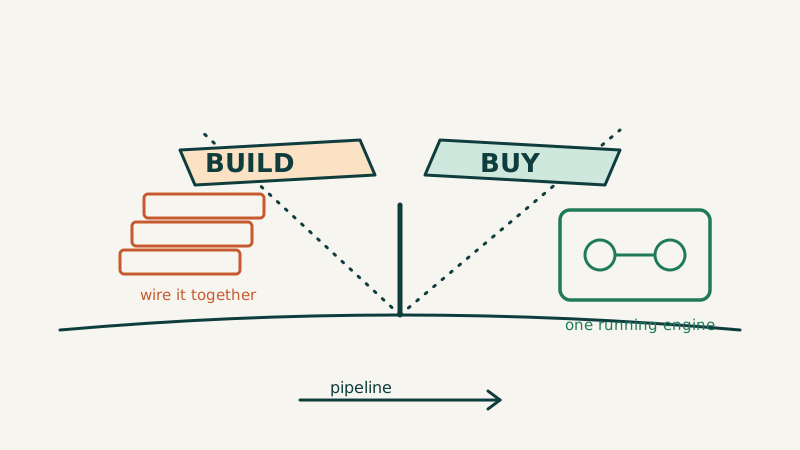
At that point you have two real paths. You can hire and train a rep, which works if you have the management bandwidth to onboard someone and the volume to keep them busy. Or you can hand the proven motion to a partner that already owns the infrastructure, the sending reputation, and the daily execution, so it scales without pulling you back in. That managed model is what Vendisys exists to run: you keep the strategy and the market knowledge you earned, and the day-to-day motion becomes someone else’s full-time job rather than a tax on yours. The wider ecosystem of tooling, from AI SDR platforms like vsdr.ai and getaia.io to presence tools like underfive.ai, all pays off only once there is a proven motion for them to execute, which is exactly what your founder-led phase is for building.
The mistake to avoid is treating outbound as beneath you and skipping the founder-led phase entirely, or treating it as your permanent job and never scaling past your own inbox. Do it yourself first, learn everything the market will teach you, prove the motion, and then get out of the way. That sequence, founder learns then founder hands off, is how early outbound turns into a pipeline engine instead of a founder’s second full-time job.