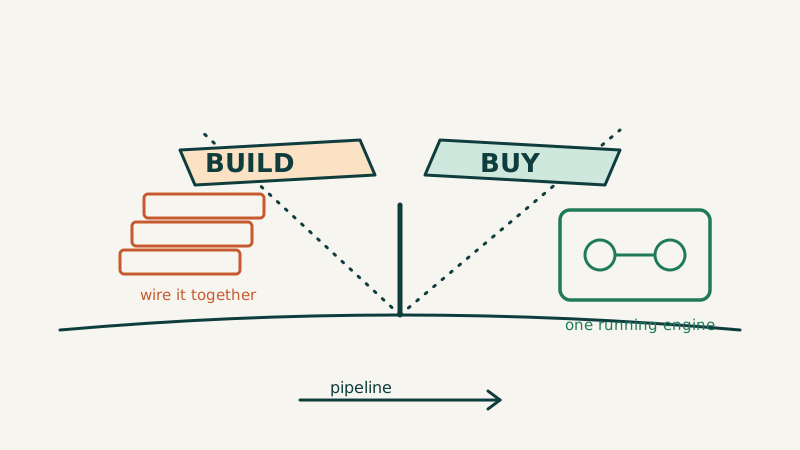
Clay has become the default answer whenever a founder or RevOps lead asks how modern teams run outbound. It is a genuinely great product: a spreadsheet-shaped canvas where you can enrich contacts from dozens of data providers, run waterfalls, score accounts, and trigger personalized messages. But there is a quiet assumption buried inside the recommendation to “just use Clay,” and it trips up a lot of teams. Clay is a tool for building an outbound engine. It is not the engine, and it is not the person who runs the engine.
That distinction is the whole build vs buy decision. This guide breaks down what Clay actually gives you, what it does not, and how to tell whether your team should build its outbound motion inside a platform like Clay or buy a done-for-you engine from an outsourced partner.
What Clay Actually Is (and Is Not)
Clay is a GTM data and automation platform. Its core strength is the enrichment waterfall: instead of relying on one data provider, you can chain many together so that if the first misses an email or a phone number, the next one fills the gap. You build tables, add enrichment columns, write conditional logic, and wire up messaging. It is flexible, powerful, and priced for teams that will use that flexibility.
Here is what Clay is not:
- It is not a sending infrastructure. You still need warmed inboxes, authenticated domains, and a sequencer.
- It is not a strategy. It does not decide your ICP, your offer, your segmentation, or your messaging angles.
- It is not an operator. Someone has to design the tables, maintain the enrichment logic, write the copy, monitor deliverability, and work the replies.
- It is not deliverability insurance. Enriched data that you blast from a cold domain still lands in spam.
None of this is a criticism of Clay. It is a canvas, and a canvas assumes you have a painter. The build vs buy question is really: do you have the painter, and is painting the best use of their time?
The Hidden Cost of “Just Build It in Clay”
When teams underestimate what building an outbound engine takes, they usually forget four categories of work that Clay does not do for you.
1. Someone has to own the platform. A Clay build is only as good as the person maintaining it. Enrichment providers change, credits get burned on bad-fit rows, and tables break when a data source shifts. This is a real, ongoing job, usually 10 to 20 hours a week once you are running at volume.
2. Data still needs to be verified before you send. Waterfall enrichment gets you more coverage, but coverage is not the same as accuracy. Catch-all domains, role accounts, and stale addresses still slip through and quietly wreck your bounce rate. You need a verification layer on top of enrichment. Running your final list through a validation tool like Scrubby before it hits the sequencer is what protects your domain reputation, and Clay does not do this natively at the depth cold sending requires.
3. Sending infrastructure lives outside Clay. You need secondary domains, inbox warmup, SPF, DKIM, and DMARC configured correctly, plus ongoing monitoring so you catch reputation drops before they tank a whole campaign. That is a separate stack and a separate skill set from building enrichment tables.
4. Copy, testing, and reply handling are all human. Clay can insert variables into a template, but it cannot tell you whether your offer resonates, which subject line wins, or how to handle a “not right now” reply so it converts three months later. That judgment is the actual outbound skill, and it is the part that a tool cannot replace.
Add these up and the “cheap” Clay build often costs more than teams expect once you price in the operator’s salary, the surrounding stack, and the months of iteration before the motion produces predictable meetings.
What Outsourced Outbound Gives You Instead
Buying a done-for-you engine flips the model. Instead of licensing a canvas and staffing a painter, you hand the entire motion to a team that already has the tools, the infrastructure, the operators, and the reps. At Vendisys, that means the enrichment stack, the verified data layer, the warmed sending infrastructure, the copywriting, the testing, and the human reps working replies are all included and already running. You are buying the outcome (booked meetings) rather than the raw materials.
The trade-off is directional control. With Clay you own every knob. With an outsourced partner you set the strategy and guardrails, then trust the operator to execute inside them. Good partners close that gap by giving you full visibility into what is being sent, letting you review and approve messaging, and reporting on the same metrics your internal team would track.
There is also a speed difference. Building a Clay motion from scratch to first predictable meetings is usually a two to four month project. A mature outsourced engine can be sending qualified, verified outreach within a couple of weeks because the infrastructure already exists. If pipeline is the constraint and time is short, that ramp difference matters more than any per-message cost comparison.
Build vs Buy: A Side-by-Side
| Factor | Build in Clay | Buy Outsourced Outbound |
|---|---|---|
| Upfront setup | You design tables, waterfalls, logic | Already built, configured to your ICP |
| Sending infrastructure | You source and warm domains yourself | Included and maintained |
| Data verification | You add a separate validation layer | Built into the pipeline |
| Copy and testing | Your team writes and iterates | Operator writes, tests, optimizes |
| Reply handling | Your reps, your inbox | Trained reps work replies |
| Time to first meetings | 2 to 4 months | 1 to 3 weeks |
| Ongoing ownership | 10 to 20 hrs/week internally | Managed for you |
| Best when | You have RevOps depth and want control | You want pipeline without building a team |
Who Should Build in Clay
Clay is the right call when three things are true. First, you have a technical RevOps or growth person who genuinely enjoys building systems and has the bandwidth to own the platform week over week. Second, outbound is a core, permanent muscle you want to develop in-house rather than rent. Third, you have the time to iterate, because the first version of any self-built motion is rarely the one that produces predictable meetings.
Teams with an existing outbound function often use Clay to level up: better enrichment, smarter account scoring, cleaner data flowing into their existing sequencer and CRM. In that context Clay is a force multiplier for a team that already knows how to run outbound. It sharpens a motion that already works.
Who Should Buy the Engine
Buying makes more sense when you need pipeline before you can realistically build the internal capability. That describes most pre-Series A companies, most founder-led teams that have outgrown the founder doing outreach personally, and any team where the person who would own the Clay build has a more valuable job to do. If your growth or RevOps lead spending 15 hours a week maintaining enrichment tables is the difference between shipping product and not, the math on outsourcing gets obvious fast.
Buying is also the pragmatic choice when the surrounding stack is the real gap. Plenty of teams could build the enrichment side but have no sending infrastructure, no deliverability monitoring, and no one to write and test copy. An outsourced engine ships all of that as one unit. If you want to layer in warm-path plays on top of cold, such as reaching former champions when they change jobs through a tool like GetChampions, or catching website and intent signals with something like CAM, a good partner folds those signals into the same motion rather than leaving you to stitch them together yourself.
You Do Not Always Have to Choose
The build vs buy framing is useful, but it is not a hard binary. A common and effective pattern is to buy first and build later: bring on an outsourced partner to generate pipeline immediately and prove the channel works, then use what you learn (which segments respond, which offers land, which messaging converts) to inform an in-house build once you are ready to invest in the team.
Some teams run both permanently. The outsourced partner handles high-volume cold outbound while the internal team runs Clay for high-touch, account-specific plays and AI-assisted personalization at the top accounts. Tools like vSDR can carry the AI SDR layer inside a build like that, drafting and personalizing at scale while human reps focus on the accounts that deserve a custom touch. The two motions coordinate at the account level so you never run a cold sequence into a buying center your partner is already working.
The Real Question
The choice is not really “Clay vs outsourced outbound,” because they are not the same kind of thing. Clay is a tool you operate. Outsourced outbound is an outcome you buy. The honest question is: do you have the operator, the infrastructure, the copy skill, and the time to turn a great tool into a running engine? If yes, build it, and Clay is an excellent place to do that. If not, buying the finished engine will get you to pipeline faster and let your best people stay focused on the work only they can do.
If you are weighing that decision right now, map your resources against the table above before you commit. The teams that regret their choice are almost always the ones that bought a powerful canvas and then discovered, three months in, that nobody had time to paint. If you want to see what buying the finished engine looks like, that is exactly what we run at Vendisys.