The AI SDR pitch is the cleanest pitch in B2B software. A ramped human SDR costs you somewhere north of six figures fully loaded, takes a quarter to get productive, and may quit in month nine. An AI SDR costs a fraction of that, starts on day one, and does not resign. Three vendors have built most of the category’s mindshare on that arithmetic: 11x with Alice, Artisan with Ava, and AiSDR.
The arithmetic is real. It is also not the comparison that decides whether you get pipeline.
Read enough reviews of all three and a pattern emerges that none of the vendor comparison pages lead with. Buyers do not complain that the AI cannot write an email. They complain that the emails get worse as volume goes up, and that keeping the output good requires a person watching targeting, messaging, and deliverability more or less continuously. One 11x reviewer who spent roughly $9,000 sending 9,000 messages concluded that using Alice well needs a full-time person on it. Artisan reviewers report the mirror image: Ava’s output at high volume drifts toward template-like copy that prospects clock as automated, and controlling the tone takes sustained coaching.
That is the actual decision. You are not choosing between software and headcount. You are choosing which software to buy and how much headcount it will quietly require. This post compares the three on that basis.
The short version
- 11x (Alice) is the most autonomous-feeling and the most expensive. Multichannel breadth is genuinely wider than the other two, pricing is bespoke and annual, and reported contracts cluster in the tens of thousands per year. You are buying a platform and committing before you have evidence.
- Artisan (Ava) is email-first and deliberately built around deliverability: warmup, mailbox health monitoring, and inbox rotation are part of the product rather than an afterthought. That is the right instinct. It also means Artisan is taking responsibility for infrastructure inside a software subscription, which is a harder thing to do well than it sounds.
- AiSDR is the cheapest way to find out whether an AI SDR works on your market, mostly because it is the only one of the three that publishes tiers and asks for a quarterly rather than annual commitment. Lower price, lower lock-in, correspondingly less platform.
If you want the one-line version: AiSDR is the test, Artisan is the email specialist, 11x is the platform bet. None of them removes the operator.
What each one actually is
11x: the digital worker framing
11x positions Alice as a digital worker rather than a tool, and the product is built to support that framing. It pulls in third-party contact data and intent signals, sequences across email and LinkedIn, and the broader 11x lineup extends into phone, SMS, and WhatsApp through a second agent. If your outbound motion genuinely needs five channels, 11x is the only one of the three that credibly covers them.
The commercial structure is the thing to understand clearly. There is no public pricing page. Contracts are negotiated, generally annual, and the reported range sits roughly between $40,000 and $65,000 a year with a median around $45,000. Alice alone is often quoted from around $25,000 annually.
That structure has a specific consequence. You will sign for twelve months before you have seen Alice perform against your ICP, with your messaging, into your market. If it works, excellent. If your ICP turns out to be harder to reach than the demo implied, you own the problem for a year. The G2 rating sits around 4.5 out of 5 across a fairly thin review base, which is respectable but not a large enough sample to lean on.
Artisan: deliverability as a feature, not a disclaimer
Artisan’s Ava handles email and LinkedIn, with no phone leg. Entry pricing is reported in the low four figures per month, often cited around $1,500, and heavier add-ons for data and sending infrastructure push it up from there. Annual figures starting near $15,000 get quoted for Ava.
What distinguishes Artisan is that it treats sending infrastructure as part of the job. Inbox warmup, mailbox health monitoring, and dynamic send limits are in the product. Most sales engagement software hands you a connector and treats whatever happens to your domain reputation as your department. Artisan at least acknowledges that an AI that writes beautiful emails into a burned domain has accomplished nothing.
The honest caveat is that bundling infrastructure into a software subscription creates a tension. Deliverability is not a feature you ship, it is an operation you run: domains aged before use, sending volume ramped per mailbox, reputation watched daily, mailboxes pulled the moment they start to wobble. We have written the full version of that discipline in our cold email deliverability guide. A software vendor can automate parts of it. It cannot take the outcome onto its own balance sheet, because the domains are yours.
Artisan’s G2 rating sits lower than 11x, around 3.8 to 3.9, against a similarly small review count, while its TrustPilot score runs higher. Read both. The G2 reviews skew toward teams running real volume, and the recurring theme there is messaging control.
AiSDR: the one that will tell you its price
AiSDR is the transparency outlier. It publishes tiers, with 2026 public guidance showing roughly $900 a month at the entry level and $2,500 a month a tier up, on quarterly minimum commitments rather than annual lock-in.
Do not undervalue that. Quarterly commitment on published pricing means you can run a real ninety-day test for a few thousand dollars and walk away with data instead of a renewal conversation. Against a $45,000 annual contract you cannot exit, that is a meaningfully different risk profile, and ninety days is roughly the window in which honest outbound signal appears at all. It is also less platform: narrower channel coverage, less infrastructure ownership, fewer enterprise hooks.
If you have never run AI-assisted outbound and you do not yet know whether your market responds to it, starting with the cheapest instrument that produces a clean read is simply correct. Starting with the most expensive one is how teams end up defending a decision instead of evaluating it.
The comparison nobody puts on the page
Here is the table that actually matters, and the three vendor sites will not build it for you.
| 11x | Artisan | AiSDR | |
|---|---|---|---|
| Pricing visible before a sales call | No | No | Yes |
| Commitment | Annual | Annual typical | Quarterly minimum |
| Channels | Email, LinkedIn, phone, SMS, WhatsApp | Email, LinkedIn | Email, LinkedIn |
| Infrastructure in product | Partial, add-ons | Warmup, mailbox health, send limits | Limited |
| Reported entry cost | ~$25K/yr for Alice | ~$15K/yr for Ava | ~$900/mo |
| Recurring buyer complaint | Needs a full-time person watching it | Message quality drifts at volume, tone control is work | Less platform depth |
Look at the last row. It is the same complaint three times. The channel matrix differs, the price differs by 4x, the contract terms differ, and the failure mode is identical: the AI produces acceptable output at low volume and degrades as you scale it, and the fix is human attention.
This is not a knock on any of the three vendors. It is a property of the category. An AI SDR is a generator. Generators need a feedback loop, and the loop is made of judgment: is this list actually our ICP, is this message landing or getting politely ignored, is this domain still getting delivered, is this reply a real buyer or a brush-off. Nobody has automated that loop. Everybody has automated the generation that feeds it.
The line item that is not on the quote
Price out any of the three honestly and you get three numbers, not one:
- The license. $900 a month to $45,000 a year, depending on which you pick.
- The data and infrastructure underneath it. Contact data, verification, sending domains, mailboxes. Sometimes bundled, usually metered, always more than the first quote implied.
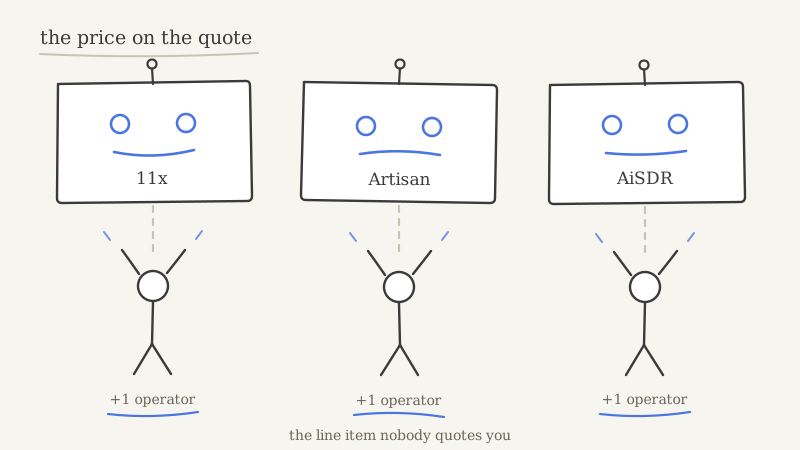
- The operator. The person who reviews targeting, rewrites the messaging the AI drifts away from, watches deliverability, and triages replies. 11x reviewers put this at a full-time person. Call it a fraction of an SDR salary if you are generous.
That third line is where AI SDR economics usually break. The pitch replaces a $120,000 SDR with a $25,000 platform, which is a $95,000 saving, until you notice the platform needs half a competent RevOps or SDR manager to produce usable output. Now you have a $25,000 platform plus $50,000 of attention, and the attention is coming out of someone who was supposed to be doing something else. We broke this calculation down in detail in our AI SDR cost and pricing analysis, and the honest version of the comparison against human headcount is in AI SDR vs outsourced human SDR team.
So the right question in a demo is not “what does it cost.” It is: who is doing the work this does not do, and what is that person’s name. If the answer is “we will figure it out,” you have found the risk.
How to run an evaluation that produces an answer
If you are going to test one of these, test it in a way that generates evidence rather than a feeling.
Fix the inputs before you compare the outputs. Every one of these platforms is a function of the list you feed it. Run the same account list, with the same verification standard, through whichever two you are comparing. If you compare 11x on a Clay-enriched list against AiSDR on a raw export, you have measured your data, not the vendors. Worth checking how much of your list is catch-all before you start, because unresolvable addresses are the quiet source of bounce rates that get blamed on the AI. Scrubby is the validator built to safely clear exactly that bucket.
Separate the three failure modes. When a test underperforms, it is one of: wrong accounts, wrong message, or the message never arrived. Those have completely different fixes and get conflated constantly. Instrument so you can tell them apart. Our cold email reply rate benchmarks give you the thresholds to judge against, and if open rates are your primary signal, read why open rate tracking is broken first.
Measure volume at the quality bar, not at the cap. Any of the three will send whatever you ask. The number you want is how much volume it produces at output you would be comfortable having your CEO read. That number is almost always well below the platform maximum, and the gap between the two is the operator’s workload.
Give it ninety days and a scorecard. Thirty days measures setup. Ninety days measures whether the motion works. Define the scorecard before you start: meetings booked, cost per meeting, and reply quality, not activity counts. Our first ninety days framework lays out what to expect at each stage, and outbound cost per meeting benchmarks give you the denominator that makes the license fee comparable across vendors.
Check the exit before you sign the entry. With AiSDR’s quarterly structure this is nearly free. With an annual 11x or Artisan contract, read the termination and performance language carefully. The clauses worth negotiating are the same ones we list in outsourced SDR contract clauses to negotiate before signing.
The third option the comparison pages omit
There is a structural choice underneath the vendor choice, and all three comparison pages have an interest in not raising it.
Buying AI SDR software means you own the operation and rent the generator. The vendor supplies the model, the sequencing, and some tooling. You supply the targeting judgment, the messaging iteration, the deliverability discipline, the reply triage, and the person who does all of it. That is a reasonable trade if you already have that person and want to make them more productive. It is a bad trade if you bought the software precisely because you do not have that person.
The alternative is to move the operation itself off your plate rather than the typing. That is what outsourced GTM infrastructure means in practice: the domains, the mailboxes, the identities, the sequencing, the monitoring, and the humans running all of it sit on someone else’s side of the line, and what arrives on yours is meetings.
At Vendisys that infrastructure is owned rather than rented. Email sends through Inboxy, our own sending domains, mailboxes, and warmup, with EMY running the sequences through infrastructure we operate. LinkedIn runs on AIA, aged and verified identities on dedicated residential IPs, with LIA doing the outreach. KALI skips the inbox entirely and lands on the calendar. CAM watches buying signals across your market so the targeting is driven by something other than a filter you set in January. Replies land in Underfive, a unified inbox for email and LinkedIn wired into your CRM, so reply triage does not become the operator job the AI SDR platforms hand back to you. Where enrichment is the right tool, we run Clay inside the program rather than selling you another seat to administer.
The honest comparison of that model against adding headcount is on our Vendisys vs hiring BDRs page, including where hiring is the better answer.
Picking one
If you have a capable outbound operator in-house and you want to multiply their output, buy software. Start with AiSDR, because the published pricing and quarterly commitment let you learn something cheaply, and graduate to Artisan if email deliverability is your binding constraint or to 11x if you genuinely need five channels and have budget for an annual bet.
If you do not have that operator, understand clearly what you are buying. None of these three platforms will hire them for you, and the reviews are unusually consistent that you will need one. A $900 a month license that requires half an FTE to produce decent output is not a $900 a month license.
And if the reason you are shopping for an AI SDR is that you want pipeline without building an outbound function, the category is answering a different question than the one you asked. The platforms automate the sending. The work was never the sending.
Worth reading next: how to evaluate an AI SDR platform for the full buyer framework, and when to outsource outbound vs build in-house for the build-versus-buy decision one level up.