Most teams obsess over subject lines and copy while quietly letting the single biggest deliverability variable slip: the IP address their mail actually leaves from. A dedicated versus shared sending IP decision does not feel urgent until half your campaign lands in spam and you cannot explain why. By then the reputation damage is already baked in.
This guide breaks down how each option behaves under real cold outbound volume, when each one makes sense, and how to protect inbox placement no matter which you run.
What “dedicated” and “shared” actually mean
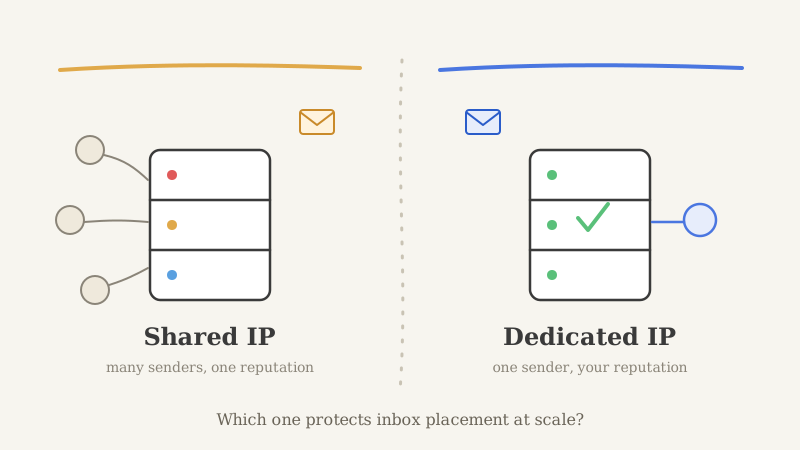
Every email you send leaves from a mail server tied to an IP address. Mailbox providers like Google and Microsoft assign a reputation score to that IP based on how recipients treat the mail flowing through it: opens, replies, spam complaints, bounces, and spam-trap hits.
A shared IP pools your sending with other customers of the same platform. You inherit a reputation you did not build, good or bad. A dedicated IP is yours alone. Every reputation signal it carries comes from your mail and nobody else’s.
That single difference drives almost everything else that matters.
The case for a shared IP
Shared IPs are the default on most sending platforms for a reason. They solve the cold-start problem.
- Instant warm reputation. A well-managed shared pool already sends steady, engaged volume. You borrow that established standing from day one instead of warming a cold address from zero over several weeks.
- Volume smoothing. Mailbox providers reward consistent daily volume. A pool of senders naturally keeps the tap flowing even when your individual campaign pauses, which keeps the IP looking active and healthy.
- No infrastructure babysitting. The provider handles rotation, blacklist monitoring, and remediation. You send and move on.
The catch is that you do not control your neighbors. If another sender on the pool blasts a dirty list and torches the shared reputation, your carefully written sequence pays the price. On a low-volume, well-policed pool this rarely happens. On a cheap, loosely moderated one it happens constantly.
The case for a dedicated IP
A dedicated IP hands you the steering wheel and the full weight of responsibility that comes with it.
- Your reputation is yours. No noisy neighbor can drag you down, and no one else benefits from the trust you build. Clean sending compounds in your favor over time.
- Predictability. When placement shifts, you can trace it to your own behavior instead of guessing which of fifty strangers caused it. Root-cause analysis becomes possible.
- Isolation for high-stakes sending. If cold outbound is a core revenue channel, you do not want it sharing a lane with anyone.
The tradeoff is that a fresh dedicated IP starts at zero reputation. You have to warm it deliberately, ramping volume over two to four weeks while keeping engagement high and complaints near zero. Push too hard too early and you will bake in a poor reputation that is painful to reverse. If you are unsure how to sequence that ramp, our cold email domain warmup timeline walks through the pacing week by week, and the same discipline applies to a new IP.
Volume is the deciding factor
The honest answer to “dedicated or shared” is: it depends on how much you send.
A dedicated IP needs consistent volume to stay healthy. Mailbox providers distrust IPs that send in erratic bursts. As a rough floor, you want to be sending enough steady daily mail (often cited around a few thousand messages a day) for the provider to form a stable read on your reputation. Below that, the signal is too thin and your placement gets jumpy.
If your outbound is a few hundred emails a day spread across a handful of inboxes, a shared IP on a reputable platform will almost always outperform a starved dedicated one. You simply do not generate enough volume to keep a dedicated IP warm.
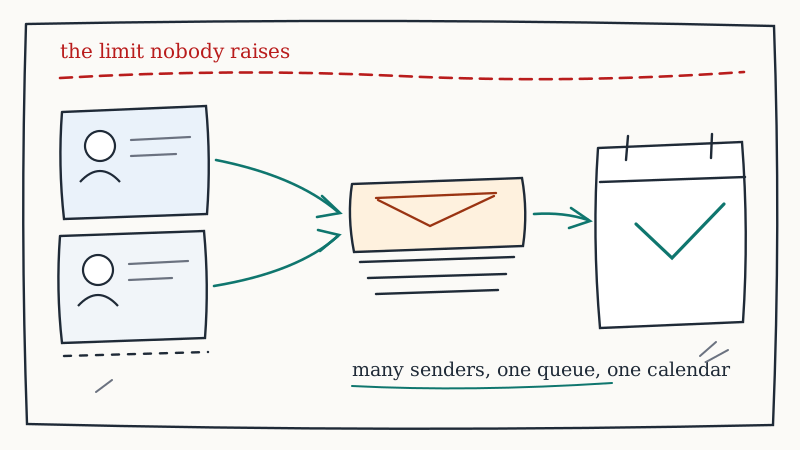
If you are running high-volume, multi-domain outbound where cold email is a primary pipeline source, a dedicated IP (or a small set of them) gives you the control and isolation that volume justifies. This is also where the number of sending domains and inboxes you provision starts to interact with your IP strategy, since you are distributing load to protect any single reputation asset.
The variable that outranks both
Here is the uncomfortable truth: the dedicated versus shared debate is a rounding error next to list quality.
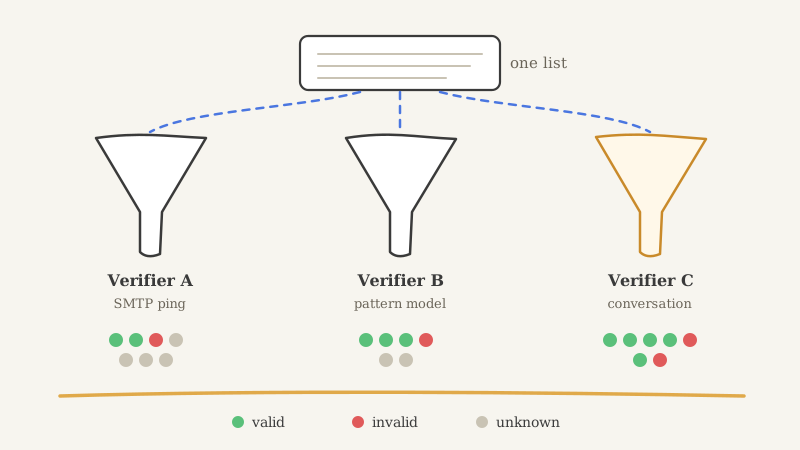
The fastest way to destroy any IP reputation, dedicated or shared, is to send to invalid addresses and spam traps. Hard bounces and trap hits are the loudest negative signals a mailbox provider tracks. You can provision the most pristine dedicated IP in existence and vaporize its standing in a single send to a stale, unvalidated list.
This is why disciplined teams validate every list before it touches their sending infrastructure. Running addresses through a verification layer like Scrubby catches the invalids, catch-alls, and risky domains that would otherwise bounce and drag your reputation down, which matters far more on a dedicated IP where every bounce is unmistakably yours. Pair that with the authentication basics covered in our SPF, DKIM, and DMARC setup guide and you have removed the two most common causes of self-inflicted spam placement.
A practical decision framework
Work through these in order:
- Are you sending high, consistent daily volume from your own infrastructure? If no, use a reputable shared IP and stop optimizing this. If yes, a dedicated IP is worth the operational cost.
- Do you have the discipline to warm and monitor an IP? A dedicated IP is a commitment: warmup, blacklist checks, and complaint monitoring. Without that, you will do worse than a managed shared pool.
- Is your list validated before every send? If not, fix this first. It outweighs the IP choice by a wide margin.
- Can you attribute placement problems? On shared you often cannot. If root-cause visibility matters to your revenue forecast, that alone can justify going dedicated.
Monitor whichever you run
Neither option is set-and-forget. Reputation drifts, blacklists update, and mailbox providers change their rules without notice. The teams that maintain strong placement are the ones watching for the early warning signs (a sudden reply-rate dip, a climb in bounces, a new blacklist entry) and reacting within hours instead of weeks.
That means keeping a live eye on your sending domains and the IPs behind them. Continuous monitoring tools such as CAM can alert you the moment a domain or IP lands on a blacklist, so you catch a reputation problem while it is still a small one instead of discovering it from a collapsing meeting rate at the end of the quarter.
The bottom line
There is no universally correct answer, only a correct answer for your volume and your discipline. Low or inconsistent volume points to a well-managed shared IP. High, steady, revenue-critical outbound points to a dedicated IP you warm and monitor carefully. Either way, validate your list before every send and watch your reputation like the revenue asset it is.
If sorting out sending infrastructure, warmup, and monitoring is pulling your team away from actually booking meetings, that is exactly the kind of operational weight Vendisys takes off your plate by running the outbound engine end to end so your pipeline does not hinge on an IP decision made in a hurry.