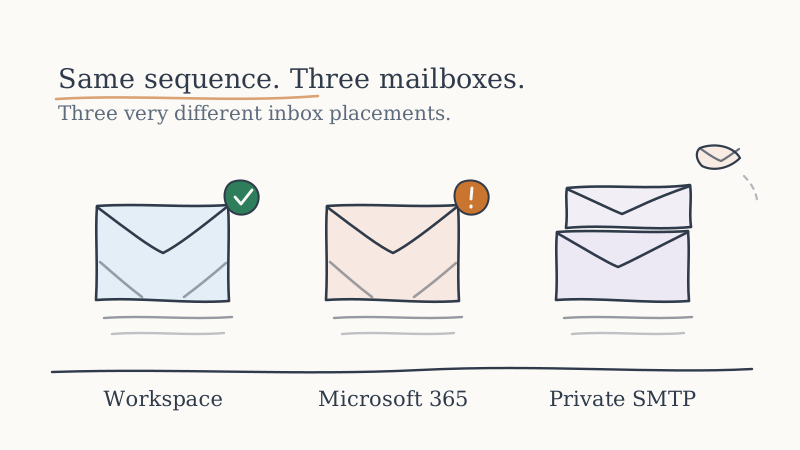
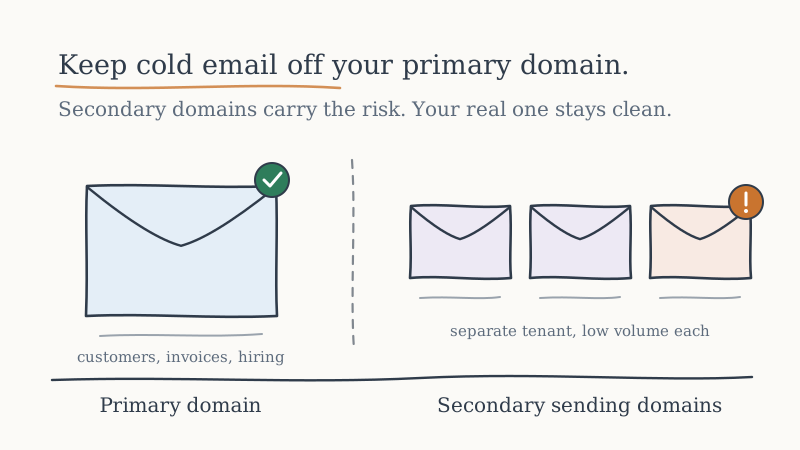
Short answer: no. Cold email should go out from separate secondary domains, in mailbox tenants that are separate from your corporate email, so that a reputation problem in a cold campaign can never reach the domain your company uses for customers, invoices and hiring. Your primary domain is the one asset in outbound you cannot replace, and cold sending is the activity most likely to damage it.
Why the Primary Domain Is the Wrong Place to Send From
Receiving mail servers judge every message partly on the reputation of the domain it comes from. Cold outbound, even when it is done well, produces signals that reputation systems treat as risky: low engagement, some spam complaints, and occasional bounces from stale data.
On a secondary domain, those signals cost you a slice of sending capacity. On your primary domain, they can affect every email your company sends. That includes replies to customers, proposals, password resets and offer letters. A team that loses placement on its primary domain does not just lose a campaign. It loses its ability to reliably email anyone.
There is also a tenant risk. If cold sending runs inside the same Google Workspace or Microsoft 365 tenant as your corporate email, an enforcement action against the cold mailboxes can touch the tenant itself. We covered how that plays out by provider in Google Workspace vs Microsoft 365 for cold email.
How to Set Up Secondary Sending Domains
| Decision | Recommended approach |
|---|---|
| Domain names | Close, recognizable variants of your brand, not random strings |
| Tenant | Separate from your corporate email tenant |
| Mailboxes per domain | A few, not many |
| Volume per mailbox | Low, ramped up gradually |
| Authentication | SPF, DKIM and DMARC on every domain |
| Website | Redirect each domain to your real site so recipients who check can verify you |
| Warmup | Let domains age and ramp before they carry real volume |
The full setup discipline is in our guides to SPF, DKIM and DMARC for cold email and how many sending domains and inboxes you need.
Common Mistakes
Using a subdomain of the primary domain. A subdomain such as outreach.yourcompany.com is still tied to your primary domain’s reputation in ways that matter. Use separate registered domains.
Replying from the primary domain. When a prospect replies to a cold email, continuing the thread from the same secondary mailbox keeps the conversation consistent. Moving to a corporate address is fine once a meeting is booked and the relationship is real.
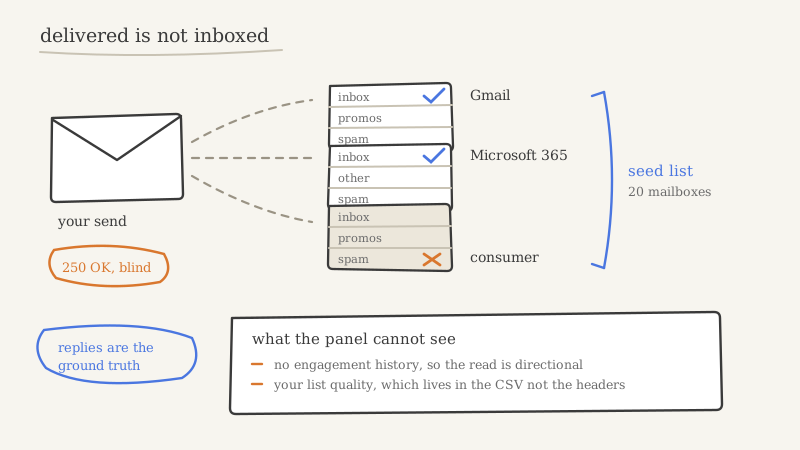
Skipping verification. Secondary domains protect your primary domain, but they still need protecting themselves. Sending unverified lists into a young domain is the quickest way to burn it.
Treating setup as a one-time job. Domains and mailboxes need ongoing monitoring and rotation. This is the layer Inboxy operates in Vendisys programs: it provisions the domains and mailboxes, warms them, monitors reputation and rotates capacity before placement drops.
FAQ
Is it ever acceptable to send cold email from the primary domain?
Very small volumes of genuinely one-to-one, hand-written outreach from a founder or executive carry little risk. Anything sequenced, automated or sent at volume belongs on secondary domains.
Will prospects distrust a secondary domain?
Not if it is a recognizable variant of your brand, redirects to your real website, and comes from a real person with a consistent signature. Prospects respond to relevance, not to the exact domain.
What happens if a secondary domain gets damaged?
You pause it, let it recover or retire it, and shift volume to healthy domains. That containment is the whole reason to use secondary domains in the first place.
Do I still need email verification if I use secondary domains?
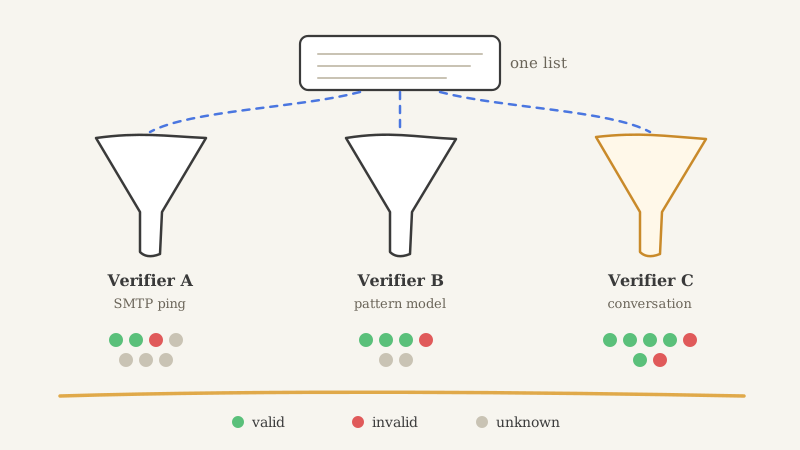
Yes. Verification protects the secondary domains you send from. Running lists through Scrubby, which safely clears catch-all email, before sending keeps bounce rates on young domains under control.