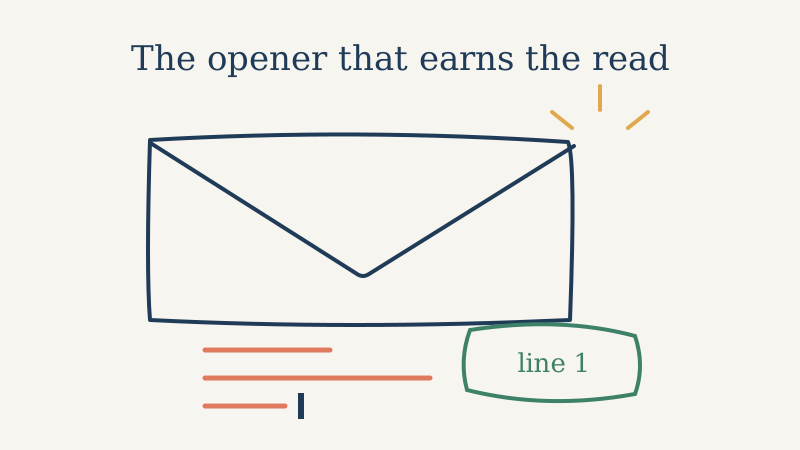
Your subject line has one job: earn the open. The moment a prospect clicks in, that job is done, and a brand new one begins. Now the first line has to earn the read. Most cold emails fail here, in the opening sentence, long before the buyer ever reaches the value proposition or the call to action you spent an hour polishing.
Open your own cold email drafts and read only the first line of each. If it starts with “I hope this email finds you well,” “My name is,” or “I am reaching out because,” you have already lost. The prospect has seen that exact opener a hundred times this month, and each repetition trains them to archive faster. This is a framework for writing first lines that do the opposite: pull the reader forward into the second sentence, and the second into the third.
Why the first line carries more weight than you think
Modern inboxes show a preview. On desktop and mobile, the first line of body text sits right next to the subject in the inbox list, and it renders in the notification banner before the message is ever opened. That means your first line is doing double duty. It is deciding whether a half-committed prospect keeps reading, and it is influencing the open decision itself.
A busy buyer is not reading your email. They are scanning it for a reason to stop. The first line is where they decide whether this is a message written for them or a template blasted to ten thousand strangers. You get one sentence to prove it is the former.
Two seconds of attention is not enough to explain what you sell. It is only enough to signal one thing: this was written by a human who knows something specific about my world. Everything below serves that single goal.
The three jobs of a first line
A strong cold email opener does three things at once:
- It proves relevance. It references something true and specific about the prospect, their company, or their role that a mass sender could not have known.
- It creates a small open loop. It raises a question in the reader’s mind that only the next sentence answers, so stopping feels like leaving something unfinished.
- It stays out of the way. It is short, plain, and free of throat-clearing, so the reader reaches the point before their patience runs out.
Miss any one of these and the line underperforms. Relevance without an open loop reads like flattery. An open loop without relevance reads like clickbait. And either one buried under “I hope you are doing well, I wanted to reach out to discuss” never gets read at all.
Five patterns that consistently work
Pattern 1: The observed trigger
Reference a specific, recent event: a funding round, a new hire, a product launch, a job posting, an expansion into a new market. Triggers work because they are unarguably about the prospect and they are time-bound, which creates natural urgency.
“Saw you just opened three AE roles in the Austin office.”
That single line signals research, relevance, and timing without a word of pitch. The reader knows exactly why you are writing, and they know you are not a bot. If you want to build outreach around signals like these systematically, our guide to trigger-based outbound timing breaks down which signals actually predict a reply.
Pattern 2: The specific observation
When there is no fresh trigger, reference something structural and true about how the prospect operates. A detail from their careers page, their pricing model, their go-to-market motion, a pattern you noticed in their category.
“Most teams selling into hospitals hit a wall at the security review, not the demo.”
This works because it demonstrates that you understand their world before you ask for anything. It also sets up the rest of the email, because the observation implies a problem you can help with.
Pattern 3: The peer proof
Lead with a relevant customer, framed as a fact rather than a boast. The key is that the named company must be a genuine peer, similar in size, segment, or stage, so the reader sees themselves in it.
“We helped two other Series A infra startups go from zero to a booked demo calendar in six weeks.”
Peer proof answers the buyer’s silent question (“does this even apply to a company like mine?”) in the first line, which is exactly when they are deciding whether to keep reading.
Pattern 4: The honest cold open
Sometimes the most disarming move is to name the elephant. A brief, self-aware acknowledgment that this is a cold email can lower the reader’s guard, as long as you immediately follow it with something worth their time.
“This is a cold email, so I will be quick: your competitors are running outbound and you are not.”
Use this sparingly. It works because it breaks the script the reader expected, but it only earns the read if the second half of the sentence delivers real substance.
Pattern 5: The pointed question
Open with a question the prospect actually asks themselves, phrased in their language, not yours. Avoid rhetorical questions with obvious answers (“Do you want more pipeline?”), which read as manipulative. Aim for a real tension in their role.
“How are you covering outbound while your one SDR ramps?”
A good question first line creates the open loop automatically. The reader wants to know why you are asking, and the only way to find out is to keep reading.
The patterns that quietly kill your reply rate
- “I hope this email finds you well.” It communicates nothing, it is used by everyone, and it wastes the most valuable line in the message. Delete it every time.
- “My name is X and I am a Y at Z.” The reader can see your name and signature. Leading with your own introduction signals the email is about you, not them.
- “I am reaching out because.” Every word before “because” is filler. Start with what comes after it.
- Fake personalization. “I loved your recent post” when there was no recent post, or a mail-merge token that clearly did not fire, is worse than no personalization. It proves the opposite of what you intended.
- The paragraph opener. A first line that runs four sentences long is not a first line, it is a wall. Buyers scanning on a phone bounce off density. Keep it to one clean sentence.
Personalization has to scale, or it does not matter
The obvious objection to everything above is time. Researching a genuine trigger or observation for every prospect can take five minutes each, and five minutes times a thousand prospects is not a campaign, it is a full-time job. This is where most teams give up and fall back on generic openers, which is exactly why generic openers are so common.
The answer is not to abandon personalization but to systematize it. Group prospects into tight segments that share a trigger or an observation, so one well-researched first line can serve a hundred similar accounts without becoming generic. Build a short library of proven opener templates mapped to the signals you can detect at scale. Reserve deep, one-to-one research for your highest-value accounts, and let repeatable segment-level openers carry the volume.
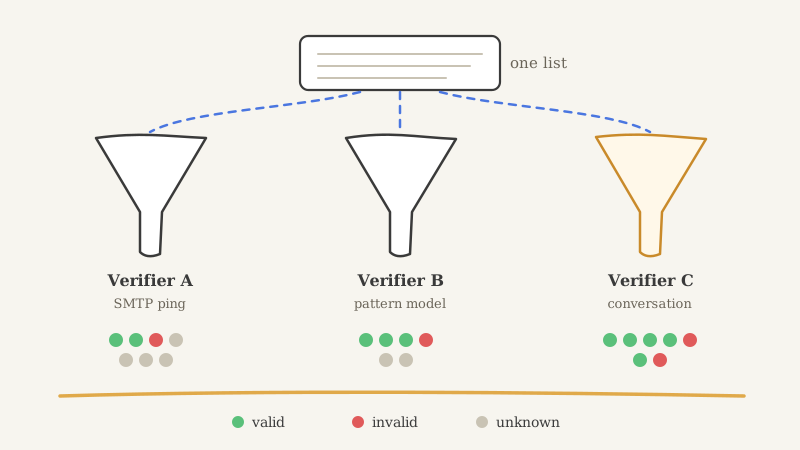
None of this matters if the email never lands in the inbox. The best first line in the world is invisible if your message routes to spam, and the fastest way to poison deliverability is to send to invalid or risky addresses. Validating your list with a tool like Scrubby before a send protects your sender reputation so your carefully written openers actually get seen. If you want the full picture on inbox placement, our cold email deliverability guide covers the infrastructure side in depth.
Test the first line on its own
Treat the first line as an independent variable. When you run an A/B test, most teams change the whole email at once and learn nothing about which change moved the number. Instead, hold the subject, body, and call to action constant and test only the opener. Two variants, one observed-trigger opener versus one specific-observation opener, will tell you which style your specific audience responds to.
Track reply rate, not open rate, when you evaluate first lines. The open already happened by the time the reader sees the body. What the first line influences is whether they keep reading long enough to reply, so reply rate is the honest scoreboard.
Where the first line sits in the bigger machine
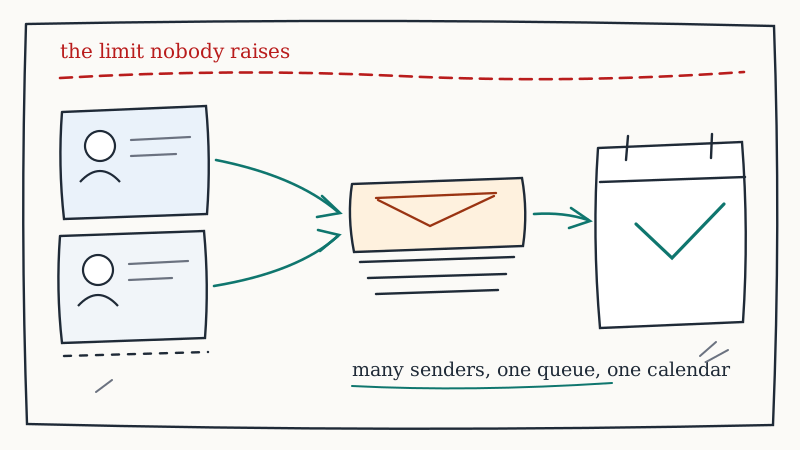
A great opener is a force multiplier, but it multiplies whatever comes after it. If the rest of your email is weak, a strong first line just gets the reader to a disappointing second paragraph faster. The opener earns the read, the body earns the interest, and a clean, low-friction call to action earns the meeting. Some teams close that final step by dropping a calendar invite directly into the sequence with a tool like Kali, turning a warm reply into a booked slot before the interest cools.
The teams that win at outbound are not the ones with a single clever line. They are the ones who treat every sentence of the sequence as a deliberate handoff to the next, and who have the research operation to make personalization repeatable rather than heroic. If building that operation in-house feels like more than your team can staff right now, that is precisely the kind of outbound infrastructure Vendisys runs on behalf of companies that would rather book meetings than manage an SDR bench.
Start with the first line. Read the opener of every template in your sequence today, and delete any that begins with a greeting instead of a reason to keep reading. That one edit will do more for your reply rate this quarter than another round of subject line tweaks.