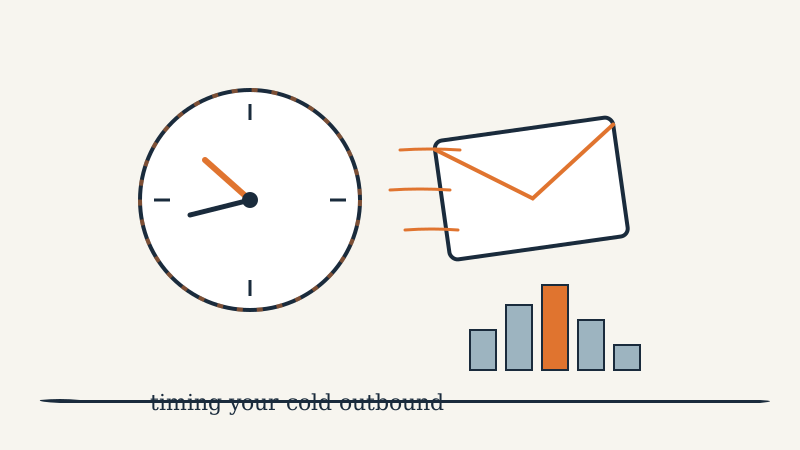
Ask ten SDRs when to send cold emails and you will get ten confident, contradictory answers. Tuesday at 10am. Sunday night, when inboxes are empty. Exactly 6:47am, because a viral LinkedIn post said so. Send time has become the astrology of outbound: everyone has a chart, nobody has a control group.
The truth is less romantic and more useful. Send timing is a real lever, but a small one, and it interacts with deliverability, sequence design, and your prospect’s time zone in ways that most “best time to send” listicles ignore. This is a practical playbook for getting timing right without treating your send schedule as a lucky ritual.
Why send time matters less than you think, and more than you hope
Two things are true at once. Send time will not save a bad campaign, and send time can meaningfully lift a good one.
If your list is stale, your copy is generic, and half your emails land in spam, no clock will rescue you. Sending garbage at 10am on a Tuesday just means it gets ignored at a statistically optimal hour. The fundamentals (list quality, deliverability, relevance) dwarf timing every time.
But once those fundamentals are solid, timing becomes the cheapest optimization you have. It costs nothing to shift a send window. There is no new copy to write, no new domain to warm. You are just deciding when an already-good email lands. On a healthy campaign, moving your sends into a prospect’s actual working hours can move open and reply rates by a few points, and a few points compounded across thousands of sends is real pipeline.
So the honest framing is this: fix the fundamentals first, then treat send timing as a free refinement, not a magic bullet.
The three timing decisions that actually matter
Most timing advice collapses into a single “best hour,” which is useless because it ignores that there are really three separate decisions.
Time of day. When during a working day does your email arrive. The goal is to land near the top of the inbox when your prospect is actually triaging email, not buried under forty overnight newsletters.
Day of week. Which days you send at all. This is less about a magic day and more about avoiding the days where your message competes with a Monday backlog or a Friday checkout.
Time zone. Whose clock you are optimizing for. This is the decision teams get wrong most often, because they schedule everything on the sender’s time zone and then wonder why West Coast prospects never see the email at the top of the pile.
Get these three right and you have captured almost all the available lift. Obsessing over the exact minute captures almost none.
Time of day: aim for the working inbox
The reliable pattern across most B2B audiences is that mid-morning and early afternoon, in the prospect’s local time, outperform the extremes. Early morning sends often get buried under the overnight pile before the prospect even opens their laptop. Late afternoon sends arrive when attention is draining and people are batching their way to the end of the day.
A workable default is to land emails in two windows: roughly 8am to 10am local, catching people as they clear the morning backlog, and roughly 1pm to 3pm local, catching the post-lunch reset. These are starting hypotheses, not laws. Your audience may skew earlier if they are founders and operators, or later if they are on the West Coast and start their day slowly.
One caveat that matters more than the exact hour: sending at odd hours can hurt deliverability, not just engagement. Blasting a large volume at 3am looks robotic to inbox providers and to humans. If you are sending at scale, spread sends across a natural window rather than firing everything in a single automated burst. Clean sending behavior protects the inbox placement you spent months earning, and validating your list with a tool like Scrubby before you send keeps bounce rates low enough that the timing conversation is even worth having.
Day of week: avoid the edges, test the middle
The old gospel says Tuesday, Wednesday, and Thursday are the sweet spot, and Monday and Friday are dead. There is some truth in it, but it is more nuanced than the meme.
Monday mornings are genuinely noisy. Your prospect is digging out of a weekend backlog and triaging aggressively, which means a cold email is more likely to be swept away in a bulk delete. Friday afternoons are checkout time, and a thoughtful reply to a stranger is the last thing on anyone’s mind.
The mid-week days are safer defaults precisely because they are the ordinary working days when people are heads-down and processing email at a steady pace. But “safer default” is not the same as “only option.” Some teams find that a Monday afternoon send, once the morning triage has settled, actually stands out because fewer competitors are sending then. The point is not to memorize a day. It is to avoid the obvious low-attention edges and then test the middle for your specific audience.
Time zone: the mistake almost everyone makes
Here is the single highest-leverage timing fix, and it has nothing to do with finding a magic hour. It is sending in the prospect’s time zone instead of your own.
If your SDR team sits in New York and schedules every send for 9am Eastern, your California prospects are receiving those emails at 6am Pacific, before they are awake, and your London prospects are getting them at 2pm, halfway through their afternoon slump. You optimized one time zone and quietly de-optimized all the others.
The fix is to segment your list by the prospect’s location and schedule each segment to land in its own local morning or early-afternoon window. Any competent sequencing tool can stagger sends this way. If you are running outreach that ends in a booked meeting, this matters twice over, because the follow-up calendar invite has to make sense in the prospect’s local time too. Sending a scheduling link or a calendar invite through a tool like Kali that respects the recipient’s time zone removes the friction of a prospect doing time math in their head, which is exactly the kind of tiny obstacle that quietly kills a booking.
Time-zone alignment is unglamorous, it never trends on LinkedIn, and it produces more consistent lift than any single “best hour” you will ever read about.
How to actually find your best time: run the test properly
The reason send-timing advice feels like superstition is that most people never test it in a way that could be true or false. They change three variables at once, look at one week of noisy data, and declare a winner. Here is how to do it so the answer means something.
Pick one variable at a time. If you want to learn about time of day, hold the day of week and the audience segment constant and vary only the send hour. Split a single, homogeneous segment into randomized groups so that the only real difference between them is when the email landed. If your morning group is all enterprise CFOs and your afternoon group is all startup founders, you have learned nothing about timing and everything about your audience.
Then give it volume and patience. Timing effects are small, which means you need a meaningful sample before the difference rises above random noise. A few hundred sends per variant is a floor, not a target, and one week is rarely enough to trust. Look at reply rate and meetings booked, not just opens, because open tracking has grown unreliable and a bump in opens that produces no replies is not a win you can bank.
If you want the full framework for structuring these experiments cleanly, our guide to A/B testing cold email walks through isolating variables and reading results without fooling yourself. Send timing is just one more variable to run through that same discipline.
What to actually do on Monday
You do not need a spreadsheet of optimal minutes. You need a sane default and a habit of testing.
Start here. Send in the prospect’s local time, not yours. Aim for a mid-morning or early-afternoon local window. Favor the middle of the week but do not treat Monday and Friday as forbidden. Spread your volume across a natural window instead of one automated burst so you protect deliverability. Then pick one timing variable and test it properly against reply rate and meetings booked, not opens.
Do that and you will capture nearly all the lift that send timing has to offer, which is real but modest. The teams that win outbound are not the ones who found a secret hour. They are the ones who nailed the fundamentals, aligned to their prospect’s clock, and spent their remaining energy on the things that actually move pipeline. If building and running that kind of disciplined outbound engine is not where you want your team spending its time, that is exactly the work Vendisys takes off your plate.