Almost every outbound team says it A/B tests cold email. Very few actually run tests that would survive a second look. They swap a subject line, watch open rates for two days, declare a winner, and roll it out. Then pipeline does not move, and nobody can explain why the “winning” email did nothing.
The problem is rarely the idea. It is the method. Cold email lives in a noisy, low-volume, deliverability-sensitive environment where most of the signals teams chase are statistically meaningless. A real testing framework accounts for that. Here is the one we use to make sure the variants we ship actually change outcomes.
Start by testing the right metric
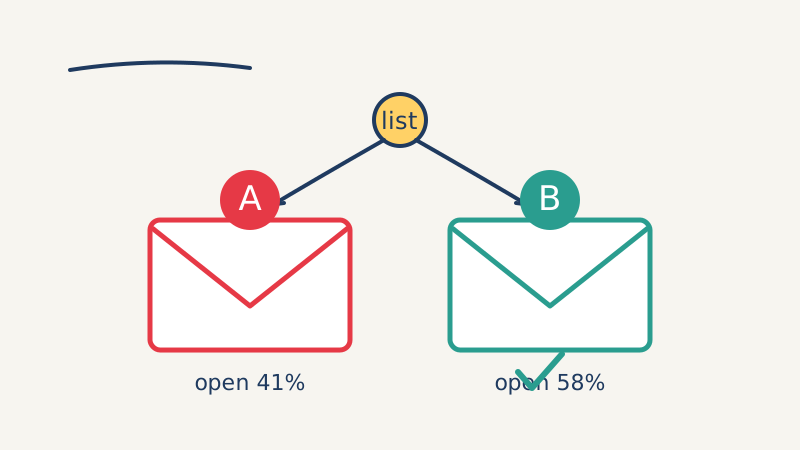
The single biggest mistake in outbound experimentation is optimizing open rate. Open tracking relies on a pixel that Apple Mail Privacy Protection, corporate security gateways, and spam filters routinely pre-fetch or block. That means a chunk of your “opens” never happened and a chunk of your real opens never registered. You are measuring a metric that is half fiction.
Rank what you test by how close it sits to revenue:
- Positive reply rate is the most reliable leading indicator. A human chose to respond and showed interest.
- Meeting booked rate is the metric that pays the bills. It is the truest measure but needs more volume to reach significance.
- Total reply rate (including objections and unsubscribes) tells you about relevance and targeting.
- Open rate is a directional input at best. Use it to catch deliverability problems, not to pick winners.
If a subject line variant lifts opens but does nothing to replies, you did not find a winner. You found a more clickable envelope around the same ignored letter.
Isolate one variable per test
When you change the subject line, the first line, and the call to action all at once and replies go up, you have learned nothing transferable. You cannot tell which change drove the lift, so you cannot reuse the insight on the next campaign.
Pick one variable per test:
- Subject line: length, curiosity vs. clarity, personalization token vs. none.
- Opening line: the personalized hook that earns the next sentence.
- Value framing: problem-first vs. outcome-first vs. social proof.
- Call to action: soft interest-check vs. direct meeting ask vs. resource offer.
- Length: three sentences vs. a fuller pitch.
Hold everything else constant. The discipline is annoying, but it is the only way to build a library of insights instead of a pile of anecdotes.
Make sure the test floor is clean before you test anything
Here is the trap nobody talks about: you cannot A/B test your way out of a deliverability problem. If variant A lands in 70 percent of inboxes and variant B lands in 85 percent because of how the sends were distributed across domains that day, your “winner” is just the one that got delivered. You measured infrastructure, not copy.
Before any test, the floor has to be level:
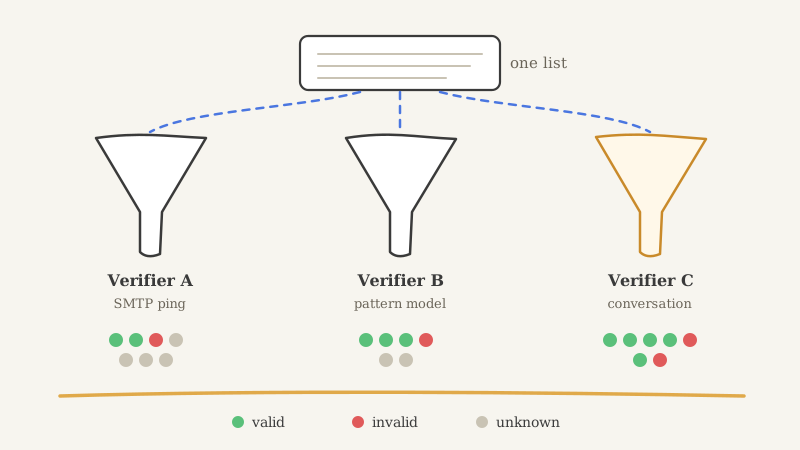
- Validate the list. Sending to dead, catch-all, or spam-trap addresses inflates bounces, wrecks domain reputation, and skews every downstream number. Running the list through a validation tool like Scrubby before the test removes the addresses that would otherwise distort your results and burn your sending domains. A clean list is the precondition for a trustworthy experiment, not an optional nicety.
- Randomize across infrastructure. Split each variant evenly across the same set of sending domains and inboxes. If A goes out from your warmest domains and B from your coldest, the test is dead on arrival.
- Send at comparable times. Outbound performance swings by send window. Run both variants across the same hours and days so timing is not a hidden variable.
If you want to understand why this matters at a foundational level, our breakdown of cold email deliverability at scale covers the domain and inbox mechanics that quietly decide who ever sees your test.
Respect sample size, or stop calling it a test
This is where most cold email A/B tests fall apart. Positive reply rates on cold outbound are low, often 1 to 5 percent. Detecting a real difference between two low rates requires far more sends than people expect.
A practical rule of thumb: if you are comparing reply rates around 2 to 4 percent and want reasonable confidence in a meaningful lift, you need on the order of several hundred sends per variant, not a few dozen. With 50 sends each, a “winner” of 4 percent versus 2 percent is one or two replies of difference, which is pure noise.
Three guardrails keep you honest:
- Set the sample size before you start, based on your baseline reply rate and the smallest lift worth shipping. Then do not peek and call it early.
- Do not stop the moment one variant pulls ahead. Early leads reverse constantly at low volume. Let the test reach the planned sample.
- If you do not have the volume, batch it. Run the same test across several weeks of campaigns to the same persona rather than forcing a verdict on thin data.
Teams without the raw volume to test cleanly are often the ones who benefit most from partnering with an outbound operation that already runs at scale across many domains and inboxes. That is a core part of what Vendisys provides as outsourced GTM infrastructure: enough sending capacity to actually reach significance instead of guessing.
Test the whole sequence, not just the first touch
Cold email is a sequence, not a single send. Obsessing over the first email while ignoring follow-ups means you optimize the touch that gets the most attention and neglect the ones that often drive the most meetings.
Map your experiments across the cadence:
- Touch one: the pattern interrupt and relevance hook.
- Follow-ups: new angle vs. simple bump, added proof vs. shorter nudge.
- The breakup email: does a direct “should I close this out?” outperform a final value drop?
Often the largest gains hide in follow-up framing, not the opener. A structured cadence gives you more shots on goal and more places to learn.
Close the loop from reply to booked meeting
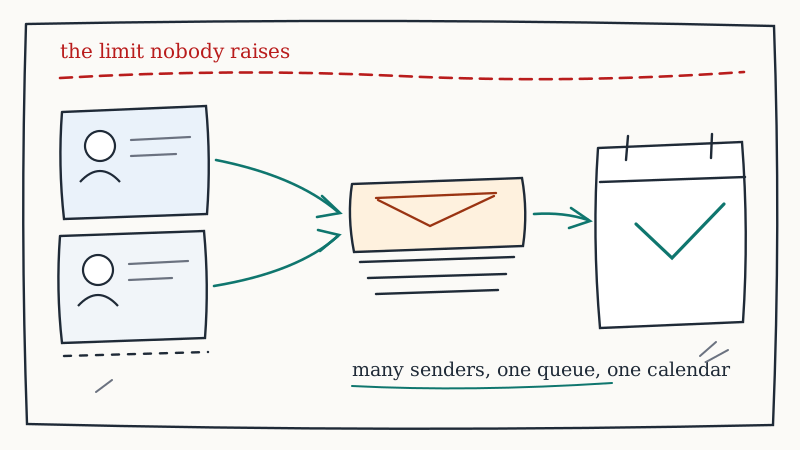
A lift in replies only matters if those replies turn into calendar holds. The handoff from “interested” to “booked” is itself testable, and it is where a lot of pipeline leaks out. Slow, manual scheduling kills warm intent fast.
Test how you convert a positive reply into a meeting: a back-and-forth to find a time, a scheduling link, or a direct calendar invite. Sending a calendar invite the moment someone shows interest, the approach behind Kali, removes the scheduling friction that lets warm replies cool off. Whatever copy test you win up top is wasted if the booking step leaks the meetings you earned.
A simple loop you can run every week
Pull the framework into a repeatable rhythm:
- Hypothesis. Write down the one variable and the outcome metric you expect to move, before you build the variants.
- Clean floor. Validate the list, randomize across infrastructure, and match send timing.
- Run to sample size. Hit the planned volume per variant. No peeking, no early calls.
- Judge on replies and meetings, not opens.
- Log the result. Win, loss, or inconclusive, write down what you learned so the next test builds on it.
- Ship and re-baseline. Roll out the winner, then treat its performance as the new control for the next round.
Run that loop consistently and your outbound stops being a slot machine. Each test compounds into a documented playbook of what works for your market, your persona, and your offer. That compounding is the real return on A/B testing, not any single clever subject line.
The teams that win at cold email are not the ones with the cleverest copy. They are the ones with the most disciplined method for finding out what is actually clever, and the volume and clean infrastructure to prove it.