When to Outsource Outbound Sales vs. Building an In-House SDR Team
Every B2B company eventually reaches the point where founder-led selling cannot scale further. The calendar is full, the pipeline depends on one person’s network, and growth requires a systematic approach to generating qualified conversations. The instinct at this stage is to hire SDRs.
That instinct is often expensive and premature.
Building an in-house SDR team is not just a hiring decision. It is an infrastructure decision that involves recruiting, training, tool procurement, management overhead, and a 3 to 6 month ramp period before you see meaningful pipeline contribution. For companies that get this decision wrong, the cost is not just the salaries. It is the opportunity cost of spending two quarters building something that an external partner could have delivered in weeks.
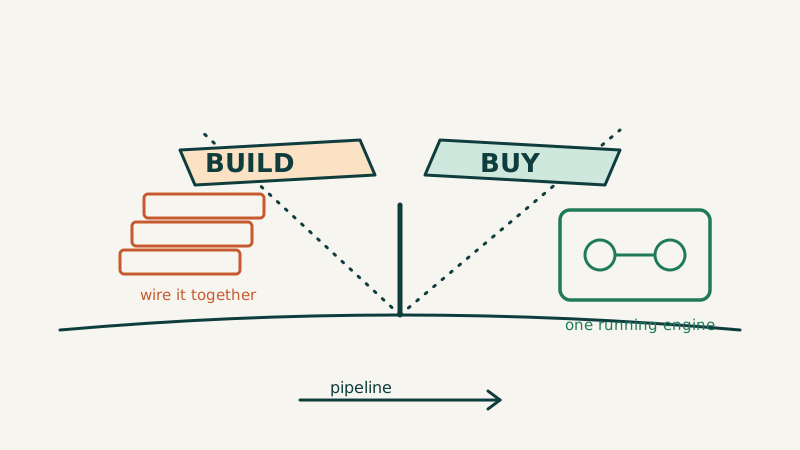
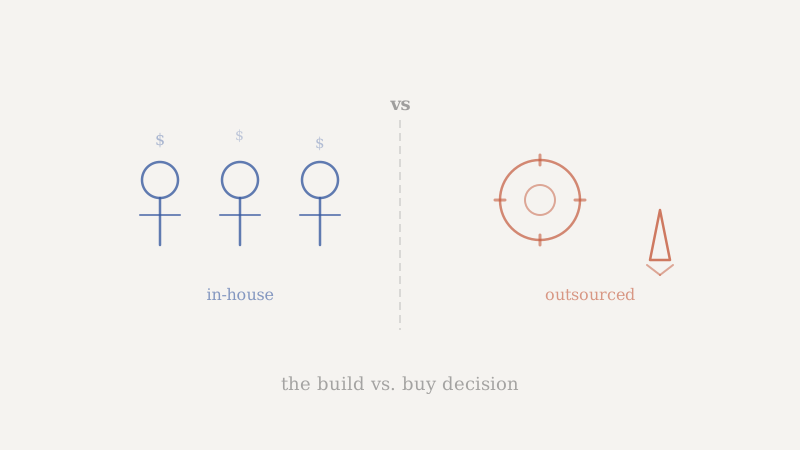
This is not an argument that outsourcing is always better. It is a framework for understanding when each approach makes sense and how to avoid the common mistakes that make either path fail.
The True Cost of an In-House SDR Team
Most founders underestimate the all-in cost of building an SDR function because they anchor on base salary. The reality includes layers of expense that do not show up in a job posting.
Compensation is the starting point, not the total. A competent SDR in a major metro costs $55,000 to $75,000 in base salary plus $15,000 to $30,000 in variable compensation. Add benefits, payroll taxes, and equipment, and you are looking at $90,000 to $130,000 per head before they generate a single meeting.
Tool stack costs add up fast. A functional SDR needs a sequencing tool, a dialer, a data provider, email infrastructure (dedicated sending domains, warmup tools), a CRM seat, and potentially LinkedIn Sales Navigator. Conservative estimate: $500 to $1,500 per SDR per month in tooling. If you are validating email lists properly (and you should be, using a tool like Scrubby to handle catch-all addresses), add that to the stack as well.
Management overhead is unavoidable. SDRs need coaching, call reviews, pipeline reviews, and performance management. If you do not have an existing sales manager, you either need to hire one ($120,000 to $180,000) or divert a founder’s time to management. Neither option is free.
Ramp time delays ROI. A new SDR typically takes 2 to 3 months to reach full productivity. During ramp, they are learning your ICP, refining messaging, building sequences, and making mistakes that experienced outbound operators would avoid. For a team of three SDRs, that ramp period represents $60,000 to $100,000 in compensation before you see consistent pipeline.
Turnover resets the clock. Average SDR tenure is 14 to 18 months. When an SDR leaves, you lose institutional knowledge, restart the hiring process, and re-enter the ramp period. High turnover turns SDR team building into a perpetual recruiting and training exercise.
When In-House Makes Sense
Despite the costs, there are clear scenarios where building internally is the right call.
You have a complex, technical sale. If your product requires deep technical knowledge to prospect effectively, if SDRs need to understand architecture decisions, compliance requirements, or industry-specific workflows to have credible conversations, the learning curve favors in-house. External teams can learn, but the ramp is longer and the quality ceiling may be lower for highly specialized products.
You are post-product-market-fit with proven messaging. If you already know your ICP, have validated sequences, and can point to a repeatable conversion motion from outbound to closed-won, you are ready to scale execution. At this stage, the question is throughput, and in-house gives you direct control over volume and quality.
You need tight feedback loops between outbound and product. Early-stage companies often use outbound conversations as a product research channel. If the primary value of outbound right now is learning what resonates (not just booking meetings), keeping it in-house ensures those insights flow directly to the team making product and positioning decisions.
You are hiring for a career path, not just a function. If your growth plan includes promoting SDRs to AE roles, building the team internally creates a talent pipeline. This long-term investment only pays off if you have the management capacity to develop people, which brings you back to the overhead question.
When Outsourcing Makes Sense
Outsourcing is not a lesser version of building in-house. In many situations, it is the strategically superior choice.
You need pipeline now, not in three months. Outsourced GTM partners like Vendisys bring existing infrastructure, trained operators, and proven processes. The ramp from engagement start to first qualified meetings is typically 2 to 4 weeks, not 2 to 4 months. If your board is asking about pipeline next quarter and you have zero outbound infrastructure today, outsourcing is the only realistic path.
You have not validated your outbound ICP or messaging. Spending $300,000 annually on an in-house team to figure out what works is an expensive experiment. An outsourced partner can test multiple ICPs, value propositions, and channels concurrently, then hand you validated playbooks that an in-house team can execute later. Think of it as paying for learning at a fraction of the cost of learning internally.
Your total addressable market requires multi-channel execution. Effective outbound in 2026 requires coordinated outreach across email, LinkedIn, phone, and increasingly channels like Kali calendar invite outreach. Building the infrastructure and expertise for multi-channel execution in-house means procuring and managing half a dozen tools, training SDRs on each channel, and optimizing conversion across touchpoints. Outsourced partners who operate across these channels daily bring operational maturity that would take an in-house team months to develop.
You are a small team that cannot absorb management overhead. If you have fewer than 50 employees and no VP of Sales, the management burden of an SDR team falls on founders or the first AE. Both options create drag. Outsourcing moves that management responsibility to a partner whose core competency is running outbound teams.
You want to test outbound as a channel before committing. Not every company should do outbound. If you are currently growing through inbound, product-led growth, or partnerships, testing outbound before making a permanent investment is prudent. A 3 to 6 month outsourced engagement gives you the data to make an informed build-vs-buy decision with actual results rather than projections.
The Hybrid Approach
The best-performing B2B companies often run a hybrid model where outsourced and in-house resources serve different functions.
Outsource prospecting, keep closing in-house. Use an external partner for top-of-funnel prospecting (identifying accounts, running sequences, booking initial meetings) while your internal team handles qualification and deal progression. This model works well because prospecting is the most operationally intensive and least strategically sensitive part of the funnel.
Use outsourced partners for new markets. When expanding into a new vertical, geography, or company size segment, outsource the initial prospecting to validate the market before hiring specialized SDRs for it.
Monitor competitive signals externally. Tools like CAM can track competitor activity and feed those signals into your outbound motions, regardless of whether those motions are run in-house or externally. Competitive intelligence should inform your outbound strategy; it does not need to be tightly coupled to who executes the sequences.
Making the Decision: A Quick Framework
Ask these five questions:
- Do I have validated outbound messaging that converts? If no, outsource first to validate.
- Do I need pipeline within 60 days? If yes, outsource. You cannot hire and ramp that fast.
- Do I have a sales manager who can coach SDRs? If no, outsourcing avoids the management gap.
- Is my sale so complex that only deep insiders can prospect effectively? If yes, lean toward in-house.
- Am I building a career development pipeline for future AEs? If yes, in-house creates that path.
If you answered “outsource” to three or more of these questions, start there. You can always build in-house later with the playbooks and learnings from your outsourced engagement.
The Worst Outcome Is Doing Neither Well
The biggest mistake is not choosing the wrong model. It is half-committing to both. Hiring one junior SDR with no management, no tooling budget, and no proven playbook is worse than either fully outsourcing or fully building. A single under-resourced SDR will produce mediocre results that make outbound look like a failing channel when the real problem was under-investment.
If you are going to build, build properly: hire at least two SDRs (they learn faster in pairs), invest in the tool stack, and assign a manager. If you are going to outsource, choose a partner with a track record in your market and commit to the engagement long enough to see real results.
The companies that scale outbound successfully are the ones that make a clear decision and resource it appropriately. Whether that means partnering with Vendisys to get pipeline moving immediately or investing in a team that you build from scratch, the path matters less than the commitment to executing it well.