The True Cost of an In-House SDR: A Fully Loaded Breakdown
When a founder budgets for a sales development rep, they usually anchor on one number: the base salary. They see a posting at $60,000, mentally add commission, and call it $80,000 a year. It feels manageable.
That number is wrong, and not by a little. A fully loaded SDR, the real cost of putting one productive person in that seat for a year, lands far closer to $150,000 once you count everything the base salary hides. Worse, a meaningful share of that spend is committed before the rep books a single meeting.
This is not an argument that SDRs are not worth it. Good ones generate multiples of their cost. It is an argument for budgeting honestly, because the gap between the salary you quote yourself and the cash you actually burn is where early GTM plans quietly fall apart.
The line items everyone counts
Start with the obvious costs, the ones that show up in the offer letter and the comp plan.
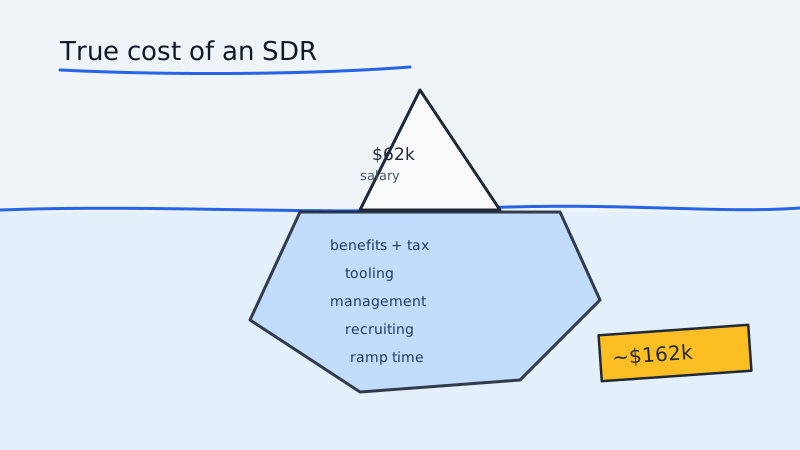
- Base salary: $55,000 to $70,000 for a mid-market SDR in a US metro. Call it $62,000.
- On-target commission: typically 30% to 50% of base. At a $25,000 variable, total cash comp is roughly $87,000.
- Payroll taxes and benefits: employer-side taxes, healthcare, and retirement contributions add 20% to 30% on top of cash comp. Add $22,000.
So far we are at about $109,000, and we have only paid the person. This is where most budgets stop. The expensive part has not started.
The line items almost nobody counts
Tooling. A modern SDR does not work with a phone and a notebook. They need a CRM seat, a sales engagement platform, a dialer, a data and enrichment provider, an email validation tool to keep deliverability intact, and usually an intent or signal layer. Per rep, this stack runs $4,000 to $8,000 a year. Call it $6,000.
Management overhead. Someone has to hire, onboard, coach, and run pipeline for this rep. A sales manager who oversees six SDRs and earns $130,000 distributes roughly $20,000 of fully loaded management cost per rep. Even if a founder does this themselves, the time has an opportunity cost, and founder time is the most expensive time in the company.
Recruiting. Filling the seat is not free. An agency placement runs 15% to 25% of first-year salary. Even with in-house recruiting, sourcing, screening, and interviewing consume real hours. Amortized, budget $8,000 to $15,000 per hire, and more if the first hire does not work out.
Ramp time. A new SDR is not productive on day one. Industry ramp to full quota averages three to five months. During that window you are paying full freight for partial output. If you value that lost productivity conservatively, ramp costs you another $15,000 to $20,000 in the first year alone.
Add these and the picture changes sharply:
| Cost category | Annual amount |
|---|---|
| Cash compensation (base + variable) | $87,000 |
| Payroll taxes and benefits | $22,000 |
| Tooling and data stack | $6,000 |
| Management overhead (allocated) | $20,000 |
| Recruiting (amortized) | $10,000 |
| Ramp productivity loss | $17,000 |
| Fully loaded year-one total | ~$162,000 |
The base salary you started with, $62,000, turns out to be roughly 38% of the real cost. The other 62% is invisible until you add it up.
The cost nobody puts in a spreadsheet: the empty seat
The breakdown above assumes the seat is filled and the rep stays. SDR roles have one of the highest turnover rates in all of sales, with average tenure often cited well under 18 months. When a rep leaves, you do not just restart recruiting. You sit with an empty seat producing zero pipeline while you source, hire, and ramp the replacement, a cycle that easily runs four to six months.
That gap is pure cost with no output. For a company depending on that single rep for pipeline, an empty seat is not a line item, it is a stall in the entire revenue engine. This is the risk that fully loaded math still understates, because it shows up as missed pipeline rather than as a bill.
Why the math favors outsourced infrastructure early
None of this means you should never hire SDRs. At scale, with a proven playbook and a manager who knows how to run the function, in-house teams are powerful. The problem is timing. Carrying $162,000 of committed cost, plus turnover risk, before you have a repeatable, documented outbound motion is how early-stage companies burn runway proving something an outsourced partner could have proven for a fraction of the spend.
Outsourced GTM infrastructure changes the unit economics in three ways. You convert a large fixed cost into a variable one. You skip the recruiting, tooling, and ramp tax because the partner already carries it. And you transfer turnover risk, because keeping the seat filled is the partner’s problem, not yours. This is exactly the model Vendisys is built around: running the outbound engine as managed infrastructure so you get pipeline data without committing to the full fixed cost before you know the motion works.
The deeper benefit is learning. An outsourced engine generates the campaign data, the messaging tests, and the conversion benchmarks that tell you whether outbound works for your market at all. When you eventually do hire in-house, you hire against a proven playbook instead of a hopeful one. We have written before about when to outsource outbound versus building an in-house SDR team, and the cost math here is the quantitative half of that argument.
How to use this number
The practical takeaway is simple: whenever you evaluate an SDR hire, an outsourced partner, or a build-versus-buy decision, use the fully loaded figure, not the salary. Comparing a $7,000-a-month outsourced engagement to a “$62,000” SDR makes outsourcing look expensive. Comparing it to a $162,000 fully loaded rep with turnover risk and a multi-month ramp tells the real story.
The companies that scale outbound efficiently are not the ones that avoid spending on it. They are the ones that know what they are actually spending, and time the commitment to match what they have proven. Budget for the fully loaded SDR, account for the empty seat, and make the build-versus-buy call with the real number in front of you.