How to Structure Your First Outsourced Outbound Pilot Without Burning Budget
You have decided to test outsourced outbound. Maybe your founding team has been running sales themselves and cannot scale it. Maybe you hired two SDRs, watched them ramp for four months, and realized the unit economics do not work at your current stage. Or maybe your board is pushing for faster pipeline growth and you need results before your next quarterly review.
Whatever the trigger, the decision to pilot outsourced outbound is sound. The execution is where most companies get it wrong.
The typical failure pattern looks like this: a company signs a three-month contract with an outbound partner, provides a vague ICP description and a list of 5,000 contacts from ZoomInfo, waits six weeks for results, sees 12 meetings booked (half of which are unqualified), and concludes that outsourced outbound does not work for their business.
The problem was never the channel. It was the pilot structure.
Why Most Outbound Pilots Fail in the First 30 Days
The first month of any outbound pilot is setup, not execution. Companies that expect pipeline in week two are measuring the wrong thing at the wrong time.
ICP definitions are too broad. When you tell an outbound partner to target “VP of Engineering at mid-market SaaS companies,” you have described roughly 40,000 people in North America alone. Without narrowing by tech stack, funding stage, team size, hiring signals, or pain indicators, your partner will burn through contacts with generic messaging that resonates with nobody.
Contact data quality is assumed, not verified. Handing over a purchased list without validation guarantees that 15 to 25 percent of sends will bounce. Those bounces do not just waste money. They damage sender reputation for your domain, which means even your internal sales emails start landing in spam. Before any outbound pilot launches, every contact list needs to go through email verification. Tools like Scrubby are essential here because they resolve catch-all email addresses that standard verification tools mark as “unknown,” which typically represent 20 to 40 percent of B2B contact lists.
Messaging is not tested before scaling. The first sequence your outbound partner sends should not go to 2,000 people. It should go to 200, with two or three messaging variants, measured over two weeks. Scaling before you have a validated message is the fastest way to burn budget.
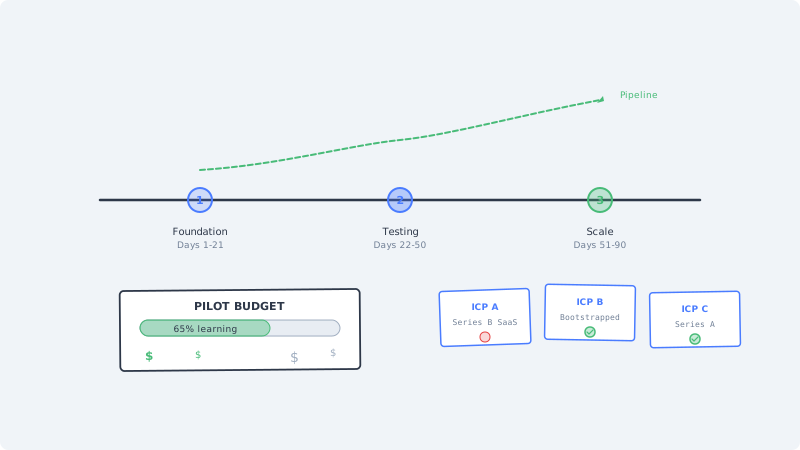
The 90-Day Pilot Framework
Here is how to structure a pilot that generates actionable data, even if the pipeline results are modest.
Phase 1: Foundation (Days 1 to 21)
This phase is about eliminating variables so that when results come in (positive or negative), you know what caused them.
Define three micro-ICPs, not one broad target. Instead of “mid-market SaaS,” define three specific profiles:
- Micro-ICP A: Series B SaaS companies (50-200 employees) that recently hired a VP of Sales, indicating they are building outbound infrastructure
- Micro-ICP B: Bootstrapped SaaS companies ($5M-$15M ARR) with no SDR team on LinkedIn, indicating they handle sales founder-led
- Micro-ICP C: Series A companies that just closed a round, signaling they have budget to invest in growth
Each micro-ICP gets its own messaging, its own contact list, and its own performance tracking. This way you learn which segments respond, not just whether “outbound” works.
Build and validate contact lists per micro-ICP. For each segment, build a list of 300 to 500 contacts. Source from multiple providers (Apollo, ZoomInfo, LinkedIn Sales Navigator) and cross-reference. Run every list through email verification before loading into your sequencing tool. Invalid contacts in a pilot contaminate your data because you cannot distinguish between “the message did not resonate” and “the email never arrived.”
Align on messaging frameworks. Work with your outbound partner to draft two to three sequence variants per micro-ICP. Each variant should test a different angle: pain-point-led, social-proof-led, and question-led approaches all perform differently depending on the segment. Keep initial sequences to three to four touches over 10 days so you get signal quickly.
Phase 2: Testing (Days 22 to 50)
This is the active experimentation phase. Resist the urge to optimize too early.
Launch micro-ICP A first. Send to 150 contacts over the first week. Monitor open rates, reply rates, and bounce rates daily. If bounce rates exceed 3 percent, pause and re-validate the list. If open rates are below 30 percent, the subject lines need work before you scale.
Launch micro-ICP B and C in the second week. Stagger launches by three to four days so you can isolate performance signals. Running all three simultaneously from day one makes it harder to diagnose deliverability issues if they arise.
Track leading indicators, not just meetings. In the testing phase, meetings booked is a lagging indicator. The metrics that actually tell you whether the pilot is working are:
- Positive reply rate (replies that express interest, ask questions, or request information): target 3 to 5 percent
- Bounce rate: must stay below 2 percent
- Opt-out rate: above 3 percent signals messaging or targeting problems
- Reply sentiment distribution: even negative replies contain signal about whether you are reaching the right people with the wrong message or the wrong people entirely
Do not change everything at once. If micro-ICP A shows 1 percent positive reply rate after 150 sends, change the messaging angle first. If that does not move the needle after another 150 sends, question the ICP definition. Changing both simultaneously teaches you nothing.
Phase 3: Scaling What Works (Days 51 to 90)
By day 50, you should have clear signal on which micro-ICP and messaging combination produces positive replies. Now you scale that winner.
Double the send volume on winning segments. If micro-ICP B with pain-point-led messaging produced a 4.5 percent positive reply rate, expand the contact list to 1,000 and maintain the same cadence. Monitor whether performance holds as volume increases.
Add channels to high-performing segments. If email alone is working, layer in calendar invite outreach using Kali for the same contacts. Calendar-based outreach through direct calendar invites often breaks through where email gets filtered, especially with enterprise prospects who receive 80+ emails daily but still review calendar notifications.
Kill underperforming segments decisively. If micro-ICP C produced zero positive replies across 300 contacts and two messaging variants, stop spending on it. A pilot is designed to identify what works, not to prove everything can work.
Build the pipeline math. By day 90, you should be able to calculate:
- Cost per positive reply by micro-ICP
- Positive reply to meeting conversion rate
- Meeting to opportunity conversion rate
- Projected cost per opportunity at scale
These numbers tell you whether outsourced outbound can be a sustainable channel, not whether one pilot “worked.”
Setting Budget Expectations
Most companies overspend on outbound pilots because they allocate budget for volume instead of learning.
Right-size your pilot budget to your learning goals. A well-structured 90-day pilot targeting three micro-ICPs with 500 contacts each requires roughly 1,500 validated contacts total. At current B2B contact data costs plus verification plus sequencing tools, your data and tooling costs should be $2,000 to $4,000. Your outbound partner fees will vary, but for a pilot-scoped engagement expect $5,000 to $10,000 per month.
The total pilot investment should be $17,000 to $34,000 over three months. This sounds like a lot until you compare it to hiring one SDR ($75,000 to $90,000 annual fully loaded cost) who needs four months to ramp and may not work out.
Budget for validation, not just volume. Allocate 10 to 15 percent of your contact data budget specifically for email verification and catch-all resolution. This is not an optional line item. Without it, you are testing your deliverability, not your messaging.
What to Measure at the End of 90 Days
When the pilot concludes, resist the temptation to evaluate it solely on revenue generated. A 90-day outbound pilot rarely produces closed-won revenue because B2B sales cycles extend beyond the pilot window.
Instead, evaluate these outcomes:
Did you identify at least one viable micro-ICP? If one of your three segments produced consistent positive replies above 3 percent, you have product-market signal from the outbound channel. That is a successful pilot, even if total meetings booked were modest.
Do you have enough data to project unit economics? Calculate cost per meeting and cost per opportunity for each segment. If the numbers work at 2x current volume, you have a case to scale. If they only work at 10x volume, the economics are fragile.
Is your domain reputation intact? Check your sender reputation scores. If the pilot damaged deliverability, that cost extends beyond the pilot itself into your marketing emails, transactional messages, and internal sales outreach.
Can you articulate what messaging works and why? The qualitative signal from a pilot is as valuable as the quantitative. Which pain points generated replies? Which social proof points resonated? This intelligence feeds every sales and marketing channel, not just outbound.
Common Pilot Mistakes to Avoid
Starting with your dream account list. Do not burn your top 50 target accounts in a pilot where messaging is unproven. Use the pilot to refine your approach on second-tier targets, then deploy the winning playbook against your highest-value prospects.
Treating outsourced outbound as “set and forget.” Your outbound partner needs weekly input: feedback on reply quality, updates on which meetings converted, shifts in competitive positioning. The companies that get the best results from outsourced outbound treat their partner as an extension of the team, not a vendor.
Ignoring competitive context. If three of your competitors just launched aggressive outbound campaigns targeting the same ICP, your response rates will be lower. Monitor what competitors are doing with tools like CAM so you can adjust messaging to differentiate rather than blend in with the noise.
Not having a handoff process for booked meetings. When your outbound partner books a meeting, what happens next? If the prospect sits in limbo for three days before someone follows up, you just wasted the entire effort. Define the handoff SLA before the pilot starts: who takes the meeting, within what timeframe, and what information gets passed.
After the Pilot: Scale or Walk Away
A well-structured pilot gives you a clear decision point. Either the data supports scaling (viable ICP, sustainable unit economics, intact domain health) or it does not. Both outcomes are valuable.
If you decide to scale, platforms like Vendisys provide the infrastructure to move from pilot to production without rebuilding your outbound engine from scratch. The key is that you are scaling something that you have already proven, not hoping that volume will fix what a pilot could not validate.
If you decide to walk away, you have spent $17,000 to $34,000 to learn definitively that outbound is not the right channel for your current stage, product, or market. That is far cheaper than a 12-month SDR hire that reaches the same conclusion.
Either way, you made the decision with data, not assumptions. That is what a pilot is for.