How to Set Realistic KPIs for Your First Quarter of Outsourced Outbound
You have signed with an outsourced outbound partner. The budget is approved, the SOW is countersigned, and now your leadership team wants to know: what does success look like?
This is the moment where most engagements go sideways. Not because the outbound work is bad, but because the KPIs were wrong from the start. Teams import their inbound conversion expectations, set month-one pipeline targets based on annual goals divided by twelve, and then wonder why their partner “isn’t working” six weeks later.
Outsourced outbound is a different motion with a different ramp curve. If you set the right KPIs for each phase, you will know exactly whether the engagement is on track, even when the pipeline numbers are still small. Here is how to build a measurement framework that gives you signal without triggering false alarms.
The Metrics That Actually Matter for Outsourced Outbound
Before setting targets, you need to agree on which numbers to track. Most teams default to “meetings booked” as the only metric. That is like evaluating a factory by counting finished products while ignoring whether the assembly line is running.
Here are the five core metrics for an outsourced outbound engagement, ordered from leading to lagging indicators:
1. Deliverability Rate
If your emails are not reaching the inbox, nothing else matters. Deliverability should sit above 95% for warmed domains. Below 90% means there is an infrastructure problem that needs immediate attention.
The most common deliverability killer in outbound is list quality. Catch-all domains and risky addresses make up a significant portion of B2B contact databases, and sending to unverifiable contacts burns your sender reputation before real prospects ever see your message. This is why serious outbound teams run every contact through deep validation using tools like Scrubby before loading them into sequences. Standard email verification checks syntax and whether a domain exists. Deep validation actually tests whether catch-all and risky addresses accept mail, which is the difference between a deliverability rate that holds and one that collapses in week three.
2. Reply Rate (Positive and Negative)
Total reply rate tells you whether your messaging is generating any reaction at all. Positive reply rate tells you whether the reaction is useful. Track both.
3. Meeting Conversion Rate
Of the positive replies, how many convert to a booked meeting? This measures both the quality of your targeting and the speed of your follow-up process.
4. Pipeline Generated
Meetings that convert into qualified opportunities with a dollar value attached. This is the metric leadership cares about most, but it is also the most lagging indicator in the stack.
5. Cost Per Meeting and Cost Per Opportunity
The unit economics that determine whether the channel is viable long-term. These numbers are meaningless in month one and only start stabilizing in month three.
Month-by-Month KPI Benchmarks: What Realistic Looks Like
The biggest mistake teams make is applying a single set of targets across all three months. Each month of the first quarter serves a fundamentally different purpose, and your KPIs should reflect that.
Month 1: The Ramp (Infrastructure and Foundation)
Month one is not a revenue month. It is an infrastructure month. Your outsourced team is building sending domains, warming email accounts, defining ICP segments, constructing messaging hypotheses, and assembling validated contact lists. Expecting pipeline from this phase is like expecting harvest in planting season.
Realistic Month 1 KPIs:
- Sending domains purchased, configured, and in active warm-up: 3-5
- ICP segments defined and approved: 2-3
- Messaging angles drafted and reviewed: 3-5 per segment
- Contact lists built and validated: 2,000-5,000 contacts
- Deliverability on warm-up sends: above 97%
- CRM integration live and routing rules tested
- Meetings booked: 0-3 (only from late warm-up sends)
If your partner is reporting 15 booked meetings in month one, they either started blasting before the infrastructure was ready or they are counting every “sure, send me info” reply as a meeting. Both are red flags.
Month 2: The Iteration (Data Replaces Assumptions)
Month two is when sequences go live at meaningful volume and the real data starts flowing. This is the testing phase. Your outsourced team should be running multiple messaging variants, testing different ICP segments, and iterating on sequences based on reply patterns.
Realistic Month 2 KPIs:
- Daily send volume: 100-200 per domain (across multiple warmed domains)
- Deliverability rate: above 95%
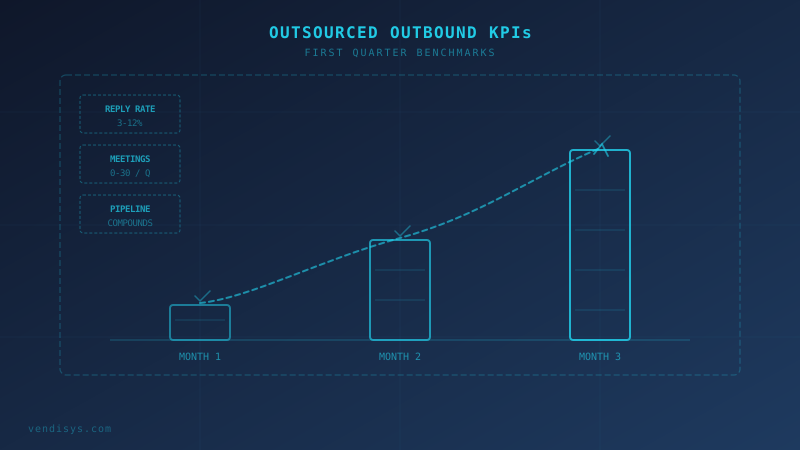
- Total reply rate: 3-8%
- Positive reply rate: 1-3%
- Meetings booked: 5-15
- Pipeline generated: early stage, typically 2-5 qualified opportunities
The wide ranges here are intentional. Month two performance depends heavily on your industry, deal size, buyer persona, and how much iteration the messaging needed after initial sends. A team selling $10K ACV software to mid-market marketing directors will see different numbers than a team selling $200K ACV infrastructure to enterprise CISOs.
What matters more than hitting a specific number is whether the trend is moving in the right direction across month two. Reply rates should increase from the first week to the fourth. Positive reply ratios should improve as messaging gets refined. If both metrics are flat or declining over the course of the month, that is a signal worth investigating.
Month 3: The Compounding (Predictable Pipeline Begins)
By month three, the foundation work pays off. Domains are fully warmed, messaging has been tested and refined, the best-performing ICP segments have been identified, and the outbound engine is running on data rather than assumptions.
Realistic Month 3 KPIs:
- Deliverability rate: above 95%
- Total reply rate: 5-12%
- Positive reply rate: 2-5%
- Meetings booked: 12-30
- Pipeline generated: 8-20 qualified opportunities
- Cost per meeting: starting to stabilize (benchmark: $200-600 depending on market)
- Cost per qualified opportunity: first reliable data point (benchmark: $500-2,000)
Month three is when you can start making meaningful comparisons to other channels. Before this point, unit economics are too noisy to draw conclusions from.
Common Mistakes That Distort Your KPI Framework
Even with the right benchmarks, several common errors can make a healthy engagement look like a failure.
Comparing Outbound to Inbound Conversion Rates
Inbound leads have already expressed interest. They visited your site, downloaded a resource, or requested a demo. Converting them at 20-40% is normal because the intent signal is already there.
Outbound prospects have not raised their hand. You are interrupting their day with a hypothesis about a problem they may or may not be actively trying to solve. A 2-5% positive reply rate on cold outbound is strong performance. Comparing it to inbound’s 20% conversion rate is comparing two fundamentally different motions.
Ignoring the Ramp and Judging at Week Six
Week six falls right in the middle of month two, when sequences are live but iteration has barely started. This is the worst possible moment to evaluate the engagement because you have just enough data to feel confident but not enough for the data to be reliable. Teams that make go/no-go decisions at the six-week mark almost always make the wrong call.
Measuring Only Meetings, Not Meeting Quality
Twenty meetings with unqualified prospects who will never close is worse than five meetings with decision-makers who have budget and a timeline. Track meeting-to-opportunity conversion rate and average opportunity value alongside raw meeting count. A good outsourced partner, like Vendisys, will optimize for pipeline value rather than vanity meeting volume, because the downstream metrics are what actually determine ROI.
Failing to Separate Channel Performance from Execution Quality
If your outsourced team is booking meetings but your AEs are not converting them to pipeline, that is a sales process problem, not an outbound problem. Make sure your KPI framework can distinguish between “outbound is generating the right conversations” and “our internal team is closing those conversations.” Attribution clarity is essential for a fair evaluation.
How to Structure the Pilot Evaluation
At the end of 90 days, you need a clear framework for deciding whether to continue, expand, or end the engagement. Here is a simple evaluation rubric:
Green Light (Continue and Scale)
- Month 3 positive reply rate above 2%
- Meeting-to-opportunity conversion above 30%
- Cost per qualified opportunity within 2x of your target CAC payback
- Clear improvement trend from month 2 to month 3
Yellow Light (Continue With Adjustments)
- Positive reply rates between 1-2% and trending upward
- Meeting volume on track but quality is inconsistent
- Some ICP segments performing well while others are flat
- Engagement needs another 30-60 days of iteration before a final verdict
Red Light (Investigate or End)
- Deliverability below 90% despite proper infrastructure setup
- Positive reply rate below 1% after two months of iteration
- No improvement trend between month 2 and month 3
- Meeting quality consistently poor with no adjustments being made
The key word in the red light category is “despite.” Bad numbers caused by fixable problems (list quality, messaging mismatch, wrong ICP) are not the same as bad numbers caused by fundamental channel-market mismatch. Before ending an engagement, make sure you have diagnosed the root cause.
Building Your KPI Dashboard
Keep the reporting simple. A weekly report with the following columns gives you everything you need:
- Sends: total emails sent that week
- Delivered: deliverability percentage
- Replies: total and positive, with rates
- Meetings: booked that week plus cumulative
- Pipeline: opportunities created plus cumulative value
- Notes: messaging changes, segment shifts, or infrastructure updates
Review weekly, but evaluate monthly. The weekly cadence catches problems early (deliverability drops, reply rate collapses). The monthly evaluation is where you assess whether the engagement is tracking toward the 90-day benchmarks.
The Bottom Line
Setting realistic KPIs for outsourced outbound comes down to respecting the ramp cycle. Month one is infrastructure. Month two is iteration. Month three is where compounding begins. Teams that build their measurement framework around this reality make better decisions, give their partners a fair chance to deliver results, and end up with a predictable pipeline channel that scales.
If you are evaluating outsourced outbound partners or preparing to launch your first engagement, Vendisys helps B2B teams build pipeline through structured outbound programs designed around realistic timelines and transparent KPI reporting. The first quarter is an investment in learning what works. The quarters that follow are where that investment compounds.