An SDR books a meeting. The account executive shows up, opens with a generic discovery question, and the prospect thinks, “I already told your colleague all of this.” Ten minutes in, the AE realizes the lead was never really qualified, or worse, the meeting quietly no-shows because nobody confirmed it after the booking. Either way, the pipeline that looked healthy in the dashboard evaporates.
The handoff between the SDR who sources a meeting and the AE who runs it is one of the most under-engineered moments in all of outbound. Teams pour effort into prospecting, sequencing, and objection handling, then treat the transfer of a hard-won lead as an afterthought. That gap is where deals stall, meetings ghost, and the two halves of the sales org start blaming each other. This is a walkthrough of how to build a handoff process that keeps momentum intact.
Why the handoff breaks
Most handoff failures trace back to one of three root causes, and none of them are about effort.
The first is a definition problem. The SDR thinks “booked a meeting” means the job is done. The AE thinks “qualified lead” means budget, authority, need, and timeline are all confirmed. When those two definitions do not match, every handoff becomes a negotiation, and the AE learns to distrust anything the SDR sends over.
The second is an information problem. The SDR gathered real context on the call, the pain the prospect described, the trigger event that made them respond, the competitor they mentioned, and then none of it makes it to the AE. The notes are one line in the CRM, or they live in the SDR’s head. The AE walks in blind and burns the first third of the meeting re-discovering what was already known.
The third is a continuity problem. There is a gap of three or five days between the SDR booking and the AE meeting. Nobody owns that window. No confirmation, no reminder, no warm introduction. The prospect’s interest cools, a competing priority takes over their calendar, and the meeting slips or vanishes.
Fix those three and the handoff stops being a leak.
Define “qualified” before anyone hands off anything
You cannot have a clean handoff without a shared, written definition of what qualifies a lead to reach an AE. This is the single highest-leverage fix, and it costs nothing but a meeting between your SDR and AE leads.
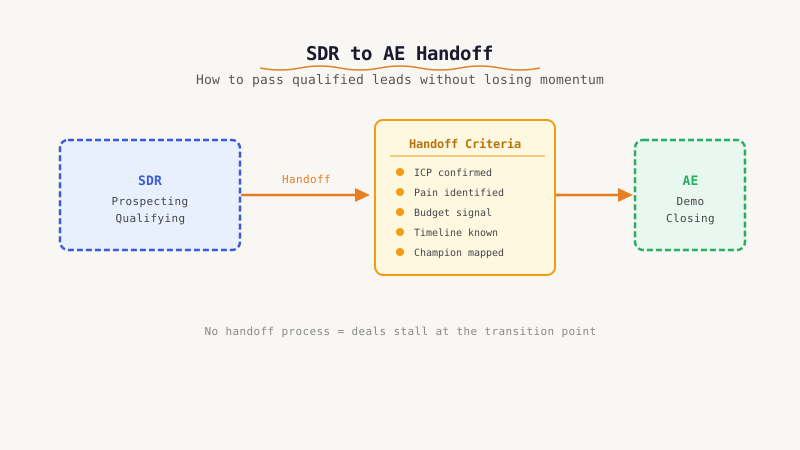
Write down the criteria explicitly. A workable baseline for most B2B outbound teams looks like this:
- The contact matches your ICP on company size, industry, and role.
- A specific pain or use case has been named by the prospect, not assumed by the rep.
- There is at least a directional signal on budget or the ability to fund a solution.
- A rough timeline or trigger event exists, so the meeting is not purely educational.
- The person taking the meeting is either the decision maker or a credible champion who can bring one in.
The point is not to make the bar so high that SDRs book nothing. The point is to make the bar visible so both sides agree on it. Some teams run a lighter bar for outbound-sourced meetings than for inbound demo requests, and that is fine, as long as the AE knows which bar was used. When the definition is shared, the AE stops second-guessing every meeting and the SDR stops feeling like their work gets rejected at random.
Build a handoff packet, not a calendar invite
A meeting on the calendar is not a handoff. The handoff is the context that travels with it. The best teams standardize a short handoff packet that the SDR fills out the moment a meeting is booked, while the call is still fresh.
Keep it tight enough that reps will actually complete it. Five fields is plenty:
- Why now. The trigger that made this prospect respond. A funding round, a new hire, a tool they are ripping out, a mandate from leadership.
- The pain in their words. A direct quote or close paraphrase of the problem they described. Not your product’s benefit, their problem.
- What they use today. The incumbent tool, process, or workaround, and whether they are actively unhappy with it.
- Stakeholders. Who else touches this decision, and whether the person on the call is the buyer or the champion.
- Landmines. Anything the AE should not step on. A bad past experience with a vendor, a hard budget ceiling, a skeptical CFO.
This packet lives in the CRM opportunity record, not in a Slack message that scrolls away. When the AE preps for the meeting, everything they need is in one place. The prospect feels like they are talking to one company instead of two strangers, and the meeting starts at discovery depth instead of introductions.
Own the gap between booking and meeting
The days between when an SDR books and when an AE meets are a no-mans-land, and no-mans-land is where meetings die. Assign ownership of that window explicitly.
A simple, effective pattern: the SDR sends a confirmation the same day, ideally a short message that reiterates the value of the meeting and, where possible, introduces the AE by name. “I have set you up with Priya, who works with teams in exactly your situation. She will walk you through how this looks for a company your size.” That warm pass does two things. It transfers trust from the SDR the prospect already talked to, and it makes the AE a known quantity rather than a stranger.
Then add a reminder the day before. This is not micromanagement, it is the difference between a fifteen percent no-show rate and a five percent one across a quarter. If your team is not tracking no-show rate as a first-class metric, start, because it is often the largest single source of wasted AE capacity.
For teams running high outbound volume, this gap management is exactly the kind of process discipline that is easy to design and hard to sustain in-house, which is one reason companies lean on a partner like Vendisys to run the full outbound motion with the handoff mechanics already built in.
Close the loop back to the SDR
Handoffs are usually described as one-directional, SDR to AE. The teams that compound over time make it a loop. After the meeting, the AE sends a two-line disposition back to the SDR: did the lead qualify, and if not, why.
This feedback is what makes SDRs better at qualification. Without it, an SDR keeps booking the same weak meetings because nothing tells them the meetings were weak. With it, they learn which signals actually predict a real opportunity and which ones they were over-weighting. Over a few months, the quality of what reaches the AE climbs on its own, because the people sourcing the meetings finally have a scoreboard for quality and not just quantity.
Some teams formalize this with a shared, simple disposition field on the meeting record: qualified, disqualified, or reschedule, plus a one-line reason. It takes the AE fifteen seconds and it is the closest thing to a free improvement your funnel has.
Instrument the handoff so you can see it
You cannot fix what you cannot see. Put numbers on the handoff so it stops being anecdotal:
- Meeting held rate. Of meetings booked, how many actually happened. This exposes the gap-management problem directly.
- Accepted rate. Of meetings held, how many the AE agreed were genuinely qualified. This exposes the definition problem.
- Handoff to opportunity rate. Of qualified meetings, how many converted to a real opportunity. This is your north star for handoff quality.
When these three numbers are visible in a weekly review, the SDR and AE teams stop arguing from opinion. A low held rate points at confirmations and reminders. A low accepted rate points at the qualification bar. A low opportunity rate points at the packet and the depth of discovery. Each symptom has a specific owner and a specific fix.
The handoff is a system, not a moment
The mistake most teams make is treating the handoff as a single event, the calendar invite that moves a lead from one rep to another. It is not an event. It is a small system with a shared definition, a context packet, gap ownership, and a feedback loop. Build those four pieces and the transition stops leaking pipeline.
If your team is scaling outbound and the SDR-to-AE seam is where meetings keep slipping, it is worth stepping back to ask whether the process is the bottleneck or the capacity to run it is. Building and staffing this motion end to end is exactly the kind of GTM infrastructure that Vendisys builds and operates for companies that would rather buy a working outbound engine than spend two years assembling one. Either way, the fix starts the same place: write down what qualified means, and never hand off a lead without the context that made it worth handing off.