Speed to Lead Is Killing Your Pipeline: How Outsourced GTM Infrastructure Fixes Response Time
A lead fills out your demo request form at 2:14 PM on a Tuesday. Your SDR sees the notification at 3:45 PM, between back-to-back calls. They draft a personalized email, pull up the prospect’s LinkedIn, check the CRM for prior touchpoints, and hit send at 4:22 PM.
That is two hours and eight minutes. In that window, the prospect has already visited two competitor websites, booked a demo with one of them, and mentally moved on from your product.
This is not a hypothetical. Research consistently shows that the probability of qualifying an inbound lead drops by 10x after the first five minutes. After 30 minutes, most leads are effectively cold. Yet the average B2B response time to inbound leads sits somewhere between 42 hours and never.
The gap between knowing this matters and actually fixing it is where most revenue teams get stuck.
Why Speed to Lead Fails at Most Companies
The problem is not awareness. Every sales leader knows that faster response times convert better. The problem is structural. Most B2B organizations are not built to respond to leads in under five minutes, and no amount of Slack notifications or CRM automations will fix the underlying constraints.
SDRs have competing priorities. Your reps are prospecting, running sequences, preparing for meetings, and updating CRM records. An inbound notification is one signal among dozens competing for their attention. Even the most disciplined rep cannot drop everything instantly for every form fill.
Coverage gaps are unavoidable. Leads arrive at all hours, but SDR teams work fixed shifts. A demo request that comes in at 6:47 PM sits untouched until 9 AM the next morning. Weekend leads wait until Monday. International prospects in different time zones hit your form when your team is asleep.
Routing adds latency. Before a lead even reaches a rep, it passes through routing logic: territory assignment, round-robin distribution, account matching, duplicate checking. Each step adds seconds or minutes. Manual routing (which is still common) can add hours.
Personalization takes time. The follow-up that converts is not a generic template. Reps need to research the company, understand the use case, reference relevant case studies, and tailor the message. Quality and speed are in constant tension when a human is doing both.
Rep capacity has hard limits. An SDR handling 40 to 60 outbound touches per day has limited bandwidth for inbound follow-up. When inbound volume spikes (after a webinar, product launch, or content campaign), response times degrade because the same team is absorbing more demand without more capacity.
The Math on Lost Pipeline
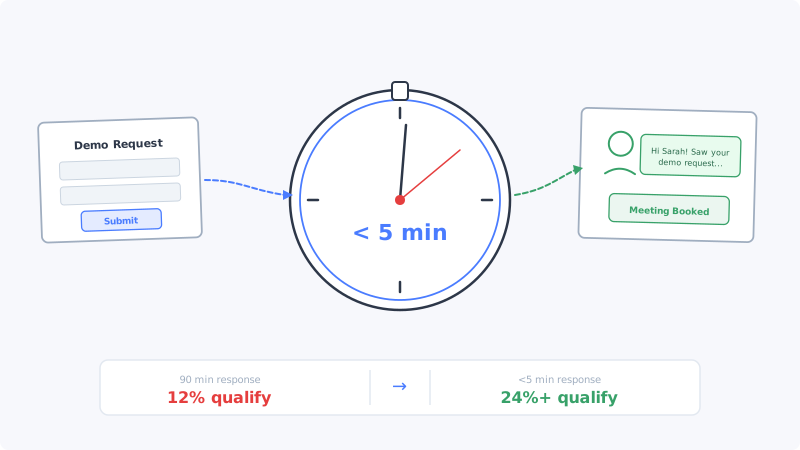
Consider a simple scenario. Your team generates 200 inbound leads per month. Your current average response time is 90 minutes. At that speed, you qualify about 12 percent of leads into pipeline.
If you cut response time to under five minutes, qualification rates typically double or more, based on data from InsideSales.com and Drift. That means moving from 24 qualified opportunities to 48 or more per month, with the same lead volume and the same product.
That is not a marginal improvement. That is doubling your pipeline without spending another dollar on demand generation, content marketing, or paid acquisition.
Now multiply that by your average deal size and win rate. For a company with a $25,000 ACV and a 25 percent close rate, the difference between 24 and 48 qualified opportunities is $150,000 in additional revenue per month. All from responding faster to leads you are already generating.
Why Technology Alone Does Not Fix This
Most teams try to solve speed to lead with technology. They add chatbots, set up Slack alerts, configure round-robin routing, and build Zapier workflows. These tools help, but they address symptoms rather than root causes.
Chatbots handle volume, not quality. A chatbot can respond instantly, but it cannot have the nuanced conversation that qualifies a high-intent lead. Prospects who fill out demo request forms expect to talk to a person, not navigate a decision tree. Chatbots are useful for simple qualification questions but fall short on complex B2B sales motions.
Routing automation reduces assignment time, not response time. Automatically assigning a lead to a rep in 30 seconds is meaningless if the rep does not act on it for an hour. The bottleneck is human action, not system processing.
Alerting creates noise, not action. After the first week of Slack pings for every form fill, reps start ignoring notifications. Alert fatigue is real, and it worsens as inbound volume increases.
The fundamental issue is that speed to lead requires dedicated, always-available human capacity focused exclusively on inbound response. Most companies cannot justify hiring a team solely for that function.
How Outsourced GTM Infrastructure Solves the Problem
Outsourced GTM infrastructure, like what Vendisys provides, eliminates the structural constraints that make fast response times impossible for in-house teams.
Dedicated inbound response capacity. Instead of asking SDRs to split attention between outbound prospecting and inbound follow-up, outsourced infrastructure provides dedicated capacity for inbound response. Leads are handled by reps whose sole focus is engaging new inquiries, which eliminates the competing-priorities problem entirely.
Full coverage across time zones. An outsourced GTM provider can staff response capacity across time zones and business hours, ensuring that a lead arriving at 7 PM or on a Saturday gets the same sub-five-minute response as one arriving at 10 AM on a Tuesday. Coverage gaps disappear.
Automated routing with human follow-through. The best outsourced GTM setups combine automated lead routing with human engagement. The system handles assignment instantly; the rep handles the personalized response. Neither step becomes a bottleneck because both are purpose-built for speed.
Scalable capacity during demand spikes. After a webinar generates 300 leads in 48 hours, an outsourced team can absorb the surge without degrading response times. In-house teams either respond slowly during spikes or maintain excess capacity during normal periods. Neither is efficient.
Process standardization without internal politics. Outsourced teams follow defined playbooks for lead engagement. There is no debate about which rep gets which lead, no territory disputes, and no variation in follow-up quality. The process runs the same way every time.
Building the Speed-to-Lead Workflow
Here is what an effective outsourced speed-to-lead system looks like in practice.
Lead capture. The prospect fills out a form on your website, clicks a calendar link, or responds to an outbound campaign. The lead enters your CRM and the outsourced system simultaneously.
Instant qualification. Within 60 seconds, the lead is scored based on firmographic data, intent signals, and form responses. High-intent leads (demo requests, pricing inquiries) are flagged for immediate human follow-up. Lower-intent leads (content downloads, webinar registrations) enter appropriate nurture sequences.
Personalized outreach. For high-intent leads, a dedicated rep reviews the prospect’s company, role, and stated needs, then sends a personalized email and schedules a call or books a meeting. This happens within the first five minutes of submission.
Multi-channel follow-up. If the prospect does not respond to the initial email, the system triggers a multi-channel sequence: a follow-up email, a LinkedIn connection request, and a phone call, all within the first 24 hours. Tools like Kali can support calendar-based outreach that gets directly onto the prospect’s calendar, increasing the chance of a live conversation.
Handoff to your sales team. Once the lead is qualified and a meeting is booked, it is handed off to your closer with full context: the prospect’s stated needs, company background, and the conversation so far. Your AE walks into the call prepared, not cold.
Measuring Speed to Lead Correctly
Most teams measure speed to lead wrong. They track the time between form submission and first email sent. But the metric that actually matters is time to meaningful engagement: when a human conversation with the prospect begins.
An auto-reply email sent in 30 seconds does not count as speed to lead. A personalized email from a rep at the 4-minute mark, followed by a phone call at the 15-minute mark, is meaningful engagement. That is what correlates with higher qualification rates.
Track these metrics instead:
Time to first personalized touch. How long between form submission and a rep sending a personalized (not automated) message? Target: under 5 minutes for high-intent leads.
Time to first live conversation. How long until the prospect actually speaks with someone? This is the metric that predicts pipeline conversion most accurately.
Response rate by response time bucket. Group your leads by how quickly they received a response (0 to 5 minutes, 5 to 30 minutes, 30 minutes to 2 hours, 2 hours plus) and compare qualification rates across buckets. This gives you the empirical data to justify investing in faster response.
Coverage rate. What percentage of leads receive a response within your target window? If your goal is sub-five-minute response and you hit it 60 percent of the time, you are still losing 40 percent of your potential pipeline to slow response on the remaining leads.
Validating Your Lead Data for Speed
Fast response is only valuable if you are responding to real prospects. When inbound volume increases (especially from content campaigns, paid ads, or webinar registrations), the percentage of invalid or low-quality submissions rises with it.
Before routing leads for immediate follow-up, validate the email addresses in your inbound funnel. Tools like Scrubby can verify email deliverability, including catch-all addresses that standard validators leave unresolved. This prevents your response team from wasting their five-minute window chasing leads that submitted fake email addresses or typo-filled forms.
Clean data feeds faster response. If your rep pulls up a lead, sees a clearly invalid email, and has to spend time investigating whether the prospect is real, you have already burned the response window. Validation before routing keeps the speed-to-lead machine running on verified contacts only.
The Compounding Effect of Fast Response
Speed to lead does not just improve conversion rates on individual leads. It creates a compounding effect across your entire pipeline.
Higher qualification rates mean more opportunities per rep, which improves rep productivity metrics and reduces cost per qualified opportunity.
Better prospect experience generates stronger word of mouth and referral pipeline. Prospects who receive fast, personalized follow-up remember it, even if they do not buy immediately.
Cleaner pipeline data from higher engagement rates makes forecasting more accurate, which improves planning and resource allocation.
Reduced lead acquisition cost. When you convert a higher percentage of existing leads, you need fewer total leads to hit pipeline targets. That means your demand generation budget goes further.
The companies that consistently respond in under five minutes are not just winning more deals today. They are building a structural advantage that compounds over quarters and years, because their competitors are still responding in two hours.
Making the Shift
If your team is averaging more than 15 minutes to respond to high-intent inbound leads, the cost of inaction is measurable and growing. Every day of slow response is pipeline you are generating, paying for, and then losing to timing.
Outsourced GTM infrastructure from Vendisys removes the structural barriers to fast response without requiring you to hire, train, and manage an in-house team dedicated solely to inbound speed. The economics typically pay for themselves within the first quarter, and the pipeline impact is visible within weeks.
Speed to lead is not a nice-to-have metric for sales ops dashboards. It is the single highest-leverage fix most B2B teams are ignoring.