How to Re-Engage Closed-Lost Deals With an Outbound Sequence
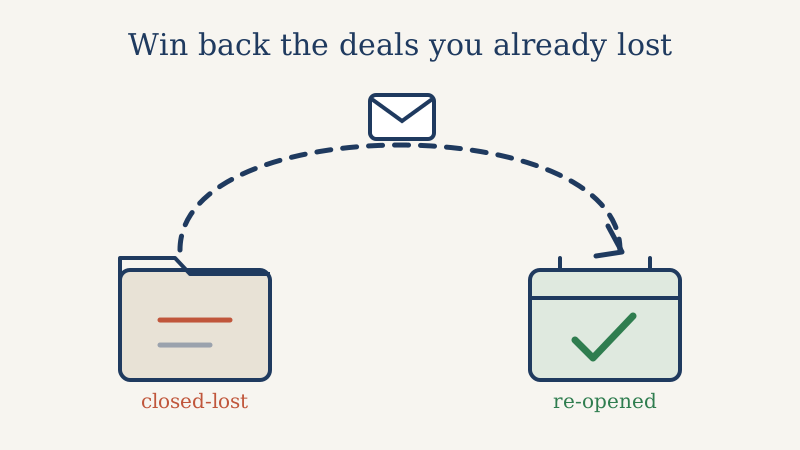
Every CRM is sitting on a graveyard of deals that almost closed. The buyer liked the product, the timing was wrong, the champion left, the budget got frozen, or a competitor won on a feature that you have since shipped. Most teams mark these “closed-lost” and never look back.
That is a mistake. Closed-lost accounts are the warmest cold list you will ever work. They already know who you are, they already had a need, and the original objection has often expired. Re-engaging them costs a fraction of net-new prospecting and converts at a higher rate, because you are restarting a conversation instead of starting one.
The catch is that you cannot just blast your closed-lost segment with the same pitch that lost the first time. You need a deliberate sequence built around what changed. Here is how to do it.
Why closed-lost is your cheapest pipeline source
Net-new outbound means buying or building a list, validating it, warming domains, and earning attention from people who have never heard of you. A closed-lost re-engagement skips most of that. The relationship exists. The pain was real enough to run an evaluation. And the reasons deals die are usually temporary:
- Timing. “Not this quarter” is the most common loss reason, and quarters end.
- Budget. Frozen budgets thaw, and new fiscal years reset the math.
- Champion turnover. Your old champion may now be at a new company that also needs you, while their replacement inherits the same problem.
- Feature gaps. Roadmaps move. The dealbreaker from twelve months ago may be shipped and in GA today.
- Competitor fatigue. Buyers who picked a competitor are often unhappy a year into the contract and shopping again before renewal.
Each of those is a trigger you can build a sequence around. The goal is not to relitigate the old loss. It is to give the buyer a reason the situation is different now.
Step 1: Clean and segment the list before you send a single email
Closed-lost data decays faster than almost any other segment. People change jobs, companies get acquired, and email addresses go dead. If your last contact with an account was eight months ago, assume a meaningful chunk of those addresses no longer route to a human.
Sending to a stale closed-lost list is the fastest way to torch your sender reputation, because dead addresses produce hard bounces and spam traps. Before you build the sequence, run the entire segment through verification. Tools like Scrubby catch the dead and risky addresses that accumulate in any aging list, so your re-engagement campaign lands in inboxes instead of triggering bounces that follow you into your net-new sends.
Once the list is clean, segment by loss reason. You should not write one sequence for the whole graveyard. At minimum, split into:
- Lost to timing or budget (the easiest revival, lead with what changed on your side or theirs)
- Lost to a competitor (time these near the prospect’s renewal window)
- Lost to a feature gap (lead with the specific capability you now ship)
- Champion left (treat as net-new to the new contact, but reference the prior evaluation)
Each segment gets its own angle. A generic “just checking in” works for none of them.
Step 2: Find the trigger that makes now different
The single most important word in a re-engagement email is “because.” Nobody reopens a closed deal for “just following up.” They reopen it because something changed. Your job is to name that change in the first two lines.
Good triggers, by segment:
- Timing or budget: A new fiscal year, a funding round the prospect just raised, a hiring spree, or a public announcement that signals they are scaling the exact function you support.
- Competitor: Their incumbent vendor raised prices, had an outage, got acquired, or is approaching the prospect’s renewal date. Renewal windows are the highest-intent moment in the entire cycle.
- Feature gap: You shipped the specific thing they asked for. Be precise. “You said you needed SSO and per-seat reporting. Both shipped in March.”
- Champion left: The original champion moved to a new company. Reach out to them there, and separately re-introduce yourself to whoever inherited their old seat.
If you sell into a market where competitive signals matter, monitoring those triggers manually does not scale. Watching competitor pricing pages, status pages, and changelogs for the moment a prospect’s incumbent stumbles is exactly the kind of work that a tool like CAM automates, so your reps get an alert the week a renewal conversation becomes winnable instead of finding out a quarter too late.
Step 3: Build the sequence (a five-touch template)
Keep it short and changed-focused. A re-engagement sequence should run roughly two to three weeks across four to five touches, mixing channels.
Touch 1 (Day 1) email. The “because” email. One reason the situation is different, one sentence of proof, one soft ask. No deck, no calendar spam. Example: “When we last spoke you held off on a decision until the new budget cycle. That cycle just opened, and we shipped the reporting view your team flagged. Worth a 15-minute look at what changed?”
Touch 2 (Day 3) LinkedIn. A light connection or comment. No pitch. You are just making your name familiar again before the next email.
Touch 3 (Day 6) email. Proof and specificity. Share a short, relevant result from a similar account that revived after a loss. Tie it back to their original use case.
Touch 4 (Day 10) calendar-first. This is where re-engagement sequences usually stall: the buyer is mildly interested but will not click through a generic “book a time” link. Lowering the friction to the actual meeting is what converts warm interest into a held slot. A calendar-invite outreach motion like Kali puts a real, ready-to-accept invite in front of the buyer instead of one more “are you free?” email, which is the difference between a reply and a booked meeting.
Touch 5 (Day 14) breakup. The polite close. “I will assume the timing still is not right and stop reaching out. If that changes, you know where to find me.” Breakup emails consistently produce some of the highest reply rates in any sequence, because they give the buyer a deadline.
Step 4: Measure revival rate, not just reply rate
Closed-lost campaigns need their own scorecard. Replies feel good but the metric that matters is revival rate: the percentage of worked closed-lost accounts that re-enter an active sales stage. Track it by loss-reason segment so you learn which triggers actually move deals.
Watch these:
- Revival rate by segment. Competitor-renewal and feature-gap segments usually outperform pure timing.
- Meetings booked per 100 worked. Your efficiency benchmark against net-new outbound.
- Time-to-second-meeting. Revived deals often move faster than net-new, because the evaluation groundwork already exists.
- Win rate on revived deals. The number that justifies running the program every quarter.
Step 5: Make it a recurring motion, not a one-time cleanup
The teams that win here do not run a closed-lost campaign once. They run it on a cadence: every closed-lost deal gets re-worked 90, 180, and 365 days after the loss, with the angle refreshed each time based on what has changed. That requires discipline, clean data, and someone owning the motion week over week.
This is precisely the kind of repeatable, unglamorous outbound work that gets dropped when an in-house team is buried in net-new quota. Running closed-lost revival as a dedicated, always-on motion is a core piece of the outsourced GTM infrastructure that Vendisys builds for teams that want pipeline from the deals they already paid to source, not just the ones they have yet to find.
The takeaway
Closed-lost is not a dead end. It is a backlog of pre-qualified demand waiting for the right “because.” Clean the list so you do not burn your domain, segment by why each deal died, build the sequence around what changed, lower the friction to the meeting, and measure revival rate instead of vanity replies. Done consistently, re-engaging closed-lost deals is the cheapest reliable pipeline most teams are completely ignoring.