Why You Should Outsource Outbound Before Series A to Protect Runway and Build Pipeline
Most startup founders make the same hiring mistake between seed and Series A. They close their seed round, feel the pressure to show traction, and immediately start recruiting salespeople. A VP of Sales, two SDRs, maybe a BDR. Within three months, they have burned through $150K to $250K in salary, tools, and onboarding costs. Six months in, the pipeline is thin, close rates are uncertain, and the board is asking hard questions about burn rate.
The problem is not that sales hiring is wrong. The problem is the timing. Building a full internal sales function before you have validated your outbound motion, your ICP, your messaging, and your conversion benchmarks is a bet with asymmetric downside. If it works, great. If it does not, you have spent half your runway learning what does not work while locked into fixed headcount costs.
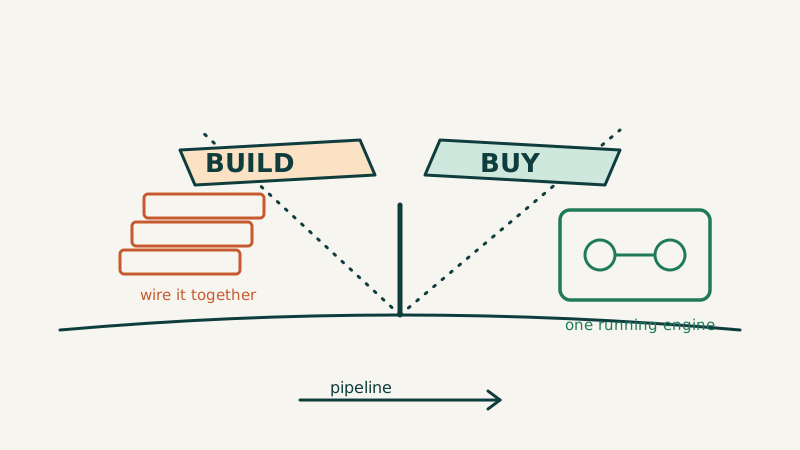
Outsourcing outbound before Series A flips the risk profile. You get pipeline, data, and validated playbooks without the fixed overhead. When you do eventually hire, you hire into a proven motion rather than building from scratch.
The Real Cost of Hiring Sales Too Early
Founders underestimate the fully loaded cost of an early sales team. The salary line is just the start.
Recruiting costs. Finding good SDRs takes time. If you use a recruiter, expect 15 to 25 percent of first-year compensation as a placement fee. If you recruit yourself, budget 40 to 80 hours of founder time across sourcing, screening, interviewing, and closing candidates. That time comes directly from product, customer success, and fundraising.
Tool stack. A working outbound motion requires a CRM, a sequencing tool, a data provider for prospecting, email warmup infrastructure, and analytics. Budget $500 to $2,000 per seat per month for a functional sales tech stack. For two SDRs and a manager, that is $1,500 to $6,000 monthly before a single email goes out.
Ramp time. New SDRs at early-stage companies take 60 to 90 days to become productive, and that assumes good onboarding, clear messaging, and a defined ICP. At a pre-Series A startup, none of those assets are typically ready. The ramp time stretches to four or five months while the SDR figures out the market alongside the founders.
Management overhead. Someone has to manage the SDRs. At most early-stage companies, that someone is the CEO or a co-founder. Every hour spent on pipeline reviews, call coaching, and CRM hygiene is an hour not spent on product or fundraising.
Separation costs. If the hire does not work out (and at early stage, turnover is higher than at established companies), you face severance, re-recruiting, and another ramp cycle. The reset can cost three to six months of progress.
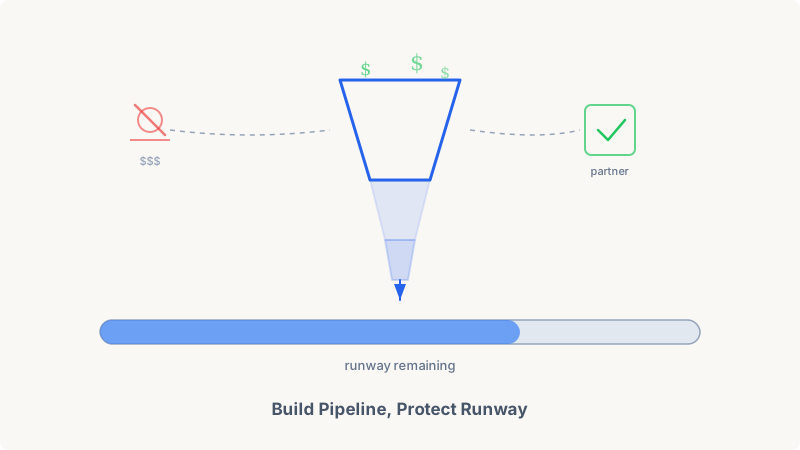
Add it up. A two-person SDR team with a fractional manager costs $200K to $400K annually when you include salary, tools, recruiting, and overhead. For a company with $1M to $2M in seed funding, that is 10 to 40 percent of total runway committed to a single, unvalidated function.
What Outsourced Outbound Actually Looks Like
Outsourcing outbound does not mean handing your sales to strangers and hoping for the best. A well-structured outsourced engagement works as an extension of your team, with clear ownership, transparent metrics, and direct access to the people doing the work.
The typical structure involves a dedicated outbound team that handles prospecting, list building, email and multi-channel sequencing, and meeting booking. The outsourced partner provides the infrastructure (tools, domains, warmup) and the operators (trained SDRs or BDRs with experience across multiple campaigns and verticals).
Vendisys operates this model specifically for B2B companies that need pipeline without premature headcount. The team runs outbound campaigns across email, LinkedIn, and calendar invite outreach through Kali, providing the multi-channel coverage that a solo SDR hire would take months to build.
What the founder provides: ICP definition, product knowledge, and feedback loops. What the outsourced partner provides: execution infrastructure, campaign management, deliverability expertise, and pipeline data.
The engagement typically runs month to month with a 30-day notice period, compared to the multi-month commitment of a salaried hire. If the ICP needs to change, the messaging needs a rewrite, or the entire outbound strategy needs a pivot, the adjustment happens in days rather than quarters.
The Data Advantage: Learning Before Committing
The most valuable output of outsourced outbound is not the meetings booked. It is the data.
When you run outbound through an experienced partner, you generate structured data about your market at a pace that internal experimentation cannot match. Open rates by persona, reply rates by messaging angle, conversion rates by company size, response patterns by industry vertical. This data tells you exactly who your buyer is, what they respond to, and where your product positioning resonates.
Founders who hire internally first generate this data too, eventually. But they generate it slowly, expensively, and with high variance because the SDR is learning both the role and the market simultaneously. An outsourced team has the execution mechanics down; the only variable they are testing is your specific market.
After 60 to 90 days of outsourced outbound, you have a dataset that answers critical questions for your Series A:
- Which ICP segments convert at the highest rate?
- What messaging frameworks generate replies?
- What is the realistic conversion rate from first touch to meeting?
- What is the average deal cycle length by segment?
- Which objections come up repeatedly (and need product or positioning fixes)?
These answers make your Series A pitch stronger because you can show investors a validated, repeatable sales motion rather than a plan. They also make your eventual sales hires dramatically more effective because you hand them a proven playbook on day one.
When Outsourced Outbound Fits Best
Not every startup should outsource outbound. The model works best in specific conditions.
Pre-Series A with limited runway. If you have 12 to 18 months of runway and need to show traction without betting half your capital on headcount, outsourcing is the highest-leverage option.
Undefined or shifting ICP. If you are still testing which market segment is your best fit, outsourced outbound lets you run parallel experiments across segments without hiring specialists for each.
Founder-led sales transitioning to team-based. If the CEO has been closing deals personally and needs to extract that motion into a repeatable process, an outsourced team is the right bridge. They can test different messaging, sequences, and channels while the founder focuses on closing the opportunities that come in.
First outbound motion. If the company has grown through inbound, product-led growth, or referrals and is launching outbound for the first time, outsourcing provides experienced operators who have built outbound motions before.
How to Evaluate an Outsourced Outbound Partner
Not all outsourced outbound providers are equal. The difference between a good partner and a bad one is the difference between validated pipeline and burned budget.
Ask about deliverability infrastructure. Email deliverability is the foundation of outbound. Ask how the partner manages domain reputation, warmup, sending limits, and bounce handling. A partner that sends from your primary domain without proper warmup will damage your sender reputation. A good partner maintains dedicated sending domains with proper authentication, gradual warmup, and continuous monitoring. They should also be using tools like Scrubby to validate email lists and handle catch-all addresses before any campaign sends.
Ask about multi-channel execution. Email-only outbound is increasingly difficult due to inbox competition and filtering. A capable partner runs coordinated sequences across email, LinkedIn, phone, and emerging channels. Calendar invite outreach through platforms like Kali adds a channel that most prospects are not saturated on, which improves overall response rates.
Ask for transparent reporting. You should see every email sent, every reply received, every meeting booked, and every metric that connects activity to pipeline. If the partner reports only top-line meeting counts without showing the underlying data, you cannot learn from the campaigns or audit quality.
Ask about their ramp process. How does the partner learn your product and market? A good partner conducts structured onboarding: product deep-dives, ICP workshops, messaging iteration cycles, and test campaigns before scaling. A partner that starts blasting emails on day one is optimizing for volume, not quality.
Ask about contract flexibility. Month-to-month or quarterly agreements with clean exit terms protect your downside. If the partnership is not producing results after 60 to 90 days, you need the ability to adjust or exit without penalty.
Making the Transition to Internal Sales
Outsourced outbound is not a permanent solution. It is a bridge that gives you the data and the pipeline to make smart, permanent hiring decisions.
The typical path looks like this:
- Months 1 to 3: Outsourced partner runs initial campaigns, tests messaging and ICP variations, and generates baseline data.
- Months 3 to 6: Refine targeting and messaging based on data. Pipeline should be producing consistent meetings. Begin documenting the playbook.
- Months 6 to 9: With a validated playbook and pipeline data in hand, start recruiting your first internal SDR or sales hire. Hand them the playbook, the CRM history, and the conversion benchmarks from the outsourced campaigns.
- Months 9 to 12: Internal hire ramps on a proven motion while the outsourced partner continues running parallel campaigns. Gradually shift volume from outsourced to internal as the hire reaches productivity.
This transition is dramatically faster and cheaper than building from scratch because the internal hire inherits months of validated market data rather than starting from zero.
What This Means for Your Series A
Investors at Series A want to see two things: product-market fit evidence and a path to scalable revenue. Outsourced outbound contributes to both.
The pipeline data shows which segments respond, at what rate, and with what deal characteristics. The cost data shows customer acquisition economics that are grounded in real campaigns rather than projections. The fact that you built pipeline without burning runway on fixed headcount shows capital discipline.
When you walk into a Series A pitch and say “we validated our outbound motion across three ICP segments, booked 150 meetings at a $180 CAC, and identified a 40-day average sales cycle in mid-market SaaS” you are telling a story backed by data. That story is fundamentally different (and more fundable) than “we hired two SDRs, and they are still ramping.”
The companies that use their seed runway most efficiently are the ones that treat early-stage sales as an experiment to be validated, not a department to be built. Outsourcing the execution while owning the strategy is how you run that experiment without betting the company on it.
Monitoring the Competitive Landscape During Growth
As you build pipeline and prepare for Series A, keeping tabs on how competitors position their offerings, adjust pricing, and target similar segments is equally important. Tools like CAM let you track competitor website changes, pricing updates, and positioning shifts in real time. This intelligence feeds directly into your outbound messaging and helps you differentiate in conversations where prospects are evaluating multiple vendors.
Outsourced outbound combined with competitive intelligence gives you a complete picture: you know who responds to your outreach, and you know how to position against the alternatives they are considering. That combination is hard to beat at any stage, and it is especially powerful when capital is limited and every dollar of runway matters.