
Outsourcing lead qualification is one of the fastest ways to scale your pipeline without hiring a full in-house SDR team. But it comes with a real risk that most companies underestimate: the moment a prospect feels like they are talking to a call center reading from a script, trust breaks down. And broken trust at the top of the funnel is expensive to repair.
The good news is that brand consistency in outsourced qualification is a solvable problem. It just requires deliberate setup upfront rather than hoping your external partner figures it out on their own.
This post walks through the practical mechanics of outsourcing lead qualification while keeping your voice, your standards, and your reputation intact.
Why Brand Voice Breaks Down When You Outsource
The failure mode is predictable. A company signs a contract with an outsourced SDR agency, sends over a one-page ICP document and a product one-pager, and expects the team to start booking meetings. Within weeks, prospects are complaining about generic outreach, reps are saying things your team would never say, and the meetings that do get booked are off-target.
What went wrong? The agency was not given the raw materials to represent your brand. They were given facts about your product, not a feel for how your company communicates.
Brand voice is not just word choice. It is:
- The level of formality in your outreach
- The assumptions you make about your prospect’s intelligence and context
- The problems you lead with versus the features you emphasize
- The tone when handling objections (collaborative vs. defensive)
- What you never say, even when it might be technically accurate
External reps default to what they know: the agency’s house style, which is usually a lowest-common-denominator version of enterprise sales speak. Without specific guidance, you get generic output.
Step One: Build a Messaging Playbook, Not Just a Script
The single most important asset you can give an external qualification team is a messaging playbook. This is different from a call script. A script tells reps what to say; a playbook teaches them how to think.
A strong messaging playbook covers:
Positioning in plain English. What do you do, and for whom, and why does it matter right now? Write this the way you would explain it to a smart friend outside your industry. If your external reps cannot pass this test, they will default to your website copy, which is rarely optimized for live conversation.
Voice and tone guidelines. Give concrete examples. If you are a direct, no-fluff company, show the difference between how your team writes and how a generic agency writes. Side-by-side comparisons are more useful than abstract descriptions like “be conversational.”
What to lead with by segment. Your ICP is rarely one homogenous group. A mid-market ops leader cares about different things than a startup founder, even if both are in your target market. Map your top two or three segments to the specific pain points and conversation starters that resonate with each.
Objection handling with guardrails. Write out the five most common objections and how your team actually handles them. More importantly, flag the responses that sound reasonable but would damage your brand. For example, if you never use aggressive urgency tactics (“this offer expires Friday”), say so explicitly. External reps will use whatever works unless you tell them what is off-limits.
Approved language and prohibited language. Keep this short. A list of five phrases you never use, and five phrases that reflect your voice, is more actionable than a 20-page style guide.
Step Two: Onboard Your External Team Like an Internal Hire
Most companies treat external SDR onboarding as a vendor briefing. It should be treated as an employee onboarding.
That means:
Include them in relevant context. Share customer success stories, not just use cases. Let the external team hear actual calls with real customers (with permission). Let them read Slack threads from your sales team discussing deals. Immersion in how your team actually talks builds intuition that no document can replicate.
Walk them through your sales motion live. Have your best internal rep or founder walk the external team through a real discovery call, narrating their thinking as they go. What signals are they listening for? What questions do they avoid in early calls? Why? This kind of tacit knowledge transfer is what separates a team that sounds like you from one that sounds like a call center.
Assign an internal point of contact. External reps need someone they can ask quick questions. If there is no easy path to guidance, they will improvise. That improvisation is where brand drift starts.
Set expectations on ramp time. Outsourced SDRs typically need four to six weeks before their output reflects your brand consistently. Plan for this in your pipeline forecasting and resist the pressure to judge the partnership in the first two weeks.
Step Three: Build a QA Process Before You Go Live
Quality assurance for outsourced qualification is not optional. It is the mechanism that keeps your brand intact over time.
A basic QA process should include:
Call recording review. Listen to a sample of calls every week, at minimum. Look for tone, framing, and whether the rep is representing your company the way you would. Flag specifics, not just vague feedback like “sounds too salesy.”
Email and sequence audits. Pull outbound emails from your CRM every two weeks and review them the same way. Outsourced reps often drift toward higher-volume, lower-personalization output over time. Catching this early prevents it from becoming the default.
Prospect feedback loops. When prospects convert or drop off, ask why. If multiple prospects report similar friction points (too pushy, unclear value prop, unfamiliar with our product category), that is a signal worth investigating at the process level.
Regular calibration sessions. Schedule a monthly call between your internal team and the external reps to review examples, share updated messaging, and discuss what is and is not working. Make these sessions collaborative rather than evaluative. External reps who feel like partners invest more in representing your brand well.
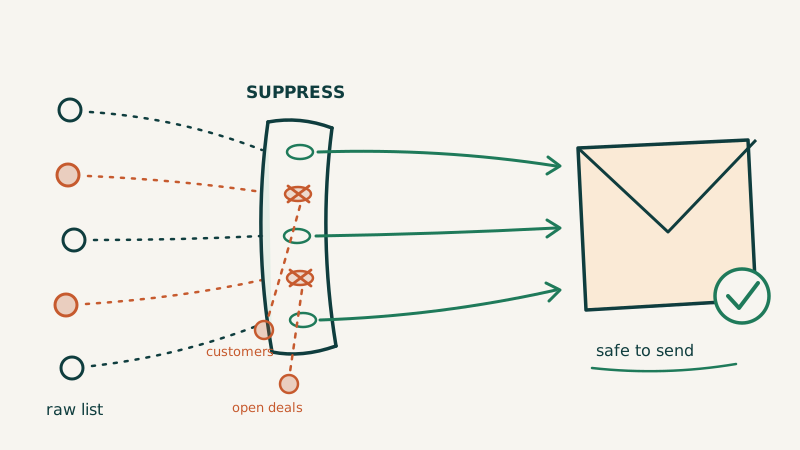
One thing worth noting: qualification quality is directly tied to lead quality. If your external team is working from lists that include invalid emails, job changers, or contacts who no longer work at the target company, they will waste time and your brand will suffer from the wrong outreach. Tools like Scrubby can catch risky or undeliverable emails before they hit your sequences, which protects both your sender reputation and the efficiency of your external team.
Step Four: Define Handoff Standards Clearly
The qualification-to-AE handoff is where brand consistency breaks down in a different way. An external team can do everything right on the qualification side, and then the handoff creates a jarring disconnect if the AE arrives to a meeting expecting one thing and the prospect arrives expecting something else.
Define what a qualified meeting looks like before you start. This means:
Required information captured. What does your AE need to know walking into a call? At minimum: confirmed pain, timeline, budget range or authority level, and the specific context that made this prospect respond. Build this into your CRM fields and make it non-negotiable.
Summary notes format. Standardize how external reps hand off context. A free-form notes field will be used inconsistently. A structured template with prompts (what did they say the problem was, what did they say they have tried, what is the next step they agreed to) forces consistency.
Setting prospect expectations. External reps should end every qualified meeting booking by telling the prospect exactly what to expect next, including who they will meet with, what format the call will take, and what the meeting is not (it is not a demo unless your process says it is). This prevents the awkward moment where a prospect thought they were getting a quick intro call and shows up to a full sales process.
Tools and Integrations That Support Consistent Execution
The right infrastructure reduces how much you have to rely on individual judgment from external reps.
A few categories worth evaluating:
Outreach sequencing tools. Locking external reps into approved sequences in your outreach platform (Outreach, Salesloft, Apollo, etc.) prevents improvisation at the message level. They can personalize within a framework, but the framework is yours.
CRM integrations that enforce data capture. Required fields in Salesforce or HubSpot that cannot be bypassed force reps to capture the information your AEs need. It is not glamorous, but it works.
AI coaching tools on recorded calls. Several tools now provide automated call scoring against rubrics you define. This scales your QA process without requiring someone to manually review every call.
Lead data validation before prospecting. The earlier in the process you clean your data, the less wasted effort downstream. Vendisys works with clients on full GTM infrastructure, including helping teams set up the data pipelines and tool integrations that make outsourced qualification sustainable rather than chaotic.
The Ongoing Management Reality
Outsourcing lead qualification is not a set-it-and-forget-it decision. The companies that do it well treat the external team as an ongoing management responsibility, not a vendor relationship on autopilot.
That means regular investment in updating the playbook as your product and positioning evolves. It means being responsive when the external team flags gaps or confusion. It means revisiting the ICP definition quarterly rather than assuming it is static.
It also means holding the external team to the same standards you would hold an internal hire. If a rep is consistently off-brand and not improving after coaching, that is a performance issue. External does not mean you have no influence over quality.
The companies that get the most out of outsourced qualification are the ones who bring the same rigor to managing the external team that they bring to managing internal hires. Less rigor equals more drift, and drift is expensive.
What Good Looks Like
When outsourced lead qualification is working well, your AEs should not be able to tell, from the meeting notes alone, whether a qualified meeting was set by an internal or external rep. The context should be as rich, the framing should be as accurate, and the prospect expectation should be as well-set.
That standard sounds high, but it is achievable. It requires a real messaging playbook, genuine onboarding investment, consistent QA, and the infrastructure to support execution at scale. Companies that skip these steps get the cost savings of outsourcing with none of the brand protection they need to make it sustainable.
Done right, outsourced lead qualification gives you the coverage and volume to run a real pipeline engine without the overhead of building a large in-house SDR org. The voice stays yours. The work gets shared.