You are three weeks into an outsourced outbound engagement. Your board asks for ROI numbers. Your VP of Sales points at the CRM and says, “We have four meetings booked.” Everyone in the room silently wonders whether this was a mistake.
It was not a mistake. The measurement was.
Most Series A and B companies evaluate outsourced outbound by counting booked meetings in the first few weeks. That is like judging a new sales hire by their closed revenue on day 15. The metric is real, but the timeline makes it meaningless. The companies that build durable pipeline through outsourced outbound measure different things at different stages, and they understand why each phase produces different types of value.
Here is the measurement framework that separates teams who scale outbound from teams who churn through vendors every two quarters.
Why Traditional ROI Math Fails for Outsourced Outbound
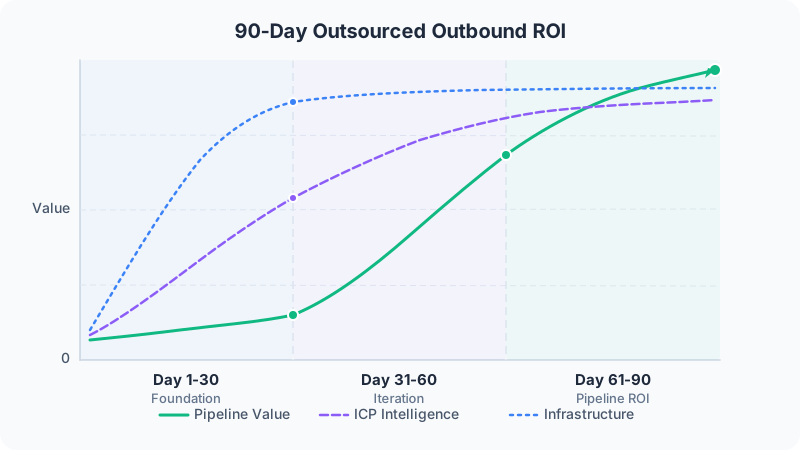
The standard ROI formula is simple: revenue generated divided by cost invested. The problem is that outsourced outbound produces value in at least three categories, and only one of them shows up in your CRM as closed revenue within 90 days.
Category 1: Direct pipeline. Meetings booked, opportunities created, deals progressing. This is what everyone measures, and it matters. But it is a lagging indicator that only becomes meaningful after month two.
Category 2: ICP and messaging intelligence. Every sequence your outsourced partner runs generates data about which personas respond, which pain points resonate, which industries convert, and which objections surface repeatedly. This data is worth tens of thousands of dollars in avoided mistakes, and it compounds across every future campaign.
Category 3: Infrastructure and speed. Warm sending domains, validated contact lists, proven sequences, deliverability history, and multi-channel playbooks. Building this in-house takes 4-6 months and a full-time hire. An outsourced partner delivers it in 30 days.
If you only measure Category 1, you will always be disappointed at day 30, cautiously optimistic at day 60, and unsure whether to continue at day 90. Measuring all three categories gives you an accurate picture at every stage.
Days 1-30: Leading Indicators and Infrastructure Value
The first 30 days of an outsourced engagement produce almost zero direct pipeline. That is by design. This phase is about building the foundation that makes months two and three productive. If your partner is booking meetings in week two, they skipped critical infrastructure steps, and you will pay for it later in deliverability problems and burned lists.
What to Measure
Infrastructure completion rate. Track whether the core setup milestones hit their targets: sending domains purchased and entering warm-up, CRM integrations live, lead routing rules tested, and initial sequences drafted. A good partner like Vendisys will have a clear onboarding checklist with dates attached. If week three arrives and domains are not warming, something is wrong.
ICP definition depth. Count the number of distinct ICP segments defined, the firmographic and technographic filters applied, and the number of messaging angles drafted per segment. You should have 2-3 segments with 3-5 messaging hypotheses each by the end of month one. The quality of this work determines everything that follows.
List quality metrics. How many contacts were sourced, how many survived validation, and what is the estimated deliverability rate? This is where the investment in proper email verification pays off immediately. Catch-all domains and risky addresses account for 20-40% of most B2B contact lists. Tools like Scrubby test whether those addresses actually accept mail rather than just checking format validity. The difference between a 95% deliverable list and a 70% deliverable list is the difference between a healthy sending reputation and a domain that gets flagged before you finish ramping.
Cost benchmark against in-house alternative. Run this calculation once at the start and revisit it at day 90. The fully loaded cost of hiring an in-house SDR includes salary (typically $55-75K base), benefits (add 20-30%), tools and subscriptions ($500-1,500/month for data, sequencing, CRM seats), management overhead (your VP of Sales spending 5-10 hours per week on coaching and pipeline review), and ramp time (3-4 months before an in-house SDR is fully productive). Total that up over 90 days. For most Series A/B companies, it lands between $45,000 and $70,000 before the SDR has generated a single qualified meeting. An outsourced engagement with a partner like Vendisys typically costs 40-60% of that figure and starts producing pipeline data in half the time.
What Not to Measure Yet
Meetings booked. Opportunities created. Revenue influenced. These are all important, and none of them are meaningful at day 30. Resist the urge to report them to your board or use them to evaluate the engagement.
Days 31-60: Early Pipeline Signals and ICP Learning
Month two is when sequences go live and the first real engagement data appears. This is not the “prove it works” month. It is the “learn what works” month, and the data it produces is significantly more valuable than most teams realize.
What to Measure
Engagement velocity. Track open rates, reply rates, and positive reply rates across segments and messaging angles. The absolute numbers matter less than the relative performance between variants. If Angle A gets a 2.1% reply rate and Angle B gets a 0.4% reply rate, you have learned something critical about your buyer’s priorities, something that would have taken an in-house team three months of trial and error to discover.
Reply quality analysis. Not all replies are equal. Categorize responses: positive interest, objection (with sub-categories), redirect to a colleague, “not now but later,” and hard no. Each category tells you something different. A high rate of “redirect to colleague” responses means you are reaching the right company but the wrong persona. A high rate of timing objections means the pain point is real but your trigger event hypothesis needs adjustment.
Meeting conversion rate. Of the positive replies, what percentage converts to a booked meeting? Industry benchmarks for outsourced outbound sit between 25-40% of positive replies converting to meetings. If you are below 25%, the handoff process between the outsourced SDR and your AE team needs work. If you are above 40%, your ICP targeting is sharp and your messaging is resonating.
Pipeline velocity by segment. This is the metric that matters most for long-term ROI. Which ICP segments move through the funnel fastest? Track time from first touch to meeting booked, and time from meeting booked to opportunity created, broken down by segment. You will almost certainly discover that one segment converts 2-3x faster than others. That insight alone can reshape your entire go-to-market strategy.
Multi-channel attribution. If your partner is running a multi-channel approach (and they should be), measure which channel combinations produce the highest engagement. Layering calendar-based outreach through tools like Kali alongside email sequences often surfaces engagement from prospects who never opened a single cold email. Calendar invites land in a different context, and for executive buyers who live in their calendar app, they can dramatically outperform email-only sequences. Track which channel initiated the conversation and which channel sealed the meeting.
The ICP Learning Multiplier
Here is the calculation most teams skip. Every piece of data from month two informs not just the current outbound engagement but every future campaign, every marketing program, every product positioning decision.
When you discover that CTOs at 200-500 person fintech companies respond 3x more frequently to compliance-related pain points than to efficiency-related ones, that insight changes your website copy, your conference strategy, your content marketing topics, and your product roadmap conversations. Quantify this by estimating what you would have spent on customer research, surveys, or focus groups to learn the same information. For most companies, the answer is $15,000-30,000 and three to six months. Outsourced outbound produced it as a byproduct.
Days 61-90: Lagging Indicators and True ROI Calculation
Month three is when the full ROI picture comes into focus. Sequences have been running long enough to produce statistically meaningful data. Early meetings have progressed (or stalled) in the pipeline. And the infrastructure is mature enough to project forward with confidence.
What to Measure
Qualified meetings booked. This is the number everyone has been waiting for. By day 90, a well-run outsourced outbound engagement should have produced 15-40 qualified meetings, depending on your ACV, ICP breadth, and how aggressive the ramp was. The range is wide because a company selling $20K ACV deals to mid-market will produce more meetings than a company selling $150K ACV deals to enterprise, even with identical execution quality.
Pipeline value created. Multiply qualified meetings by your average opportunity value and your historical meeting-to-opportunity conversion rate. If you booked 25 meetings, your meeting-to-opp rate is 60%, and your average opportunity is $50K, that is $750K in pipeline. Against a 90-day outsourced engagement cost of $25-40K, the pipeline-to-cost ratio is compelling even before a single deal closes.
Cost per qualified meeting. Divide total engagement cost by qualified meetings booked. Compare this to your cost per meeting from other channels (inbound, events, paid ads, referrals). For most B2B companies, outsourced outbound produces qualified meetings at $800-2,000 each. Inbound typically costs $500-1,500 per meeting but has volume ceilings. Events cost $2,000-5,000 per meeting. The channel mix matters more than any single channel’s efficiency.
Sales cycle acceleration. Measure whether deals sourced from outsourced outbound move through the pipeline faster or slower than deals from other sources. Outbound-sourced deals sometimes close faster because the SDR pre-qualified them against specific criteria. They sometimes close slower because the buyer was not actively searching. Track this honestly; it affects your revenue projection models.
Competitive intelligence gathered. Track every instance where a prospect mentions a competitor, describes their current solution, or explains why they chose an alternative. This data feeds directly into competitive positioning and sales enablement. Some teams integrate tools like CAM for ongoing competitor monitoring, but the intelligence gathered organically through outbound conversations is uniquely valuable because it reflects what prospects actually think, not what competitors publish.
The Full ROI Formula
At day 90, calculate ROI across all three value categories:
Direct pipeline ROI = (Pipeline value created x historical close rate) / Total engagement cost
ICP intelligence value = Estimated cost to acquire equivalent buyer intelligence through research, surveys, or consultants
Infrastructure value = Cost to build equivalent sending infrastructure, validated lists, and proven sequences in-house (typically 4-6 months of an SDR’s fully loaded cost plus tools)
Add all three. For a typical Series A/B company, the combined 90-day ROI ranges from 3x to 8x the engagement cost. The companies at the high end of that range are the ones who measured correctly from day one and used the ICP intelligence to optimize in real time.
Red Flags: When Outsourced Outbound Is Not Working
Measurement is also about knowing when to cut your losses. Here are the signals that an engagement is failing, separated from the signals that it is simply ramping:
Genuine red flags (act on these):
- Bounce rates above 8% after month one (list quality or validation failure)
- Zero positive replies after 3,000+ contacts entered sequences (messaging or targeting is fundamentally off)
- No A/B testing or optimization between weeks 4 and 8 (the partner is on autopilot)
- Your partner cannot explain their ICP hypothesis or why they chose specific segments
- Deliverability scores declining month over month instead of improving
Normal ramp behavior (do not panic):
- Fewer than 5 meetings in the first 45 days
- Reply rates below 2% on initial sequences before optimization
- Some ICP segments underperforming while others show promise
- Sequences requiring 2-3 rounds of revision based on early data
The difference between a failing engagement and a ramping one is the presence of learning. If your partner is generating data, analyzing it, and making specific changes based on what they find, the engagement is working even if the meeting count is still low. If they are sending the same sequences to the same segments with no iteration, the engagement is failing regardless of meeting count.
Building the 90-Day Measurement Dashboard
Set this up in week one, before a single email sends. You need four views:
Weekly operational metrics: Send volume, open rate, reply rate, bounce rate, positive reply rate, meetings booked. Updated every Monday. Shared with your internal team and the outsourced partner.
Monthly strategic metrics: Pipeline value created, cost per meeting, ICP segment performance comparison, messaging angle performance comparison, channel attribution breakdown. Reviewed in a monthly strategy call.
Quarterly ROI summary: Full three-category ROI calculation, comparison to in-house cost benchmark, forward projection based on observed conversion rates, and a clear recommendation on whether to expand, maintain, or adjust the engagement.
ICP learning log: A running document of every insight about your buyer that the outbound data revealed. This is the asset that appreciates over time. Six months from now, when you are planning your next product launch or entering a new market segment, this document will be worth more than the pipeline it helped generate.
The Bottom Line
Outsourced outbound ROI is real, measurable, and often larger than companies expect, but only if you measure it correctly. Counting meetings in week three and calling it a failure is like checking your 401(k) balance every day and panicking at the dips.
The 30/60/90 framework gives you the right metrics at the right time: infrastructure completion and ICP depth in month one, engagement velocity and learning value in month two, pipeline value and full ROI in month three. Companies that follow this framework make better decisions about their outbound investment and, more importantly, they extract compounding value from every week the engagement runs.
Stop measuring outsourced outbound like a light switch. Start measuring it like what it is: an investment with a defined ramp curve, multiple value streams, and a payoff that accelerates over time.