Most teams bolt LinkedIn onto their outbound as an afterthought. They export a list, fire off connection requests with a templated note, and then wonder why acceptance rates are low and almost no one books. The problem is not LinkedIn. The problem is that they are running it like a slower, character-limited version of cold email instead of a distinct channel with its own rules.
Done well, LinkedIn reaches buyers who never open a cold email, warms accounts before your first call, and gives your outbound a second thread into the same account. Done badly, it burns your prospect list and gets your reps restricted. This guide walks through a connection request strategy that consistently opens conversations, and how to sequence LinkedIn with the rest of your outbound so the channels compound instead of competing.
Why LinkedIn Deserves Its Own Playbook
Email and LinkedIn look similar on the surface. Both are asynchronous, both are text, both live or die on relevance. But the buyer behaves completely differently in each.
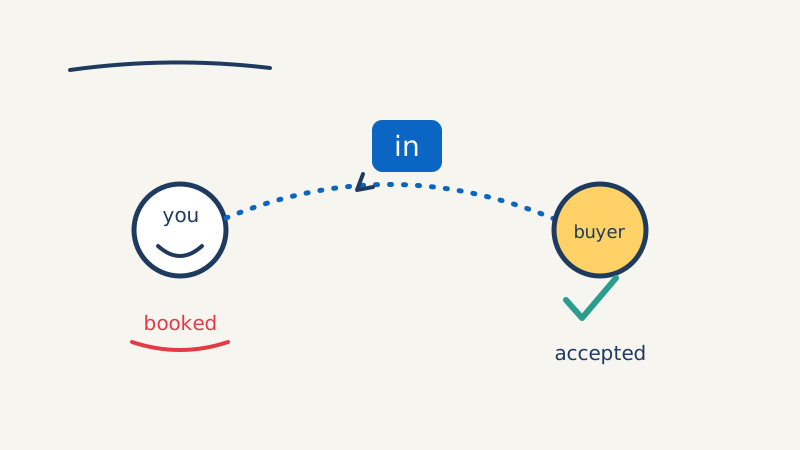
In the inbox, your message competes with hundreds of others and gets a two second scan. On LinkedIn, a connection request is a social signal, not a pitch. Accepting it costs the prospect almost nothing, which is exactly why the acceptance is not permission to sell. It is permission to earn a reply.
That distinction is the whole game. Reps who treat an accepted connection as a green light to paste their email pitch get ignored. Reps who treat it as the start of a relationship get conversations. LinkedIn rewards patience and punishes the copy-paste sequence that email tolerates.
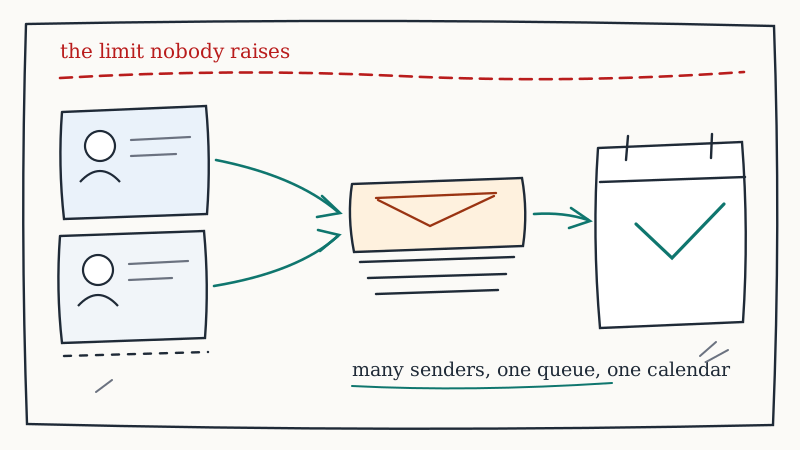
There is also a hard operational reason to run LinkedIn separately: the platform actively limits volume. You cannot send 500 connection requests a day the way you can send emails. That constraint forces discipline, which is a feature, not a bug. It means every touch has to be worth sending.
The Four Layers of a LinkedIn Motion
A LinkedIn outbound motion has four distinct layers, and most teams only run one of them.
Profile as landing page. Before you send a single request, your rep’s profile has to do the selling. When a prospect gets a connection request, the first thing they do is click the profile. If the headline reads like a resume and the banner is the default gradient, the request looks like spam. The headline should speak to the buyer’s problem, not the rep’s job title. The featured section should link to something useful.
The connection request. This is the highest leverage 300 characters in outbound. More on the exact structure below.
The engagement layer. Commenting on a prospect’s post, reacting to company news, and sharing content that speaks to their world. This is the slow warm that makes a later message land as familiar rather than cold.
The direct message sequence. The follow-up conversation after the connection is accepted, paced over days, never in a single wall of text.
The mistake is running only layer two. Reps blast connection requests, skip the profile work and the engagement, and then send a pitch on acceptance. The layers are supposed to reinforce each other. When they do, a prospect who accepts on Monday has already seen your name, read a useful profile, and maybe noticed a thoughtful comment before your first real message ever arrives.
The Connection Request That Gets Accepted
The single biggest lever is whether you send a note at all, and if so, what it says. Here is the framework that works.
Keep it short and specific. You have 300 characters. Use fewer. A request that reads like it was written for one person beats a polished paragraph that could go to anyone. Reference something real: a post they wrote, a hire they just made, a market shift in their category.
Lead with them, not you. The worst opener is a pitch. The second worst is a compliment so generic it signals automation. The best opener shows you understand their situation. “Saw you are scaling the SDR team after the Series B. We work with a lot of teams making that build-versus-buy call, would be good to connect.” That is specific, relevant, and makes zero demands.
Make no ask. The connection request is not where you book the meeting. Any request that ends with “do you have 15 minutes” gets ignored or reported. The only goal of the request is to get accepted.
Consider the no-note request. Counterintuitively, sending no note at all often produces a higher acceptance rate, because it reads as low pressure. The tradeoff is that you lose the chance to set context. Test both against your segment. For senior buyers who get flooded with pitches, no note frequently wins. For peers and practitioners, a sharp note wins.
A useful discipline: if you would not send the note to someone you respect at a conference, do not send it on LinkedIn. The medium is different but the social contract is the same.
Sequencing the Follow-Up
Acceptance is the start, not the finish. The days after a connection is accepted decide whether you get a conversation, and this is where most sequences collapse into an email pitch pasted into the message box.
Slow it down. A workable rhythm:
- Day of acceptance: a short thank-you with zero pitch. Reinforce the specific reason you reached out. No link, no ask.
- Two to three days later: share something genuinely useful tied to their world. A benchmark, a short take, a relevant resource. Still no meeting ask.
- Four to five days after that: the soft ask. Now that you have given value twice, you can ask whether the problem you have been circling is worth a short conversation.
Every message should be sendable on its own. If a prospect read only your third message, it should still make sense and still be respectful. The pacing is what separates a relationship from a drip campaign, and it is exactly the discipline that gets lost when LinkedIn is treated as an email clone. Building that kind of outbound cadence that actually books meetings takes the same rigor across every channel.
Running LinkedIn and Email as One Motion
The point of adding LinkedIn is not to have two separate campaigns. It is to build a single multi-channel outbound motion where each channel does what it does best.
Email carries detail and volume. LinkedIn carries signal and presence. The strongest sequences interleave them so a prospect experiences a coherent, human outreach rather than two disconnected bots. A practical pattern:
- Connection request goes out first, with no note or a light one.
- First cold email lands a day or two later, referencing nothing about LinkedIn.
- If the connection is accepted, the LinkedIn thank-you and email follow-up run on parallel, staggered tracks.
- A thoughtful comment on the prospect’s post lands somewhere in the middle, so your name shows up in a context that is not a pitch.
Done right, the prospect sees your name three or four times across two channels in a week, each touch adding a little familiarity, none of them feeling like pressure. That repetition is what moves a cold account to a warm reply. The key is that the channels have to be coordinated by one owner working one account list, not two teams working two spreadsheets that never reconcile.
The Metrics That Actually Matter
Vanity metrics will lie to you here. Connection acceptance rate feels like the number to chase, but a high acceptance rate with no conversations means you are collecting connections, not building pipeline. Track the funnel that leads to revenue:
- Acceptance rate as a top-of-funnel health check, not a goal.
- Reply rate on the post-acceptance sequence, which tells you whether your follow-up is earning conversations.
- Meetings booked from LinkedIn-sourced or LinkedIn-influenced conversations, the number that ties the channel to pipeline.
- Account penetration, how many stakeholders inside a target account you have reached, since LinkedIn is uniquely good at multi-threading.
That last one is where LinkedIn quietly outperforms email. It lets you reach the champion, the economic buyer, and the influencer inside the same account without needing a verified email for each. Multi-threading a single account across two or three roles is far more predictable than praying one cold email lands with the right person.
Where Teams Go Wrong
A few failure patterns show up again and again:
- Over-automation. Tools that auto-send hundreds of requests and messages get accounts restricted and make every touch feel robotic. The volume you gain is not worth the reputation and access you lose.
- The instant pitch. Sending the sales message the second a connection is accepted. It is the fastest way to get ignored.
- No profile work. Sending requests from a profile that looks like a default template. The profile is your landing page, and a bad one kills good outreach.
- Treating it as a solo channel. Running LinkedIn disconnected from email so the prospect gets two uncoordinated streams instead of one coherent motion.
Each of these comes from the same root: treating LinkedIn as a volume game instead of a relevance game. The platform simply does not scale the way email does, and the teams that accept that constraint and lean into precision are the ones that win.
Making It Operational
The reason most companies never run LinkedIn well is not strategy, it is consistency. Profiles need to be built and maintained. Requests need to be personalized, which takes real research per prospect. Follow-up sequences need a human touch and daily attention. Engagement has to happen every day, not in bursts. That is a meaningful amount of disciplined work, and it competes with every other demand on a small sales team’s time.
This is exactly the kind of motion that benefits from dedicated outbound infrastructure rather than being squeezed into a founder’s spare hours. A team whose whole job is running coordinated, multi-channel outbound will keep the profiles sharp, the research real, and the cadences consistent in a way that an already stretched internal team rarely can. If you are weighing whether to build that capability in-house or bring in a partner who runs it as a system, that build-versus-buy decision is worth working through deliberately.
LinkedIn is not a magic channel and it is not dead. It is a relationship channel that rewards the teams willing to be specific, patient, and coordinated, and punishes the ones looking for a shortcut. Run it with its own playbook, wire it into your email motion, and measure it against pipeline rather than acceptance rates, and it becomes one of the most reliable ways to open the accounts your cold email can never reach.