Every inbound-led company eventually hits the same wall. Content traffic flattens, paid CAC creeps up, MQL volume holds steady but conversion to SQL drifts down, and the pipeline forecast that used to feel comfortable starts requiring more caveats every quarter. The CRO knows what comes next: it is time to add outbound.
And then the political fight starts.
Marketing has spent years building attribution dashboards that prove their contribution. The moment outbound contacts show up in the same accounts, those dashboards stop telling a clean story. Sales claims credit for deals marketing nurtured for nine months. Marketing claims credit for deals SDRs cold-called. The CFO loses faith in both numbers. Pipeline goes up, but trust in the data goes down.
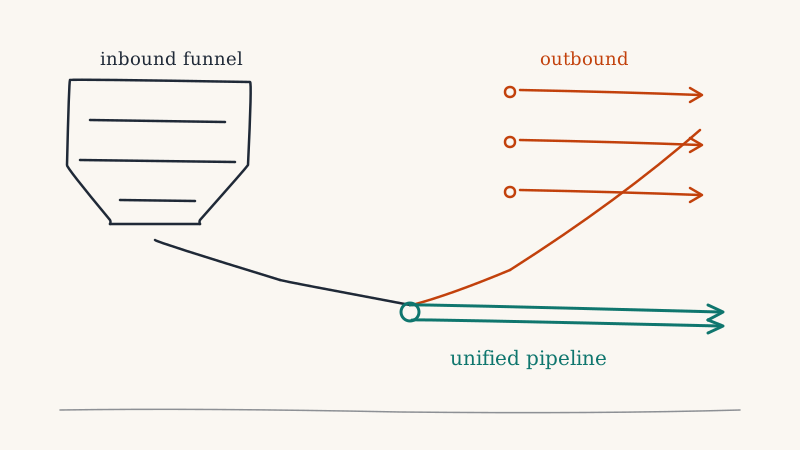
This is the problem worth solving before you launch a single outbound sequence. Layering outbound on top of inbound is not just an execution exercise. It is an attribution architecture problem.
Signs Your Inbound Pipeline Has Plateaued
Before adding outbound, get honest about whether inbound has actually stalled. Most teams misread short-term volatility as a structural plateau, then over-correct. The signals that matter are the ones that hold across at least two quarters.
Lead Quality Is Declining Faster Than Volume
Lead volume is a vanity number. The signal that inbound is plateauing is when MQL volume holds flat or grows slightly, but the percentage that converts to SQL drops. Marketing is still doing its job at the top of the funnel. The pool of qualified buyers actively in-market on your topic just got smaller, so the marginal lead is lower quality.
If your MQL-to-SQL rate has dropped 20% or more over the last two quarters and you cannot tie it to a specific campaign or channel change, your inbound channel is saturating. Adding more spend to the same channel will not fix it.
CAC Is Creeping Up Without Obvious Cause
Customer acquisition cost is the cleanest leading indicator. When CAC rises while conversion rates and ACV stay flat, you are paying more for the same buyer. This usually means your audience pool is exhausted or competitors are bidding up the same keywords. Either way, the next dollar of marketing spend buys less pipeline than the last one.
Your Pipeline Is Concentrated in a Small Number of Sources
A healthy revenue mix has at least three meaningful pipeline sources. If 70% of your pipeline comes from one channel (paid search, organic content, partner referrals), you are one algorithm change or competitor move away from a bad quarter. Outbound is not just a growth lever. It is a diversification hedge.
Why Most Teams Resist Adding Outbound
The need is usually obvious to the CRO and the board. Resistance comes from somewhere else.
Attribution Panic
Marketing leaders have spent years convincing finance that their channel produces measurable pipeline. Adding outbound creates a category of deals where the touchpoints overlap. A prospect downloads an ebook in March, gets cold-emailed by an SDR in May, books a demo in June. Who gets credit? If marketing loses the deal in the dashboard, they lose budget the next planning cycle. The fear is rational.
Fear of Brand Cannibalization
Inbound-led companies often have a strong brand that converts on inbound trust. Cold outreach feels off-brand. There is real concern that aggressive outbound will train the market to associate your name with spam, and that the long-term cost will be higher than the short-term pipeline gain.
This concern is valid if outbound is poorly executed. It evaporates when outbound is well-targeted and operates more like account-based marketing than like spray-and-pray cold email.
Marketing and Sales Tension
In an inbound-only world, marketing generates leads and sales closes them. Roles are clean. Outbound blurs that line. SDRs identify accounts, marketing supports with content, sales closes. If incentives are not redesigned, the team will spend more energy fighting over credit than generating pipeline. CROs who underestimate this dynamic see outbound rollouts stall in month three when the political cost outweighs the pipeline benefit.
The Attribution Problem When Outbound Touches In-Funnel Inbound Leads
Here is the scenario that breaks dashboards. Your marketing team has a contact in the nurture stream. They downloaded a whitepaper, attended a webinar, and have an MQL score of 48. They have not yet hit the threshold to be routed to sales. An SDR running outbound on the target account list emails the same person, gets a reply, and books a meeting.
The deal closes six months later for $180K ARR.
Last-touch attribution credits outbound. First-touch credits inbound. The marketing team correctly points out that the prospect was already engaged. The SDR correctly points out that without the outbound email, the prospect would have stayed in the nurture loop indefinitely. Both are right. The dashboard does not know how to reflect that.
This is not a hypothetical edge case. In B2B with long sales cycles and multi-threaded buying committees, this overlap pattern shows up on 30% to 50% of closed deals once outbound is layered on. If your attribution model cannot handle it, your reporting is going to lie to you for at least two quarters while you figure it out.
Three Attribution Models That Survive Multi-Touch Reality
You do not need a perfect attribution model. You need one that is consistent, explainable, and hard to game. Three approaches actually work in practice.
Last Non-Direct Touch
The simplest model that works. Credit goes to the last marketing or sales touch that was not a direct visit to your website. If a prospect downloads content in January, gets cold-emailed in March, and books a demo through that email, outbound gets credit. If they download content in January, get cold-emailed in March, then return six weeks later via a paid search ad and book a demo, paid search gets credit.
This model is easy to explain to non-technical stakeholders and resists most gaming. It under-credits early-funnel content, which is its main weakness.
Weighted Multi-Touch
Every meaningful touchpoint gets a percentage of credit, weighted by recency and influence. A typical split: 30% to the first touch (created awareness), 30% to the lead-creation touch (started the relationship), 30% to the closing touch (drove the conversion), 10% distributed across middle touches.
This model is fair to both inbound and outbound, but it requires clean data and discipline. If your CRM and marketing automation systems do not deduplicate contacts well, the math falls apart. This is one of the reasons running Scrubby on imported contact lists matters: bad data corrupts attribution before any model touches it. Garbage contacts inflate touchpoint counts and distort the weights.
Source-of-Truth-by-Channel
Stop trying to attribute every deal to a single source. Instead, define each pipeline source by the channel that originated the engagement, and report two numbers: total pipeline, and pipeline by primary channel. A deal can have an inbound primary source and an outbound assist, or vice versa.
This is the most operationally useful model for sales-led companies adding outbound. It removes the political battle (everyone gets credit when they earned it) while keeping channel-level investment decisions clear. The downside is that finance needs to be educated on why total pipeline by channel adds up to more than total pipeline. Once they accept that, the model holds.
Setting Up Outbound to Complement, Not Compete
The technical attribution work is necessary but not sufficient. The bigger lever is structural: design outbound so it operates on different territory than inbound.
Territory Split by Account Status
The cleanest split is by account engagement. Marketing owns accounts that have engaged in the last 90 days. Outbound owns everything else. If a contact at an outbound account fills out a demo form, they convert to a marketing lead and route through the inbound process. If a marketing-owned account goes cold for 90 days, it returns to the outbound pool.
This rule is simple, defensible, and removes the daily fights. It also forces marketing to actually nurture, because losing accounts to outbound after 90 days of silence creates real consequence.
ICP Segmentation by Channel Fit
Some segments respond to inbound. Others do not. Run a 60-day audit of your existing pipeline and identify which ICP segments converted from inbound versus which segments are largely absent from inbound entirely. Point outbound at the segments that inbound does not reach.
For example, mid-market companies often respond well to content-led inbound. Enterprise targets in regulated industries usually do not, because their procurement processes do not start with a Google search. Outbound is the only viable path to those buyers. Tools like CAM help here by surfacing competitor displacement signals at the account level, which gives outbound a reason to reach out that does not depend on the prospect having engaged with your content yet.
Dormant Lead Re-Engagement
The most underused outbound play is re-engaging dormant inbound leads. Marketing has a graveyard of MQLs that converted six, twelve, eighteen months ago and never closed. Most of them are still at the same companies, still in similar roles, and still have the same problem. They just got busy.
A focused outbound effort against the dormant pool produces some of the highest-converting outbound pipeline you will ever see, because the prospects already know your name. Pair this with calendar-based outreach through Kali for booking demos directly and reply automation through Underfive for handling the volume of responses, and you can revive a meaningful percentage of the dormant pool in 90 days.
What to Monitor in the First 90 Days
The first 90 days of layered outbound is where most rollouts succeed or fail. The metrics to watch are not the obvious ones.
Inbound MQL volume. If outbound execution is poor, prospects mark your domain as spam, deliverability drops across all sending, and inbound form fills decline. If MQLs drop more than 10% in the first 60 days, pause outbound and audit deliverability before continuing.
Pipeline source mix. Watch the percentage of pipeline tagged to outbound versus inbound versus overlap. A healthy first-90-day target is 15% to 25% of new pipeline tagged to outbound, with overlap deals clearly identified and not double-counted.
Marketing-influenced revenue (not just sourced). Marketing-influenced revenue should grow even as marketing-sourced percentage declines. If both decline, marketing has a real problem and is right to be concerned. If influenced grows while sourced declines, the data is doing what you want it to do.
SDR-to-AE handoff quality. Outbound meetings should convert to opportunities at a rate within 20% of inbound meeting conversion. If outbound meetings convert at a third of inbound, the targeting or qualification criteria are wrong, not the channel.
A Closing Decision Framework
Before launching outbound on top of inbound, work through these five questions in order.
- Has inbound actually plateaued, or is this a temporary dip? Look at two quarters of data minimum.
- Do you have an attribution model that can handle multi-touch overlap, and have you socialized it with marketing and finance? If not, fix this before launching anything.
- Have you defined a clear territory split between inbound and outbound, with a written rule for what happens when they overlap?
- Do you have the operational capacity to run outbound well, or are you about to launch poorly executed outbound that damages the brand inbound built?
- Are you committed to a 90-day evaluation window with clearly defined success metrics, or is this a “let us try outbound and see” experiment?
If the answer to any of these is unclear, the smart move is not to delay outbound. It is to bring in operators who have already solved this problem at other companies.
This is the case for layering outbound through an outsourced partner like Vendisys before building a full internal SDR org. The infrastructure, the playbook, and the attribution discipline are already built. You get pipeline diversification without the 6-month internal political fight, and your marketing team keeps their dashboards intact because the partner is set up to integrate with whatever attribution model you already use.
Inbound plateaus are not a failure. They are a sign your company has saturated one channel and needs to diversify. Layer outbound on top correctly, and the inbound engine keeps running while a second engine spins up alongside it. Layer it on top sloppily, and you spend two quarters litigating who deserves credit while pipeline stalls. The difference is almost entirely in the attribution architecture you put in place before the first email goes out.