Ask ten sales leaders how they set their SDR quota and most will give you some version of “we need X in pipeline, divide by the number of reps, done.” That top-down math feels rigorous, but it skips the part that decides whether the number is achievable: what one rep can actually do in a day.
A quota built backward from a revenue goal, with no reality check against capacity, does one of two things. It gets missed every month until reps stop believing in it, or it gets hit by sandbagging and gaming that quietly corrupts your data. Neither builds a predictable pipeline. This is a walkthrough of how to set a quota that survives contact with a real week of outbound work.
Start with capacity, not the revenue goal
The revenue goal tells you what you need. Capacity tells you what is possible. You have to know both before you set a number, and you have to reconcile them honestly.
Capacity planning for an SDR is simpler than it looks. Start with a real working week and subtract everything that is not active outreach:
- Selling days per month. A 21-day month is not 21 selling days. Subtract training, all-hands, pipeline reviews, and the friction of ramping tools. Most teams land at 17 to 18 usable days.
- Productive hours per day. Between standup, list building, CRM hygiene, and reply management, an SDR gets four to five hours of genuine outreach time, not eight.
- Activity per hour. Depending on channel mix, a rep can personalize and send a realistic number of touches per hour. Sequenced email scales; manual research-heavy personalization does not.
Multiply those together and you get a monthly activity ceiling. That ceiling, not the revenue target, is the honest starting point for the conversation. If the math says a rep can run 1,200 quality touches a month and your quota assumes 2,500, you do not have a motivation problem. You have an arithmetic problem.
Convert activity into meetings with your real funnel
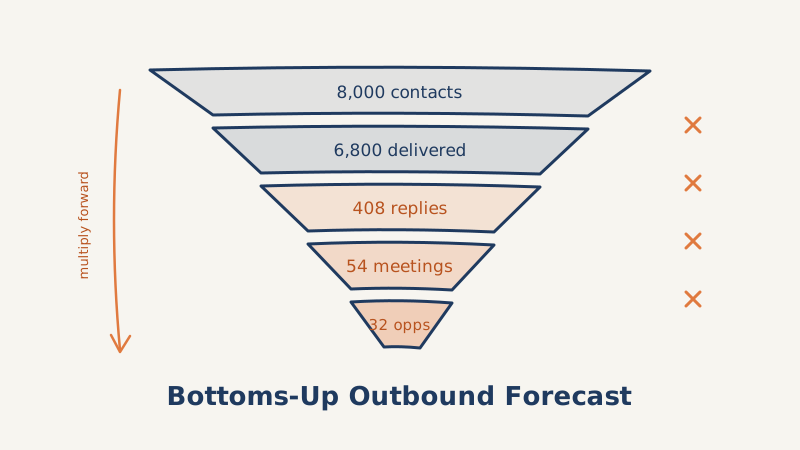
Activity is an input, not a quota. What you actually want reps carrying is a meetings-booked or qualified-opportunity number, because that is the thing that turns into pipeline. To get there, you need your own conversion rates, not benchmarks from a vendor blog.
Pull the last two or three quarters and calculate the honest ratios:
- Touches to positive reply
- Positive reply to booked meeting
- Booked meeting to held meeting (your no-show rate matters here more than people admit)
- Held meeting to qualified opportunity
Walk your activity ceiling through that funnel and you get a defensible meetings number. This is where a lot of quotas fall apart, because leaders use aspirational conversion rates. If your held-meeting rate is 65 percent and you model at 90 percent, every quota downstream is inflated by a third before a single call is made.
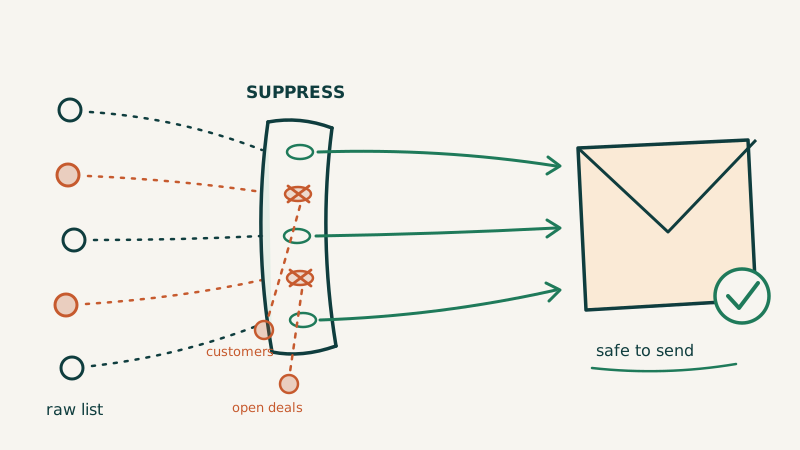
One thing that quietly wrecks these ratios: bad data at the top of the funnel. If a meaningful slice of your list bounces or lands in spam, your touches-to-reply rate is measuring deliverability failure, not messaging. Cleaning your list with a verification layer like Scrubby before you calculate conversion keeps the funnel math honest, so the quota you build on top of it reflects selling ability rather than list rot.
Build the ramp into the quota, not around it
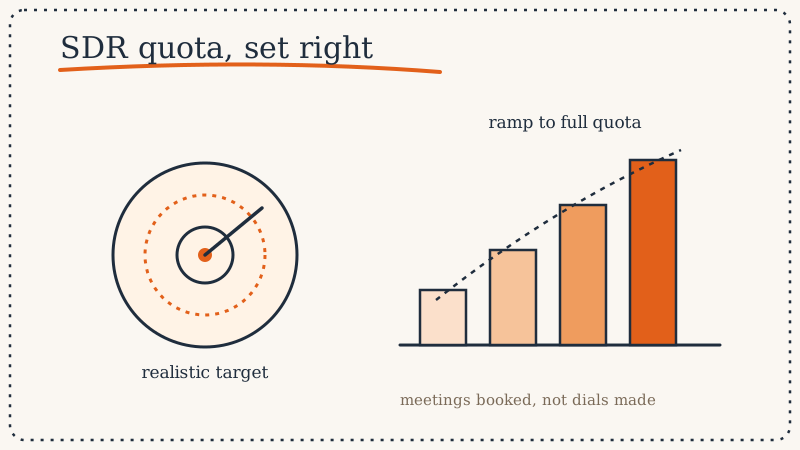
The most common quota mistake is a flat number that applies to a rep in month one and a rep in month nine. New SDRs do not produce at full capacity on day one, and pretending they do sets them up to fail during the exact window when confidence matters most.
Instead, tier the quota to the ramp curve:
- Month 1: Activity and learning targets only. No meetings quota. The goal is reps, tools, and message fluency.
- Month 2: 40 to 50 percent of full quota. Reps are booking, but you are still coaching mechanics.
- Month 3: 70 to 80 percent. Most of the skills are there; consistency is not yet.
- Month 4 and beyond: Full quota, assuming the territory and list support it.
Ramp-adjusted quotas do two things. They give new reps a fair, winnable target, and they give you a cleaner read on whether a struggling rep has a skill problem or a territory problem. When everyone is measured against the same flat number regardless of tenure, you cannot tell the difference. This is one of the reasons teams that lean on outsourced outbound GTM infrastructure can show pipeline faster: the ramp is already priced into a proven motion, so you are not funding month one of a learning curve every time you add capacity.
Pressure-test the number against territory reality
A quota is only fair if the territory can support it. Two reps carrying identical numbers with wildly different total addressable markets are not being held to the same standard, and the one with the thin list will churn.
Before you lock a quota, check three things per rep:
- Addressable accounts. Does the territory hold enough in-profile accounts to feed the quota without recycling the same names every 30 days? If a rep has to touch their whole list three times a month to hit the number, the list is too small, not the rep too slow.
- List freshness. Contact data decays fast. A territory that looked healthy two quarters ago may be half stale now, which silently raises the effective quota.
- Channel fit. A quota that assumes cold calling in a market that only responds to email (or the reverse) is a mismatch no amount of effort fixes.
If the territory cannot support the number, you fix the territory or the number. You do not ask the rep to close the gap with willpower.
Make the quota a system, not a stone tablet
The last piece is treating the quota as something you revisit, not something you carve once and defend forever. Conversion rates drift. Markets soften. A new competitor changes reply rates overnight. A quota set in January against Q4 data can be badly wrong by March.
Build a light quarterly review into your sales-ops cadence:
- Recompute the funnel ratios from the most recent 90 days.
- Re-check capacity assumptions against what reps actually logged, not what the plan assumed.
- Adjust ramp tiers if hiring velocity changed.
- Flag any territory where the addressable market shifted enough to move the number.
External signals matter here too. If a competitor changes pricing or ships a feature that shifts how your market responds, your reply rates move before your quota does. Watching those shifts with a monitoring tool like CAM gives sales-ops an early read on why conversion moved, so a quota adjustment is a deliberate decision rather than a reaction three months too late.
The number should tell the truth
A good SDR quota is not the biggest number leadership can justify to the board. It is the number that is simultaneously ambitious and achievable, grounded in what a real rep can do in a real week, walked through your real funnel, and adjusted for where each rep sits on the ramp.
Get that right and the quota stops being a source of monthly anxiety and starts being what it is supposed to be: a reliable forecast of the pipeline your team will produce. If building that capacity in-house feels like more machinery than you want to run, that is precisely the work an outsourced outbound partner like Vendisys takes off your plate, delivering the meetings without asking you to reverse-engineer the quota math from scratch.