Most outbound teams spend ninety percent of their energy on the send and almost nothing on the reply. They tune subject lines, warm up domains, and argue about cadence length, then let inbound responses pile up in a shared inbox until a prospect who raised their hand goes cold. The reply is where outbound actually converts, and it is the most neglected stage in the entire motion.
A reply is the single highest-intent signal a cold prospect will ever give you. Someone who was interrupted by an unsolicited email cared enough to type a response. Whether that response is “tell me more,” “not now,” or “who gave you my email,” it is a live human at the other end of your sequence. How you handle the next sixty minutes decides whether that turns into a meeting or a missed opportunity.
This playbook covers how to categorize replies, how fast you need to move, what to say to each reply type, and how to build the infrastructure so this scales past a single rep.
Why reply handling is the real bottleneck
Picture a campaign that sends 5,000 emails and generates a 3 percent reply rate. That is 150 humans responding to a cold message. If your team converts 20 percent of positive replies into booked meetings, the difference between a sloppy reply process and a sharp one is enormous. Drop your speed-to-reply from four hours to fifteen minutes and your meeting rate on positive responses can climb by half or more, because intent decays fast.
The math is brutal in the other direction too. Every “interested” reply that sits unanswered for a day is a prospect who has already moved on to the next thing in their inbox, or worse, replied to a competitor running the same play. Volume without a reply system is just noise. You paid for the data, the inbox infrastructure, and the copy, then let the warmest leads in the funnel evaporate.
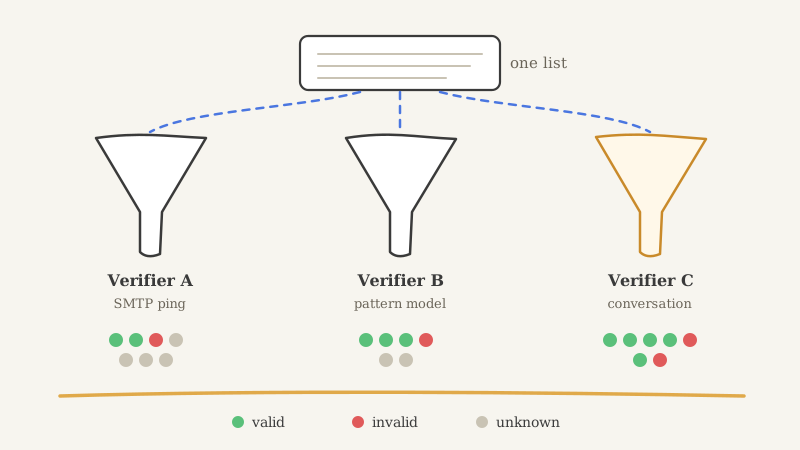
This is exactly why deliverability and list quality feed directly into reply quality. If half your sends bounce or land in spam, the replies you do get are skewed and thin. Cleaning your list with a tool like Scrubby before launch means the replies you manage are from real, reachable humans rather than catch-all noise, so your reply team spends its time on signal instead of garbage.
Step one: categorize every reply within minutes
You cannot apply the right response if you do not know what kind of reply you are looking at. Sort every inbound response into one of five buckets the moment it lands.
- Positive intent. “Sounds interesting,” “send me a calendar link,” “what does pricing look like.” These are your money replies.
- Soft positive or referral. “Not me, talk to Sarah,” or “reach back out in Q3.” There is a path here, just not today.
- Objection. “We already use a competitor,” “no budget,” “we built this in-house.” A real concern, not a no.
- Hard no or opt-out. “Remove me,” “not interested,” “unsubscribe.” Respect it immediately and suppress.
- Automated or out-of-office. Bounce-backs, auto-replies, ticketing confirmations. Route these to logic, not a human.
The first three buckets deserve a human response. The last two deserve automation and suppression rules. Mixing them up is how reps waste an afternoon replying to mailbox bots while a hot lead waits.
Step two: respond fast, and respond like a person
Speed beats polish. A two-line reply sent in fifteen minutes outperforms a perfectly crafted paragraph sent the next morning. Set an internal service level: positive replies get a human response within thirty minutes during business hours. If you outsource your outbound, this should be written into the agreement, because reply speed is one of the clearest signals of whether a partner is actually working your pipeline or just hitting send.
When you respond, match the prospect’s energy and length. If they wrote one line, do not answer with five paragraphs. The goal of the reply is almost never to sell. It is to book the meeting. Drop the pitch, confirm interest, and offer a concrete next step with as little friction as possible.
The friction point most teams miss is the booking step itself. Sending “let me know what times work” forces the prospect to do scheduling labor, which kills momentum. Sending a direct, pre-filled calendar invite they can accept in one click removes that drag entirely. This is where a tool like Kali earns its place, because it turns a positive reply into a booked slot without the back-and-forth that loses warm prospects between Tuesday and Thursday.
Step three: scripts for each reply type
Templates are a starting point, not a crutch. Personalize the first line, keep the structure.
Positive intent. Keep it short and move to the calendar.
“Great, glad it landed. Easiest next step is a quick 20 minutes so I can show you exactly how this maps to your team. Here is my calendar, grab whatever works: [link]. Or tell me a couple of windows and I will send an invite.”
Soft positive or referral. Make the handoff effortless and lock a follow-up.
“Appreciate the steer. Mind if I mention you connected us when I reach out to Sarah? And I will make a note to circle back with you in Q3 so this does not fall off the radar.”
Objection: already using a competitor. Do not argue. Open a door.
“Makes sense, plenty of teams we work with came over from the same setup. Not asking you to rip anything out. Worth 15 minutes to see where we are different, and if it is not better for your use case I will tell you straight.”
Objection: no budget or no time. Lower the cost of saying yes.
“Totally fair. No ask for budget today. If I send over a two-minute overview, you can decide if it is worth a conversation later this quarter. Want me to send it?”
Hard no or opt-out. One line, then suppress.
“Understood, I will close this out and won’t reach back. Thanks for the reply.”
Then actually suppress the address across every sending domain, not just the one that got the reply. A prospect who opts out of one inbox and gets hit from another is a deliverability and reputation risk.
Step four: build the infrastructure so it scales
A reply playbook that lives in one rep’s head breaks the moment volume climbs or that rep takes a vacation. Make it a system.
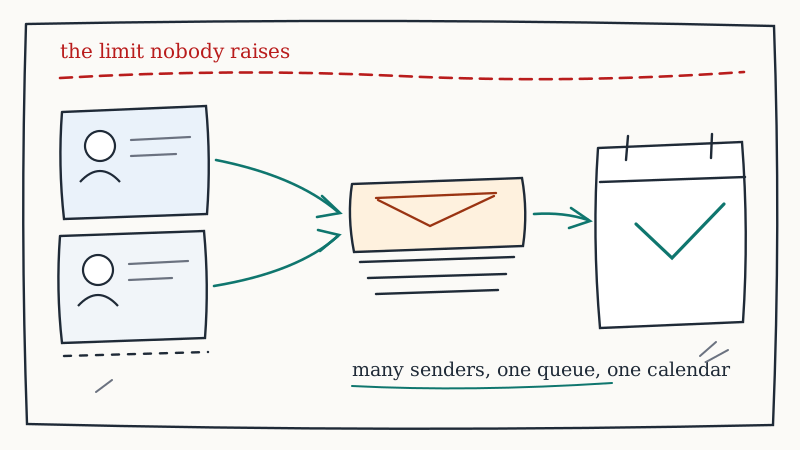
- Centralize replies. Route every sending inbox into one view so no response hides in a domain nobody checks. Scattered inboxes are where warm leads die.
- Define ownership and SLAs. Every reply bucket needs an owner and a clock. Positive replies in thirty minutes, referrals same day, objections within two hours.
- Suppress globally. Opt-outs and hard nos must propagate across all domains and all future campaigns instantly. This is a compliance issue as much as a courtesy one.
- Log outcomes, not just activity. Track reply type, response time, and whether it converted to a meeting. That data tells you which campaigns generate quality intent versus quantity.
- Protect your sending health. High reply rates mean nothing if your domains are burning. Monitor bounce and spam signals continuously, because a flagged domain poisons every reply downstream.
The infrastructure question is exactly why many teams stop trying to run reply management with a generalist and a shared Gmail. The discipline of categorizing, responding within an SLA, and suppressing globally across dozens of inboxes is operational work, and it is one of the core reasons companies move outbound to a dedicated partner. Vendisys treats reply management as a first-class part of the motion rather than an afterthought bolted onto a send tool, because the meeting gets booked in the reply, not the send.
The takeaway
Send volume gets the attention, but replies get the meetings. Every response a cold prospect sends is the highest-intent moment in your entire funnel, and most teams fumble it by being slow, robotic, or disorganized. Categorize fast, respond like a human within minutes, use scripts that move toward a booked slot instead of a pitch, and build the infrastructure so the process survives past one rep.
Get the reply stage right and the same campaign that booked five meetings starts booking twelve, with no change to your send volume at all. That is the cheapest pipeline you will ever build, because you already paid for it the moment the prospect hit reply.