You signed the contract with an outsourced outbound partner. The SOW says “pipeline generation.” Your CEO asks when the first meetings will land. Your honest answer should be: not this week, and probably not next week either.
That is not a failure. It is how outbound actually works when done correctly. The teams that understand the real timeline build compounding pipeline by month three. The teams that expect instant results churn through vendors, blame the channel, and end up back at square one every quarter.
Here is what actually happens in each phase, what you should measure, and where most engagements go wrong.
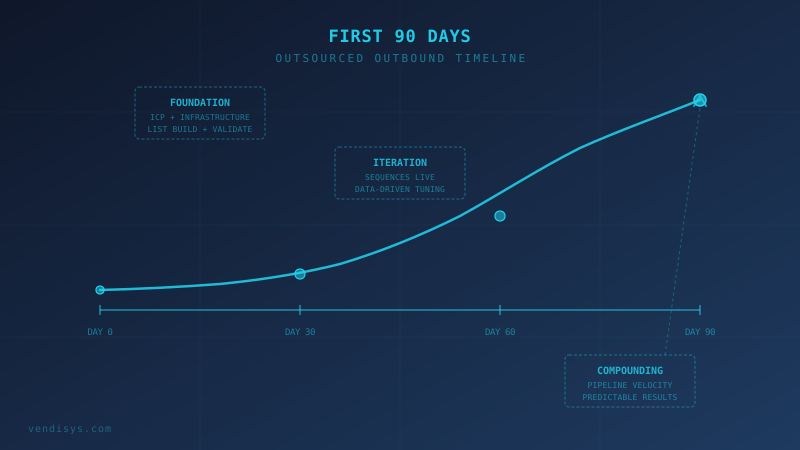
Days 1-30: Foundation (The Month That Feels Like Nothing Is Happening)
The first 30 days of an outsourced outbound engagement produce zero pipeline. If your partner promises otherwise, they are either cutting corners or lying. This phase is entirely about building the infrastructure that makes months two and three productive.
Week 1-2: ICP Definition and Messaging Architecture
The engagement starts with the question that most internal teams skip: who exactly are we targeting, and why would they care right now?
This is not a brainstorming session. A good outsourced team will audit your existing customer data, identify patterns in your closed-won deals, and build a targeting framework based on firmographic, technographic, and behavioral signals. They are looking for the intersection of “has the problem,” “has budget,” and “is reachable.”
The messaging work happens in parallel. Your partner should produce 3-5 distinct angle variations for your primary ICP segment, each built around a different pain point or trigger event. These are not templates; they are hypotheses that will be tested in month two.
Expect to spend significant time in this phase doing reviews and providing feedback. The outsourced team knows outbound mechanics, but you know your buyer. The quality of your input here directly determines the quality of output in month three.
Week 2-3: Infrastructure Setup and List Building
While messaging is being finalized, the technical infrastructure goes up. This includes domain purchasing and warm-up for dedicated sending domains, email account configuration, deliverability monitoring, and CRM integration for lead routing.
List building is the most underestimated task in this phase. A good outsourced partner does not just pull contacts from a data provider and call it done. They cross-reference multiple sources, enrich records with intent signals, and validate every address before it enters a sequence.
That validation step is critical. Catch-all domains, recycled addresses, and syntax-valid but undeliverable contacts make up 20-40% of most B2B lists. Sending to those addresses destroys sender reputation before a single real prospect sees your message. Tools like Scrubby exist specifically for this problem, testing whether catch-all and risky addresses actually accept mail rather than just checking whether the format looks right. Running every contact through deep validation before it hits a sequence is non-negotiable if you want your sending domains to survive past the first campaign.
Week 3-4: Sequence Construction and Sending Domain Warm-Up
The final week of month one is about assembling the sequences and beginning the warm-up process. New sending domains need 2-3 weeks of gradually increasing volume before they can handle full campaign loads. Skipping this step is the single most common reason outsourced outbound fails early: the domain gets flagged, deliverability craters, and the team spends month two rebuilding instead of iterating.
What to measure in month one:
- ICP segments defined and approved (target: 2-3 segments)
- Messaging angles drafted and reviewed (target: 3-5 per segment)
- Sending domains purchased, configured, and in warm-up
- Contact lists built, validated, and loaded (target: 2,000-5,000 validated contacts)
- CRM integration live and routing rules tested
What not to measure in month one: meetings booked, replies received, or pipeline created. If your partner is reporting those numbers in month one, they either started sending before the infrastructure was ready (bad) or they are counting low-quality responses (worse).
Days 31-60: Iteration (The Month Where Data Replaces Assumptions)
Month two is when sequences go live and the real work begins. This is not the month where pipeline floods in. It is the month where you learn what works, discard what does not, and tune the machine.
Week 5-6: First Sequences Launch
With domains warmed and lists validated, the first sequences start sending. Volume should still be conservative: 50-100 new contacts entering sequences per day, per sending domain. The goal is generating enough data to make decisions without risking deliverability.
Within the first two weeks of sending, you will see early signal. Open rates tell you whether subject lines and sending infrastructure are working. Reply rates tell you whether the messaging resonates. Bounce rates tell you whether list quality is holding up.
Expect reply rates of 1-3% on initial sequences. That is not a failure; it is a starting point. The teams that win at outbound are the ones that treat early data as diagnostic information, not a verdict.
Week 6-8: The Optimization Cycle
This is the phase that separates professional outsourced outbound from “we sent some emails and hoped for the best.”
A good partner runs structured A/B tests across messaging angles, subject lines, send times, and sequence length. They analyze replies qualitatively, not just quantitatively. A “not interested” reply still contains signal: did the prospect understand the offer? Did they object to the pitch or the timing? Did they redirect to someone else in the org?
Multi-channel layering also starts in this phase. Adding Kali calendar invite touches to email sequences creates a second engagement surface that bypasses inbox clutter entirely. Calendar invites land in a different context than cold emails, and for certain buyer personas (especially executives who live in their calendar), they significantly outperform email-only sequences.
LinkedIn touchpoints get layered in as well: profile views before the first email, connection requests after the second touch, engagement with the prospect’s content where relevant. Each channel reinforces the others.
By the end of month two, your partner should have enough data to identify which ICP segments respond best, which messaging angles generate the most positive replies, and which channels drive engagement for each persona.
What to measure in month two:
- Sequences launched and sending on schedule
- Open rates by sequence variant (target: 45-65%)
- Reply rates by messaging angle (target: 2-5% by end of month)
- Bounce rates holding below 3%
- Positive reply ratio (what percentage of replies are interested vs. not interested vs. wrong person)
- First qualified meetings booked (target: 5-15 depending on ACV and market)
The meeting number will feel low. That is normal. Month two meetings are a leading indicator, not the final result. The optimization work happening now is what makes month three productive.
Days 61-90: Compounding (The Month Where the Investment Pays Off)
Month three is where outsourced outbound starts producing the results that justified the investment. The infrastructure is built, the messaging is tested, and the optimization cycles from month two have identified what works.
Week 9-10: Scaling What Works
By now, you know which ICP segments convert, which messaging angles generate meetings, and which channel combinations drive engagement. Month three is about scaling those winning combinations.
Volume increases. The sending domains are fully warmed and have established reputation. Contact lists expand into adjacent segments that share characteristics with your best-performing audiences. Sequences that proved effective in month two get deployed more broadly.
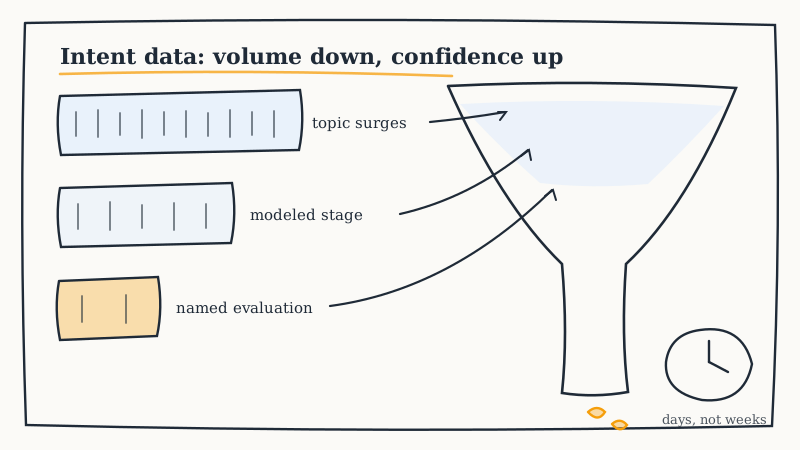
This is also when competitive intelligence becomes valuable. Understanding which accounts are actively evaluating alternatives in your category lets you prioritize outreach to buyers who are already in-market. CAM provides exactly this kind of signal, monitoring competitor activity so your outbound team can focus volume on accounts showing purchase intent rather than spraying messages across cold audiences.
Week 10-12: Pipeline Velocity Kicks In
The compounding effect comes from multiple sources hitting simultaneously. Prospects who entered sequences in month two and did not respond to the first touch are now seeing follow-up three, four, and five. New prospects from scaled campaigns are entering at the top. Multi-channel touches are building familiarity across your target accounts.
Meeting volume should increase 2-3x from month two. More importantly, meeting quality improves because the targeting and messaging have been refined through two months of data. Prospects arriving at this stage are better qualified, more aware of the problem you solve, and further along in their buying process.
Reply handling also matures in this phase. Early in an engagement, most teams handle replies manually. By month three, the volume justifies systemizing the process. Underfive automates reply classification and initial response handling, ensuring that interested prospects get a fast, contextual follow-up while objections are routed appropriately. When reply volume doubles or triples in month three, having AI handle the first response within minutes instead of hours directly impacts conversion from reply to booked meeting.
What the Numbers Should Look Like at Day 90
Here is a realistic benchmark for a mid-market B2B SaaS company ($30K-$100K ACV) with one outsourced outbound program running:
- Total contacts sequenced: 4,000-8,000
- Positive reply rate: 3-7%
- Qualified meetings booked (cumulative): 25-50
- Pipeline generated: 3-8x the monthly cost of the engagement
- Cost per qualified meeting: 40-60% lower than month two
These numbers are not aspirational. They are what consistently happens when the first 60 days are executed properly. Teams that skip the foundation work or demand immediate results in month one typically see half these numbers or worse, because they burned their sending infrastructure before the optimization phase could begin.
The Three Mistakes That Derail the Timeline
Most outsourced outbound engagements that fail do so for predictable reasons.
Mistake 1: Judging month one by month three metrics. If you are tracking meetings booked during the foundation phase, you will make bad decisions. You will pressure your partner to send before domains are warmed. You will skip list validation to move faster. You will approve messaging without proper review because “we just need to get something out there.” Every one of these shortcuts costs you in months two and three.
Mistake 2: Changing the ICP mid-stream. The most destructive thing a stakeholder can do in month two is say “let’s pivot to a completely different persona.” Iteration within a segment is productive. Abandoning a segment before you have statistically significant data is not. Give each hypothesis at least 500-1,000 contacts and 3-4 weeks before drawing conclusions.
Mistake 3: Treating outsourced outbound as a black box. The best results come from teams that stay engaged throughout the 90 days: providing feedback on messaging, sharing context on deal outcomes, flagging market shifts that affect positioning. Your outsourced partner runs the infrastructure. You provide the market intelligence. That collaboration is what makes the difference between a 3x and an 8x return on the engagement.
What Happens After Day 90
Day 90 is not the finish line. It is the point where the system becomes predictable enough to plan around. You now have validated ICP segments, tested messaging, proven channel strategies, and enough data to forecast pipeline generation with reasonable accuracy.
The question shifts from “is this working?” to “how do we scale it?” That might mean expanding to new ICP segments, adding more sending domains to increase volume, layering in additional channels, or building a Vendisys-managed GTM infrastructure that consolidates all of these functions under one operational layer.
The 90-day ramp is the cost of building something that compounds. Teams that pay it end up with a pipeline engine that produces results every month without starting over each quarter. Teams that do not pay it keep searching for shortcuts that do not exist.
Your first 90 days will feel slow. That is exactly how it is supposed to feel when it is being done right.