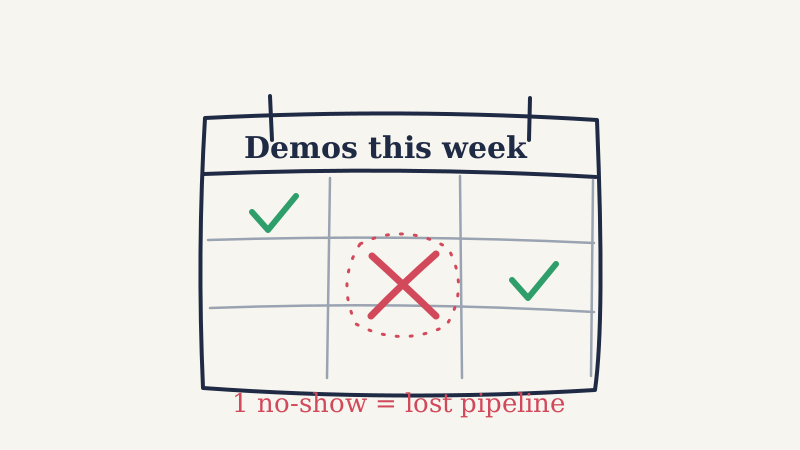
Your outbound program is working. Reps are booking meetings, the calendar is filling up, and the weekly report shows a healthy number of demos scheduled. Then Monday arrives and three of the seven booked accounts simply do not show.
No-shows are the quiet tax on outbound pipeline. Every meeting that evaporates burned an SDR’s time to book it, an account executive’s time to prepare for it, and a prospect’s interest that may never come back. Worse, no-shows distort your reporting: a 40% no-show rate means your “12 meetings booked” headline is really 7 conversations had.
If you run an outsourced outbound motion, this problem is easy to misdiagnose. It looks like a lead-quality issue when it is often a process issue. Here is how to bring no-show rates down without asking your team to book a single extra meeting.
First, Measure the Real Number
Most teams cannot tell you their no-show rate from memory, which is the first sign it is too high. Before you fix anything, separate three categories that often get lumped together:
- Hard no-shows: the prospect never joins and never responds.
- Reschedules: the prospect cancels or moves the meeting in advance. These are not failures, they are friction.
- Disqualified-on-arrival: the prospect shows up but was never a real fit.
The first two are process problems you can fix. The third is a targeting problem that belongs upstream in your ICP definition. If you are working with a partner like Vendisys, insist that booked-meeting reporting breaks out these categories. A blended “show rate” hides where the leak actually is.
A healthy benchmark for cold outbound demos is a 70% to 80% show rate. If you are below 60%, you have a fixable problem, not a market problem.
The No-Show Math Most Teams Ignore
Consider a team booking 20 demos a month at a 50% show rate. That is 10 real conversations. To get to 16 conversations, you have two options:
- Book 32 demos a month (a 60% increase in top-of-funnel effort), or
- Lift the show rate from 50% to 80% with the same 20 bookings.
Option two is almost always cheaper. Reducing no-shows is the highest-leverage improvement in most outbound programs precisely because it requires no additional prospecting volume. You are recovering pipeline you already paid to create.
Fix the Data Before the Cadence
The single most overlooked cause of no-shows is bad contact data. A confirmation email that bounces, a calendar invite sent to a role address nobody reads, or a meeting booked with someone who already left the company all show up in your metrics as a no-show.
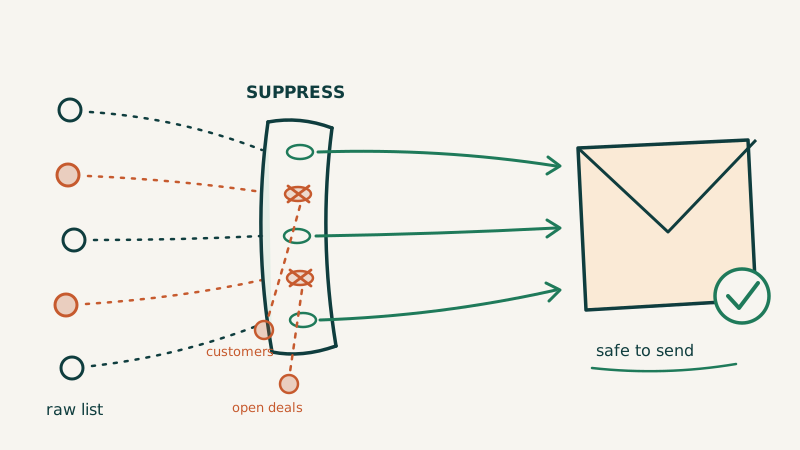
Before you build a single reminder sequence, make sure the email addresses your team books against are real and deliverable. Running your outbound list through a validation layer like Scrubby removes the invalid and risky addresses that silently swallow your confirmations. If the prospect never receives the invite, no reminder cadence on earth will get them to the meeting.
Data hygiene is not a one-time cleanup. Contacts go stale at roughly 2% to 3% per month as people change jobs. Re-verify the addresses tied to upcoming meetings, not just the ones at the top of the funnel.
Build a Confirmation Cadence That Actually Lands
Once your data is clean, the confirmation cadence does the heavy lifting. The goal is to keep the meeting top of mind and to give the prospect easy, low-friction ways to confirm or reschedule. A reliable structure looks like this:
At booking: Send the calendar invite immediately, with a clear agenda in the body. A meeting with no stated purpose is the easiest thing in the world to skip. One or two lines on what the prospect will get out of the 30 minutes is enough.
24 hours before: Send a short, human reminder. Not a templated “Reminder: your meeting is tomorrow,” but a one-line note that references something specific to their account or the reason they took the meeting. This is also the moment to make rescheduling effortless. A prospect who can move the meeting in two clicks will do that instead of ghosting.
1 to 2 hours before: Send a final nudge with the join link front and center. Many no-shows are not rejections, they are people who lost the link in a crowded inbox.
The delivery mechanism matters as much as the message. Sending calendar invites and reminders that land in the inbox rather than the promotions tab is its own discipline. Tools like Kali are built around calendar-invite-based outreach, which keeps the meeting itself, not just an email about it, in front of the prospect. When the invite is the touchpoint, confirmation and rescheduling happen inside the calendar where the prospect already lives.
Make the Account Executive Visible Before the Call
No-shows climb when the prospect feels they booked time with a faceless company rather than a person. A short, personal note from the account executive who will actually run the demo (not the SDR who booked it) does two things: it transfers the relationship, and it raises the social cost of skipping.
This handoff is also where many outsourced motions break. The SDR books the meeting, but the internal AE never confirms it landed on their calendar or that they have the context to run it. Align the handoff so that every booked meeting has a named owner on your side before the confirmation cadence even starts. If your outsourced partner cannot show you a clean booking-to-AE handoff process, that gap is likely costing you shows.
Time the Meeting for the Prospect, Not the Rep
Friday afternoon demos no-show at far higher rates than Tuesday or Wednesday mid-morning ones. Meetings booked more than seven days out also decay sharply, because the urgency that drove the prospect to say yes fades. Two practical rules:
- Book demos within five business days of the prospect agreeing, while intent is warm.
- Avoid Monday mornings and Friday afternoons unless the prospect specifically requests them.
These are small adjustments, but across a quarter of bookings they compound into several recovered conversations a month.
Treat Every No-Show as a Recoverable Lead
A no-show is not a closed door. A surprising share of no-shows will rebook if you reach out within a few hours with a genuinely easy path back. Your follow-up should assume good faith (“Looks like the timing did not work, here is my calendar to grab a better slot”) rather than scolding. Reserve the polite breakup message for the second or third missed meeting, not the first.
Track rebook rates separately. A team that recovers 30% of its no-shows into rescheduled meetings is materially more productive than one that writes them off, even if their initial show rate is identical.
Put It Together
Cutting no-show rates is not one tactic, it is a stack of small, compounding fixes:
- Measure the real rate and separate no-shows from reschedules and bad-fit accounts.
- Validate contact data so confirmations actually reach a human inbox.
- Run a three-touch confirmation cadence with effortless rescheduling.
- Introduce the account executive before the call and own the SDR-to-AE handoff.
- Book within five days and avoid the dead zones of the week.
- Treat every no-show as a recoverable lead with a fast, friendly rebook offer.
None of these require booking more meetings. They simply make sure the meetings you already won turn into the conversations that build pipeline. For teams running outsourced outbound, the show rate is one of the cleanest signals of whether your partner is managing the full funnel or just the top of it. If you want help building this discipline into your motion, that is exactly the kind of operational rigor Vendisys brings to outsourced GTM.