Voicemail is the most argued-about tactic in outbound calling. Half of sales leaders tell reps to never leave one because “nobody calls back.” The other half insist every unanswered dial should end with a message. Both camps are working from anecdotes instead of a system.
The truth is more useful: a voicemail is not a callback machine. It is a touch in a multi-channel sequence, and it only earns its place when it does a specific job. Leave the wrong one and you waste 30 seconds per dial and train prospects to ignore your number. Leave the right one at the right moment and you lift the connect rate on the follow-up channels that actually book meetings.
This guide covers when a voicemail is worth leaving, what to say, and how to fit it into the rest of your outbound motion so it compounds instead of leaking time.
Why most cold call voicemails fail
Before the scripts, understand why the default voicemail gets deleted. Three failure modes account for almost all of them.
It sounds like a pitch, not a person. The moment a prospect hears “I wanted to reach out about our platform that helps companies like yours,” the message is over. They have heard that opening a thousand times and their thumb is already moving to delete.
It asks for too much. A 45-second voicemail that ends with “give me a call back to discuss how we can transform your pipeline” asks a stranger to invest real effort for something they never requested. The ask is out of proportion to the relationship, which is zero.
It stands alone. A voicemail left with no matching email, no LinkedIn touch, and no second call is a message shouted into a void. Prospects rarely act on a single voice touch from an unknown number. The voicemail only works when it references or reinforces something else you are doing.
Fix those three things and the voicemail stops being a coin flip. It becomes a deliberate assist to the rest of your sequence.
The one decision that matters: is this voicemail a primer or a payload?
Every effective cold voicemail plays one of two roles. Decide which before you dial.
A primer voicemail does not try to get a callback at all. Its only job is to make your name familiar so the email you send two minutes later gets opened, and the next call gets answered. You are buying recognition. Success is measured by what happens on the other channels, not by returned calls.
A payload voicemail carries a genuine reason to call back right now: a specific trigger, a referral, a time-sensitive event. You leave these rarely, because real payloads are rare. When you have one, the voicemail can do heavy lifting on its own.
Most SDRs get this backward. They try to make every voicemail a payload, cramming in value props and callback asks, and end up with neither recognition nor callbacks. Lead with primers, save payloads for when you have earned them, and your numbers move.
When to leave a voicemail (and when to skip it)
Use these rules to decide dial by dial.
Leave a primer voicemail when:
- It is the first or second touch and you want your name to land before the matching email.
- You have a real trigger to reference (funding, a new hire, a product launch, an expansion).
- The prospect is a senior buyer who screens numbers and needs a reason to recognize you later.
Skip the voicemail when:
- You have already left two on the same contact with no response. A third trains them to ignore you.
- You have no email or LinkedIn touch queued to reinforce it. A lone voicemail rarely pays off.
- The number is a shared or general line where your message will not reach the target.
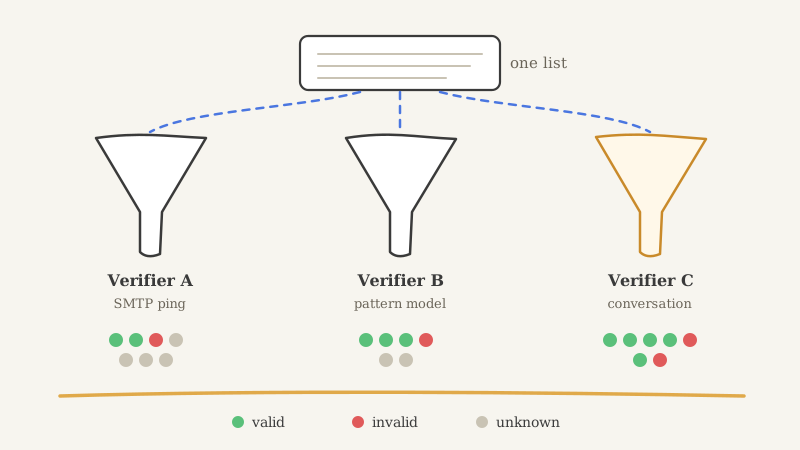
The discipline here matters more than the wording. A rep who leaves three thoughtful primer voicemails across a 12-touch sequence will outperform one who leaves eight rambling messages, every time. Keeping the list clean helps too: dialing dead numbers and pushing email touches to invalid addresses burns hours, which is why teams pair their calling data with an email verification pass through a tool like Scrubby before a sequence goes live.
Four voicemail scripts that earn callbacks
Each script is built to be left in under 20 seconds. Say your name and number slowly at the start and again at the end. Sound like you are leaving a message for a colleague, not reading ad copy.
Script 1: The primer (first touch)
“Hi [Name], it’s [Your Name] from [Company], my number is [number]. I’m sending you a short email right now with the reason I called, subject line is [subject]. Wanted my name to be familiar when it lands. Again, [Your Name], [number]. Talk soon.”
This does one thing well: it turns your follow-up email from cold to warm. The prospect now has a voice attached to the name in their inbox. Note that it does not pitch anything. The email carries the substance.
Script 2: The trigger reference
“Hi [Name], [Your Name] from [Company], [number]. Saw [specific trigger, e.g. you just opened a second office in Austin]. It usually creates a specific problem around [relevant challenge], and I had one idea on it. No pitch, just the idea. I’ll email it over. [Your Name], [number].”
Specificity is the whole game. “Saw you’re growing” is generic. “Saw you opened a second office in Austin” proves you did homework and gives the prospect a concrete reason to pay attention. Timing these around real signals is its own discipline, and teams that get it right build their calling lists off intent and event triggers rather than static account lists.
Script 3: The referral or mutual connection
“Hi [Name], [Your Name], [number]. [Mutual contact] mentioned you’re the right person to talk to about [topic]. Didn’t want to reach out cold without saying why. I’ll send a quick note with the context. Again [Your Name], [number].”
A referral name is the single strongest thing you can put in a voicemail. If you have a legitimate mutual connection or internal referral, lead with it. It converts a cold touch into a warm one instantly.
Script 4: The break-up
“Hi [Name], [Your Name] from [Company], [number]. I’ve reached out a few times and haven’t connected, so I’ll assume the timing isn’t right and stop for now. If [relevant problem] ever moves up your list, my number is [number]. No hard feelings either way.”
The break-up voicemail closes a loop and, counterintuitively, produces some of the highest callback rates of any message. Removing the pressure and signaling you will stop often prompts a “wait, actually” response. Use it as the final voice touch, not a bluff you repeat.
Fit the voicemail into a real sequence
A voicemail only compounds when it is one coordinated touch among several. Here is a simple 10-business-day frame that puts voice in its place.
- Day 1: Call. Leave Script 1 primer. Send the matching email within two minutes.
- Day 2: LinkedIn connection request with a one-line note referencing the email.
- Day 4: Call. Leave Script 2 trigger voicemail. Send a follow-up email with the promised idea.
- Day 6: Value email, no call. Share a resource or short insight.
- Day 8: Call, no voicemail if the first two went unanswered.
- Day 10: Call. Leave Script 4 break-up voicemail. Send matching break-up email.
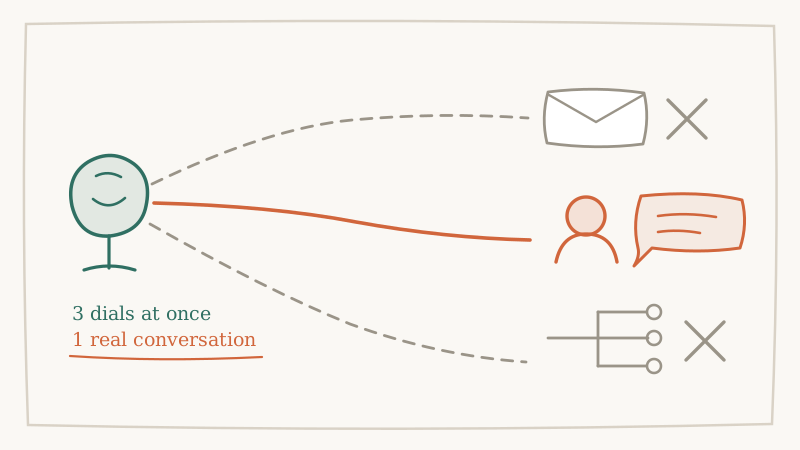
The pattern is deliberate: voicemails are paired with emails so the voice touch always has a written reinforcement, and they are spaced so you never leave more than three across the whole sequence. The phone is not carrying the sequence alone. It is amplifying the channels around it.
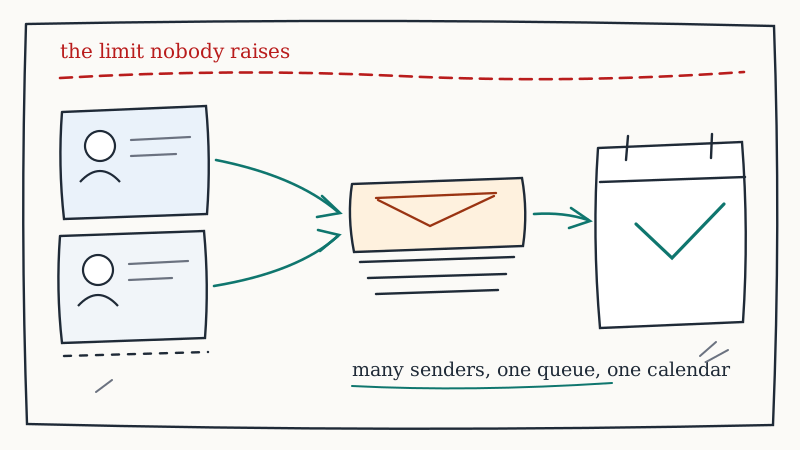
The other half of the equation is what happens when someone does call back or reply positively. If your booking process is a back-and-forth of “what times work for you,” you will lose momentum you worked hard to create. High-performing teams shorten that gap by sending a ready-to-accept calendar invite the moment interest appears, which is exactly the kind of low-friction booking motion Kali is built for. Speed from interest to booked meeting is where a lot of hard-won pipeline quietly leaks out.
Measure the right thing
Do not judge voicemails by callback rate alone. That number will always look bad in isolation and it will push you to abandon a tactic that is quietly working. Instead track:
- Connect rate on follow-up calls to accounts where you left a primer versus accounts where you did not. If primers work, later dials get answered more often.
- Email open and reply rates on messages that follow a voicemail versus cold sends. Recognition should lift both.
- Meetings booked per account touched, not per voicemail. The voicemail is one input to that number, not the whole story.
When you measure the assist, not just the direct callback, the value of primer voicemails becomes obvious and the case for skipping the rambling payload messages makes itself.
Where this fits in your outbound program
Voicemail strategy is a small piece of a larger machine: clean data, tight targeting, coordinated channels, and fast follow-up. Getting the voicemail right will not fix a broken sequence, but a broken voicemail habit can quietly drag down an otherwise good one by burning rep time and training prospects to tune you out.
If your team is spending real hours on the phone without a clear framework for when to leave a message and what to say, that is usually a sign the whole outbound motion could use a tune-up. Building and running a disciplined multi-channel program (calls, email, and social working together) is the core of what Vendisys does for companies that want pipeline without staffing and managing an SDR floor themselves.
Start with the primer-versus-payload decision. Leave fewer voicemails, make each one shorter and more specific, pair every one with a written touch, and measure the assist instead of the callback. Do that and the most argued-about tactic in outbound quietly becomes one of the most reliable.