How to Build a Predictable Pipeline Without an In-House SDR Team
Every B2B founder hits the same wall. You have product-market fit. Inbound is generating some pipeline but not enough to hit your growth targets. The obvious next step seems clear: hire SDRs. Build an outbound team. Start filling the top of the funnel with booked meetings.
Then you run the numbers. A single SDR in the US costs $70-90K in base salary plus $20-30K in OTE commissions. Add benefits, management overhead, tools (CRM, sequencer, dialer, enrichment — easily $500-800/month per seat), and ramp time. Your fully loaded cost per SDR is $120-150K annually, and that SDR will not be productive for 2-3 months after hire. If they churn — and the average SDR tenure is 14 months — you reset the clock.
For a startup trying to go from $2M to $10M ARR, the math does not work. You need pipeline now, not in six months when your first two SDR hires finish ramping.
There is another path. One that gives you the pipeline output of an SDR team without the headcount, ramp time, or management burden. It requires a different mental model of how pipeline generation works, but the results are measurable from month one.
The In-House SDR Model Is Designed for Scale, Not Speed
The traditional SDR model was built by companies that had already achieved significant revenue and needed to scale a proven playbook. Salesforce, HubSpot, and other enterprise companies that popularized the SDR/AE split were operating at hundreds of millions in revenue when they formalized these roles.
For companies under $20M ARR, the in-house SDR model has structural problems:
Ramp time destroys early momentum. A new SDR needs 60-90 days to learn your product, understand your ICP, develop effective messaging, and build enough pipeline to justify their cost. During that ramp period, you are paying full salary for minimal output. If you hire two SDRs simultaneously, you have $20-30K in monthly burn with close to zero incremental pipeline for the first quarter.
Management overhead is underestimated. SDRs do not manage themselves. Someone needs to train them, review their sequences, analyze their metrics, coach their calls, and keep them motivated. If that person is you (the founder or VP Sales), you are spending 10-15 hours per week on SDR management instead of closing deals or building product. If you hire a sales manager to handle it, you just added another $150K+ to your cost structure.
Tool sprawl adds hidden costs. An SDR team needs a CRM, a sequencing tool, a dialer, a data enrichment platform, an email warmup service, and usually an intent data provider. Individually, each tool seems reasonable. Combined, you are looking at $4-6K per month in SaaS spend for a two-person SDR team, on top of salary and commission.
Single-channel dependency creates fragility. Most SDR teams default to one primary channel (usually cold email or cold calling) and treat others as afterthoughts. When that primary channel experiences deliverability issues, platform changes, or market saturation, pipeline drops with no backup.
What Outsourced Pipeline Actually Looks Like
The word “outsourced” triggers skepticism for good reason. The traditional outsourced sales development model — offshore callers reading scripts from a CRM — produced poor results and damaged brand perception. That model is dead.
Modern outsourced pipeline generation looks fundamentally different. Instead of hiring warm bodies to make calls, you are engaging a system that handles the entire top-of-funnel workflow: targeting, data enrichment, email infrastructure, multi-channel sequencing, response handling, and meeting qualification.
Here is what that system produces:
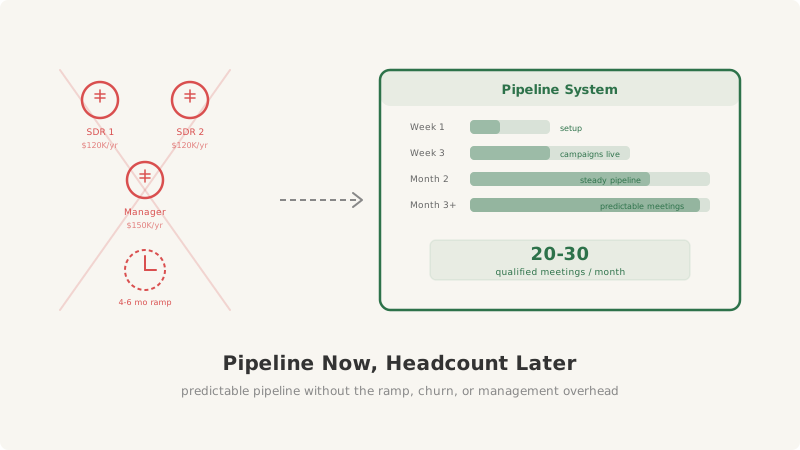
Week 1-2: Infrastructure setup. Domains are purchased and configured. Email accounts are created and begin warming up. Your ICP is defined and validated against available data sources. Initial messaging and sequences are drafted based on your value proposition and competitive positioning.
Week 3-4: First campaigns launch. Cold email sequences go live. LinkedIn touchpoints begin. Calendar invite outreach starts for high-priority prospects using tools like Kali. Every contact in the sequence has been validated through email verification, including catch-all address resolution through Scrubby, to protect sending infrastructure.
Month 2 onward: Steady-state pipeline. Campaigns are running across multiple channels simultaneously. Response handling is managed so that interested replies are qualified and booked as meetings on your calendar. Negative responses and objections are handled professionally without your involvement. You receive qualified meetings.
The critical difference from in-house SDRs is the time-to-pipeline. An outsourced system can begin generating qualified meetings within 3-4 weeks of engagement. An in-house hire takes 3-4 months.
The Economics of Outsourced vs In-House Pipeline
Let us run the actual comparison for a company targeting 20-30 qualified meetings per month.
In-house team (2 SDRs + Manager):
- SDR salaries and commissions: $20K/month
- Manager salary: $12K/month
- Tools and infrastructure: $5K/month
- Total monthly cost: $37K
- Time to reach target output: 4-6 months
- First-year total investment before reaching steady state: $220K+
Outsourced pipeline through Vendisys:
- Flat monthly engagement: varies by scope, but typically 40-60% less than in-house fully loaded cost
- Time to reach target output: 4-6 weeks
- No ramp cost, no management overhead, no tool procurement
The outsourced model is not cheaper per meeting in steady state once an in-house team is fully ramped and performing well. But it is dramatically cheaper when you factor in ramp time, churn risk, and management overhead. For companies that need pipeline now, the cost of waiting 4-6 months for an in-house team to ramp is far more expensive than the monthly engagement fee.
Building Predictability Into Outsourced Pipeline
The concern most founders have about outsourced pipeline is control. If you do not own the team, how do you ensure consistent output? Here is how to structure the engagement for predictability.
Define your ICP with specificity. The most common failure in outsourced pipeline is vague targeting. “Series A to Series C SaaS companies in the US” is not an ICP. “B2B SaaS companies with 50-200 employees, selling to mid-market, headquartered in the US, that have posted SDR or BDR job openings in the last 90 days” is an ICP. The more specific your targeting criteria, the more consistent the output will be.
Agree on leading indicators, not just meetings. Meetings booked is the ultimate metric, but it is a lagging indicator. Monitor leading indicators weekly: emails sent, response rates, positive response rates, and meetings scheduled. If sent volume is consistent but response rates are declining, you have a messaging problem. If response rates are healthy but meeting conversion is dropping, you have a qualification problem. Leading indicators let you diagnose and fix issues before they affect pipeline.
Maintain message approval authority. You should own the messaging strategy even if you do not write every email. Review and approve the initial sequence messaging. Set guardrails for what can and cannot be said about your product, your competitors, and your pricing. The outsourced team handles execution, but the narrative stays under your control.
Build multi-channel sequences from the start. A pipeline system that relies exclusively on cold email is fragile. Effective outsourced pipeline uses email as the primary channel with LinkedIn touches, calendar invites via Kali, and direct mail for high-value accounts as complementary channels. When one channel experiences issues, others maintain momentum.
Monitor competitive positioning with intelligence. Use tools like CAM to track what competitors are saying about themselves and about you. Feed competitive intelligence directly into your outbound messaging so that your sequences address objections and differentiation points that are current, not stale.
When to Bring Pipeline In-House
Outsourced pipeline is not a permanent solution for every company. It is the right solution at specific stages of growth, and there is a clear signal for when to transition.
Keep pipeline outsourced when:
- You are pre-$5M ARR and need to preserve capital for product development
- You are testing new markets or ICPs and need flexibility to pivot quickly
- Your founding team is focused on closing deals and cannot manage an SDR team
- You are in a seasonal business where pipeline needs fluctuate significantly
Begin transitioning in-house when:
- You have a proven, documented playbook that an outsourced team has validated
- Your monthly pipeline target requires more than 50 qualified meetings and the unit economics favor headcount
- You have a sales manager in place who can own SDR performance
- Your sales cycle and product complexity require deep product knowledge that is hard to outsource
The ideal transition is gradual. Run in-house SDRs alongside outsourced pipeline for 3-6 months. Use the outsourced team to maintain baseline pipeline while new hires ramp. Only sunset the outsourced engagement once your in-house team has demonstrated consistent output at or above the outsourced baseline.
Speed-to-Response Matters as Much as Lead Volume
One often-overlooked aspect of pipeline generation is what happens after a prospect replies. Research consistently shows that responding to a sales inquiry within 5 minutes produces dramatically higher conversion rates than responding within an hour. After 24 hours, the lead is essentially cold again regardless of how warm the initial response was.
This is where Underfive becomes a critical part of the pipeline stack. An AI reply agent that responds to interested prospects within seconds — qualifying their intent, answering initial questions, and booking a meeting on your calendar — ensures that the pipeline your outbound system generates does not leak at the response stage.
If you are generating 50 positive replies per month and your team takes an average of 4 hours to respond, you are losing a meaningful percentage of those opportunities to competitors or to simple prospect inattention. Automating the first response closes that gap.
Pipeline Is a System, Not a Team
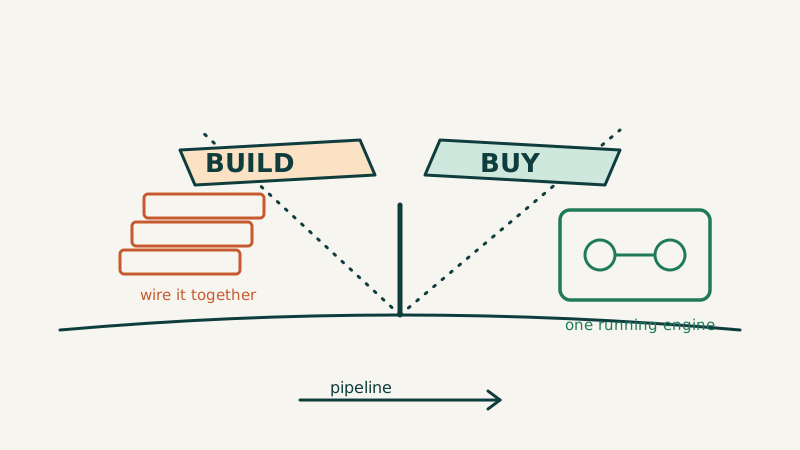
The mental shift required to build predictable pipeline without an in-house SDR team is to stop thinking about pipeline as a function of headcount and start thinking about it as a system with inputs, processes, and outputs.
The inputs are your ICP definition, messaging strategy, and competitive positioning. The process is multi-channel outreach executed consistently with validated data and protected infrastructure. The output is qualified meetings on your calendar.
Whether that system is run by employees you hired or by a team like Vendisys that operates the system on your behalf, the pipeline is still yours. The meetings are still yours. The revenue is still yours. The only question is whether you want to build and manage the system yourself, or pay someone who already has it running to point it at your market.
For most companies under $10M ARR, the answer is clear. Get pipeline now. Hire later.