How to Align Outsourced SDRs With Your AE Team for Faster Deal Cycles
How to Align Outsourced SDRs With Your AE Team for Faster Deal Cycles
The most common failure mode in outsourced outbound is not bad targeting, weak messaging, or low reply rates. It is the gap between the outsourced SDR team and your internal AEs.
SDRs book a meeting. The meeting appears on the AE’s calendar. The AE walks in blind, asks questions the SDR already covered, and the prospect loses confidence. Or the SDR qualifies based on criteria that do not match what your AEs actually need. Or the handoff happens over a Slack message with three lines of context, and the AE spends the first ten minutes of the call rebuilding rapport that the SDR already established.
Each of these friction points adds days to your deal cycle. Multiply that across dozens of meetings per month and you have a pipeline that moves slower than it should, not because the leads are bad but because the relay between SDR and AE drops the baton.
Why Outsourced SDR-AE Alignment Is Harder Than In-House
When SDRs sit in the same office, use the same CRM, attend the same standups, and report to the same VP, alignment happens through proximity. The AE overhears the SDR’s calls. The SDR learns what the AE needs by watching deals close. Information flows informally.
Outsourced SDR teams operate in a different environment with different tools, different management, and different incentive structures. The informal information channels that in-house teams rely on simply do not exist.
This is not a flaw of outsourcing. It is a structural reality that requires deliberate systems to solve. The companies that get the most value from outsourced outbound through partners like Vendisys are the ones that build explicit handoff protocols instead of hoping alignment happens naturally.
The Handoff Protocol
Define the Qualified Meeting Standard
Your AEs need to know exactly what a “qualified meeting” looks like before the first outsourced SDR picks up the phone. This is not a generic ICP document. It is a specific checklist of information the SDR must gather before scheduling a meeting.
A practical qualified meeting standard includes:
- Company fit: industry, employee count, revenue range, tech stack (confirmed, not assumed from enrichment data)
- Contact fit: title, reporting line, decision-making authority or influence
- Situation: what prompted the conversation, current solution in place, contract timing
- Interest signal: what specifically interested the prospect (feature, outcome, comparison)
- Next step expectation: what the prospect believes the meeting will cover
If the SDR cannot confirm at least 4 of these 5 elements, the meeting is not qualified. It gets rescheduled or returned to nurture.
This standard must be co-created with your AE team, not handed down from management. AEs know what makes a meeting productive because they sit through hundreds of them. Let their input shape the criteria.
Structured Handoff Notes
Replace free-text Slack messages with a standardized handoff template that the SDR completes for every booked meeting. The template should map directly to the qualified meeting standard:
Prospect: [Name, Title, Company] How we connected: [Channel, sequence, which message got the reply] Current situation: [What they are using today, pain points mentioned] Interest trigger: [What specifically caught their attention] Key quote: [One direct quote from the prospect that reveals intent] Landmines: [Anything the prospect pushed back on, objections raised] Meeting expectation: [What the prospect thinks they will see/learn]
The “key quote” field is the most valuable and the most often skipped. A direct quote gives the AE authentic context they can reference in the meeting: “You mentioned to my colleague that migrating your CRM data has been painful.” That single sentence shows the prospect their words were heard and creates continuity between the SDR and AE interaction.
Pre-Meeting Sync
For high-value accounts, a 5-minute pre-meeting sync between the outsourced SDR and your AE eliminates the most common handoff failures. This is not a full briefing. It is three questions:
- What is the one thing the prospect cares most about?
- What should the AE avoid saying or doing?
- Is there anything the prospect said that is not in the handoff notes?
SDRs pick up signals in conversation that are difficult to document: tone of voice, enthusiasm level, hesitation on certain topics. A brief verbal sync captures these nuances.
For teams managing high meeting volumes, this sync can happen asynchronously through a 60-second voice memo from the SDR attached to the calendar invite or CRM record.
Feedback Loops That Actually Work
Meeting Quality Scoring
After every outsourced SDR meeting, the AE scores the meeting on a simple 1 to 5 scale across three dimensions:
- Prospect fit (1-5): did the prospect match the qualified meeting standard?
- Preparation (1-5): did the handoff notes give the AE enough context?
- Prospect expectation (1-5): was the prospect expecting the right conversation?
Average these three scores into a single meeting quality score. Share weekly with the outsourced SDR team. This creates a direct feedback signal that the SDR team can act on without requiring lengthy review calls.
If average scores drop below 3.5, schedule an alignment session. If they stay above 4.0, the handoff protocol is working. Share what is working so it gets replicated.
Win/Loss Attribution
Track which outsourced SDR-sourced meetings convert to opportunities and which convert to closed-won deals. Share this data monthly with the SDR team, including the deal size and the specific account.
Most outsourced SDR teams never learn what happened after the meeting. They book the meeting, hand it off, and never hear whether the deal closed six months later. That information gap means they cannot calibrate their targeting and qualification over time.
When SDRs see that certain industries, titles, or pain points correlate with closed-won deals, they naturally sharpen their outreach toward those signals. This calibration cannot happen without downstream visibility.
Disqualification Transparency
When an AE disqualifies a meeting or a prospect does not show up, communicate why to the SDR team within 24 hours. “Prospect was not the decision maker” is actionable feedback. “Not qualified” with no explanation is useless.
Build a disqualification taxonomy with 5 to 8 standard reasons. Track the distribution monthly. If 30% of disqualifications are “wrong persona,” that is a targeting problem. If 25% are “not ready to buy,” that is a qualification timing problem. Each pattern has a different fix.
Reducing Deal Cycle Length
When SDR-AE alignment is tight, deal cycles compress in three ways.
Fewer Wasted First Calls
A well-briefed AE skips the discovery questions the SDR already answered. Instead of spending 20 minutes learning what the prospect needs, the AE can open with “I understand you are currently dealing with [specific problem]. Let me show you how we address that.” The meeting immediately becomes a solution conversation instead of another discovery call.
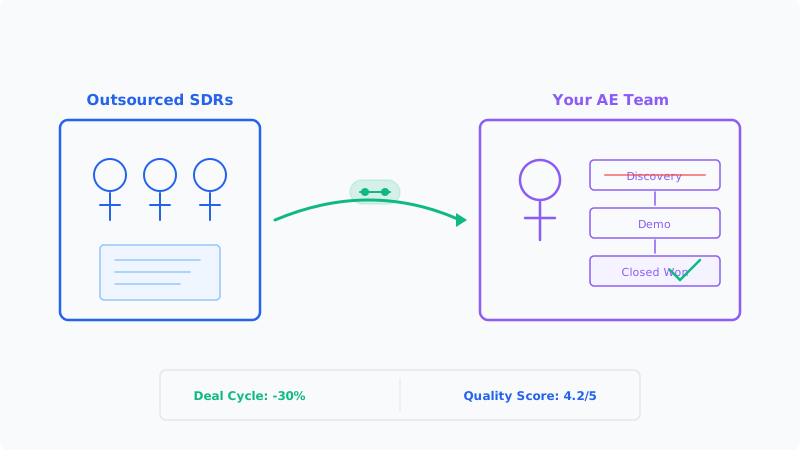
This alone can remove one entire meeting from your deal cycle. Instead of Discovery Call then Demo then Proposal, you collapse into Demo (with context) then Proposal.
Faster Multi-Threading
The SDR’s handoff notes should include any additional stakeholders the prospect mentioned. “My VP will want to see this” or “our IT team evaluates all new vendors” are signals the AE can act on immediately, inviting those stakeholders into the next meeting rather than discovering them three weeks into the deal.
For teams using Kali for calendar-based outreach, the outsourced SDR can even send calendar invites to the additional stakeholders directly, warming them up before the AE reaches out.
Consistent Narrative
When the SDR and AE tell the same story, the prospect trusts the organization. When they tell different stories (different value propositions, different pricing signals, different positioning against competitors), the prospect hesitates.
Alignment on narrative starts with shared battlecards and positioning documents. The outsourced SDR team should use the same competitive messaging framework as your AE team. Review these materials together quarterly, because messaging that worked three months ago may not match current market conditions.
The Alignment Meeting Cadence
Establish a regular cadence between your AE team and the outsourced SDR team:
Weekly (15 minutes): review meeting quality scores, flag any immediate handoff issues, share any new competitive intelligence.
Monthly (30 minutes): review win/loss data, analyze disqualification patterns, update targeting criteria if needed.
Quarterly (60 minutes): refresh the qualified meeting standard, update competitive battlecards, realign on messaging and positioning.
This cadence keeps alignment tight without overwhelming either team with meetings. The weekly check-in catches small problems before they become patterns. The monthly review drives calibration. The quarterly reset ensures the system evolves with your market.
Measuring Alignment Health
Track these metrics to confirm your SDR-AE alignment is working:
Meeting-to-opportunity conversion rate: should be 30 to 50% for well-aligned teams. Below 25% indicates qualification problems. Above 50% suggests the SDR team is being too conservative and leaving bookable meetings on the table.
Average meeting quality score: maintain above 3.5 on your 1-5 scale. Track the trend, not individual data points.
Time from meeting booked to opportunity created: this should decrease as alignment improves. Target under 10 business days for straightforward deals.
AE-initiated disqualification rate: track the percentage of meetings that AEs reject or disqualify. Healthy range is 10 to 20%. Above 30% means the handoff protocol needs work.
Conclusion
Outsourced SDR teams generate meetings. Your AEs turn meetings into revenue. The handoff between them is not a minor operational detail. It is the mechanism that determines whether your outbound investment produces pipeline or frustration.
Build the protocol. Score the meetings. Share the data. Keep the cadence. Alignment is not a one-time setup. It is an ongoing system that requires maintenance, feedback, and regular calibration. The teams that treat it as infrastructure (not an afterthought) close deals faster and waste fewer meetings.