How to Run Account-Based Outbound Without an ABM Platform
The ABM software market wants you to believe that account-based outbound requires a dedicated platform. Vendors pitch intent data overlays, account scoring algorithms, display ad orchestration, and unified dashboards that cost $30,000 to $100,000 per year. For companies running under $5M ARR, or even between $5M and $20M, that spend rarely makes sense. The platform becomes the strategy instead of supporting it, and most teams end up using 15 percent of the features while drowning in configuration overhead.
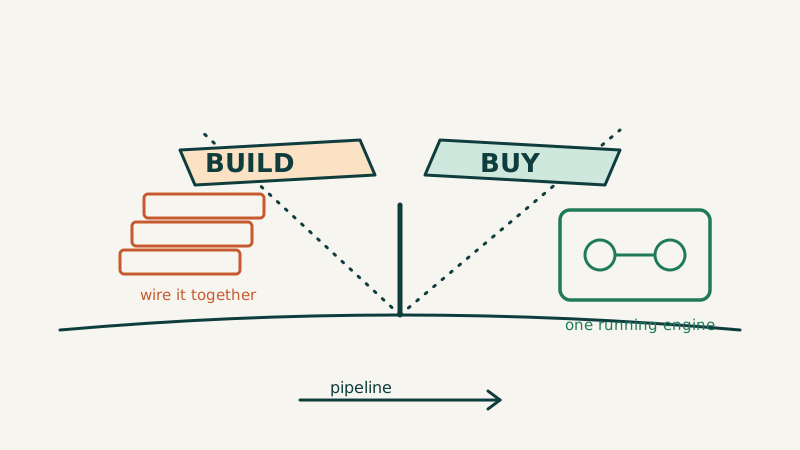
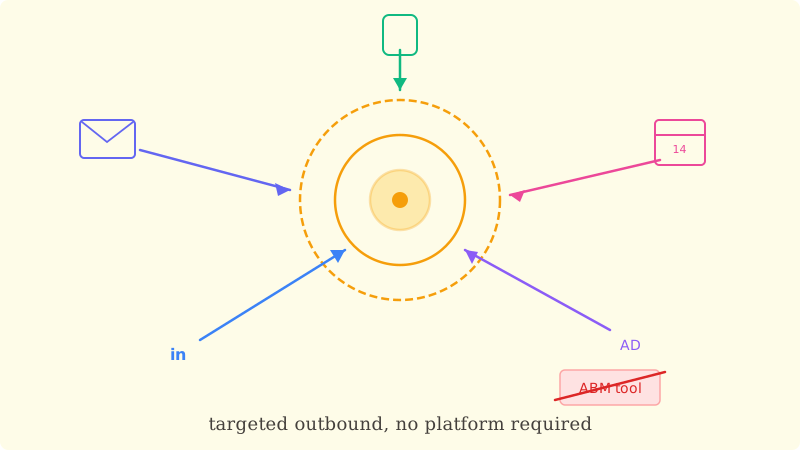
Account-based outbound is a strategy, not a software category. You can execute a focused, multi-channel ABM motion using a CRM, an email sequencer, a LinkedIn account, and some structured thinking. The hard part is the targeting and the messaging, not the tooling.
Start With a List of 50 Accounts, Not 500
The first mistake teams make when trying ABM without a platform is going too broad. ABM platforms encourage scale because their pricing models reward volume. More accounts means more seats, more intent signals to process, more display impressions to serve.
Without a platform, your advantage is focus. Pick 50 target accounts. Not 200, not 100. Fifty.
Build your list by answering three questions:
Which companies match your ideal customer profile exactly? Not loosely, not “they could benefit.” Exactly. Same industry, same company size, same tech stack, same pain point that your product solves today.
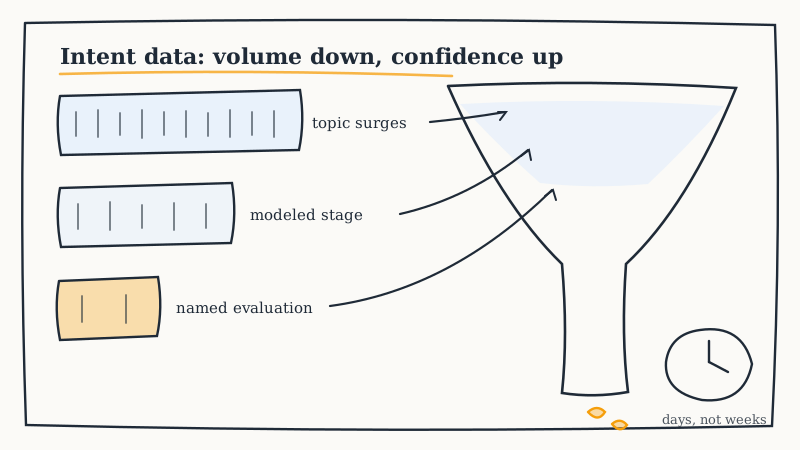
Which accounts have you seen buying signals from in the last 90 days? This does not require intent data software. Check which companies have visited your website (most analytics tools show this at the company level). Look at who has engaged with your LinkedIn content. Review inbound leads that came from companies on your target list but did not convert. Check if any target accounts are hiring for roles that suggest they are building the function your product supports.
Which accounts can you actually reach? If your product requires a VP of Sales to sign off but you have zero connections into a particular company, that account goes to the bottom of the list. Prioritize accounts where you have a realistic path to the decision maker through existing connections, shared networks, or accessible contact information.
Fifty focused accounts with personalized outreach will outperform 500 accounts with templated sequences every time. You can always expand the list later once your process is working.
Map the Buying Committee for Each Account
ABM platforms automate contact discovery across accounts. Without one, you do this manually for your 50 accounts. It takes a few hours, and the quality is typically higher because you are making judgment calls that software cannot.
For each account, identify three to five people:
The decision maker. The person who signs the contract. This is usually a VP or C-level executive in the function your product serves.
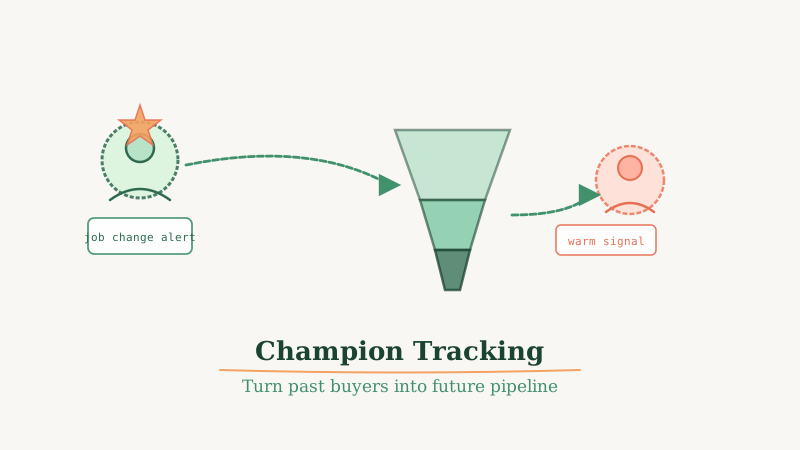
The champion. The person who will use your product daily and advocate internally. This is usually a manager or senior individual contributor.
The influencer. Someone adjacent to the buying decision who can provide context or make introductions. This might be someone in operations, finance, or a cross-functional partner.
Build this map in a spreadsheet or your CRM. For each contact, note their LinkedIn profile, email address, any mutual connections, and any content they have recently published or engaged with. This context powers your personalization later.
For email addresses, validate them before adding to any sequence. Run your contact list through Scrubby to verify deliverability, especially for enterprise domains that use catch-all configurations. Nothing undermines an ABM motion faster than bounced emails to your most important prospects.
Build Multi-Channel Sequences by Hand
ABM platforms coordinate touches across email, display ads, direct mail, and social. You can do this yourself with a simple sequence tracker.
For each account, design a 3 to 4 week sequence that combines multiple channels:
Week 1: Warm the account on LinkedIn. Connect with the champion and influencer. Engage with their posts (comment, not just like). Share relevant content that positions you as knowledgeable about their industry. Do not pitch anything in week 1.
Week 2: Open the email channel. Send a personalized email to the champion referencing something specific about their company, their role, or a challenge you know they face. This is not a template with {company_name} merged in. This is a message that could only have been written for this person. Follow up with a second email 3 days later that adds value (a case study, a relevant framework, a data point) rather than just asking for time.
Week 3: Multi-thread the account. Send a tailored email to the decision maker, referencing the champion by name if you have gotten any engagement. Simultaneously, send a LinkedIn message to the influencer. The goal is to create the impression that your company is relevant across the organization, not just pinging one person. Use Kali to add calendar invite outreach as an additional channel. A well-crafted calendar invite can bypass the inbox entirely and land directly on a prospect’s calendar, which is particularly effective for decision makers who have overflowing email but actively manage their schedule.
Week 4: Direct outreach to the decision maker with a concrete ask. By now, someone at the account has seen your name. Your email to the decision maker should reference the specific business problem, mention any engagement you have gotten from their team, and propose a 20-minute conversation with a clear agenda.
Track all of this in a shared spreadsheet or your CRM with a column per channel and per contact. It is low-tech, and it works.
Use Content as Air Cover
ABM platforms include display ad orchestration that serves banner ads to people at your target accounts. This is the one ABM feature that is genuinely hard to replicate without a platform, and it is also the one with the weakest attribution.
Instead of display ads, use content as your air cover:
Publish LinkedIn posts that address the specific problems your target accounts face. If you are targeting fintech companies struggling with compliance, publish a post about compliance infrastructure challenges. Your target contacts will see it in their feed, especially if you have already connected with them.
Share targeted content in industry communities. Find the Slack groups, Discord servers, Reddit communities, or forums where your target buyers participate. Share genuinely useful content (not product pitches) that positions your company as an authority.
Create account-specific content when warranted. For your top 10 accounts, consider creating a short analysis or benchmark that is directly relevant to their business. “We analyzed the public data on [Company]‘s GTM approach and noticed X” is a powerful outreach hook when backed by real research. This is where a unified GTM infrastructure from Vendisys can help coordinate content creation, outreach, and pipeline tracking without the complexity of a dedicated ABM platform.
Measure What Matters: Meetings, Not Impressions
ABM platforms generate impressive dashboards showing account engagement scores, web visit trends, and intent signal heat maps. Most of these metrics are vanity metrics that make you feel productive without indicating whether pipeline is actually being created.
Without a platform, your metrics are simpler and more honest:
Meetings booked per account. How many of your 50 target accounts have you gotten a meeting with? This is the only metric that matters in the first 30 days.
Multi-thread depth. How many contacts per account have you engaged? An account where you have talked to the champion and the decision maker is further along than one where you emailed one person three times.
Channel response rates. Which channel is generating replies? Email, LinkedIn, calendar invites, phone? Track this per account and per persona so you can double down on what works.
Pipeline created from target accounts. At the end of 60 days, how much pipeline exists from your 50 target accounts? Compare this to your cost (your time, any tools, any outsourced help) and you have a real ROI number.
These metrics are trackable in any CRM or even a well-structured spreadsheet. You do not need a platform to know whether your ABM motion is working.
When to Consider a Platform (and When to Keep Going Without One)
There is a point where an ABM platform becomes worth the investment. That point is not when you start doing ABM. It is when you have proven that your manual ABM process works and you need to scale it.
Keep going without a platform if: You are targeting fewer than 200 accounts, your team is fewer than 5 people working outbound, and your manual process is generating meetings at an acceptable cost per meeting.
Consider a platform if: You need to coordinate ABM across 500 or more accounts, you have a dedicated marketing team that can manage the platform, and your manual process has proven the unit economics work but you cannot scale the execution with people alone.
The danger is buying the platform before you have proven the motion. If your targeting is wrong, your messaging is off, or your product is not ready for the segment you are pursuing, an ABM platform will not fix any of that. It will just make the failure more expensive and harder to diagnose.
Start manual. Prove the motion. Scale the tooling only when the bottleneck is execution capacity, not strategy or product-market fit. And when you are ready to scale, solutions like Vendisys can provide the outsourced GTM infrastructure to expand your outbound without the overhead of a full ABM platform or a large in-house team.